
President Bush this week signed into law a bill that seeks to bolster mathematics and science education through improved teacher recruitment and training and the promotion of successful classroom practices through federal grants for schools.
The bipartisan legislation, which the House approved by a 367-57 vote and the Senate passed unanimously, had the backing of numerous business and education organizations.
Members of Congress have dubbed the bill the America COMPETES Act, a reference to what they believe is the proposal’s potential to strengthen the quality of the U.S. workforce and gird the economy against foreign competition.
“In my mind, there will be no more important legislation that passes the Congress this year,” Sen. Lamar Alexander, R-Tenn., one of its sponsors, told reporters on Aug. 1. “This is the prime model of bipartisan cooperation.”
The law will establish several new federal math and science programs and expand existing ones. If Congress appropriates money for all the programs, it will cost $43.3 billion over three years, though much of that spending would be devoted to research programs in technology, energy, and other areas.
The measure will broaden the Robert Noyce Scholarship Program, which provides grants of $10,000 a year to college majors in math- and science-related subjects who agree to teach in highneed schools, by expanding recipients’ years of eligibility for aid and giving them more time to finish teacher training.
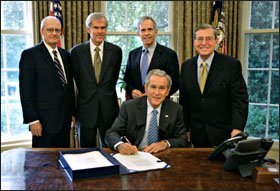
The bill, signed by Mr. Bush on Aug. 9, also addresses some of the president’s priorities for math and science education. It will create “Math Now,” a program in which the Department of Education will award grant money to implement proven strategies in that subject.
Bush administration officials have likened Math Now to the federal Reading First program, a $1 billion-a-year effort that seeks to improve instruction through the promotion of research-based practices in reading. The math program seeks to help students reach grade level in that subject and prepare them for algebra, which most students take in 8th or 9th grade, through federal grants that will flow to the states and then to local schools to improve K-9 instruction.
The law also authorizes more grant money for the expansion of Advanced Placement and International Baccalaureate classes in schools nationwide—programs the administration has supported.
In addition, it calls for the secretary of education to contract with the National Academy of Sciences to convene a national panel to “identify promising practices” in school science, technology, engineering, and mathematics studies—the so-called STEM subjects.
Dollars Not Guaranteed
Last year, the White House set up the National Mathematics Advisory Panel, a 17-member group charged with studying effective classroom strategies in math and presenting recommendations to the president. Lee Pitts, a spokesman for Sen. Alexander, said the new panel would “extend the work of the math panel into science, technology, and engineering,” not duplicate the work of the math advisers.
While the America COMPETES Act—which stands for America Creating Opportunities to Meaningfully Promote Excellence in Technology, Education, and Science— authorizes new spending on math and science programs, it does not guarantee they will get that money. Appropriations for those programs are included in three separate spending bills under consideration by Congress, Mr. Pitts said.
At a press conference the day he signed the bill, President Bush voiced support for the overall bill while also complaining that it did not include several of his suggestions for improving math and science. He also lamented its pricetag, and said he would ask Congress to limit spending on the new programs.
“These are important steps forward,” Mr. Bush said. “Yet the bill Congress sent to my desk leaves some of the key priorities unfulfilled, and authorizes unnecessary and duplicative programs.”
Francis M. “Skip” Fennell, the president of the 100,000-member National Council of Teachers of Mathematics, in Reston, Va., commended provisions in the legislation that create support for inexperienced and struggling educators.
“[L]ack of proper mentoring and support for teachers is one reason so many leave the profession in the first years of teaching,” Mr. Fennell said in a statement.
Improving math and science education has been a constant theme among lawmakers and business leaders in recent years. While acknowledging the value of a strong math and science education, two former high-ranking Education Department officials, Chester E. Finn Jr. and Diane Ravitch, cautioned in an essay this week in The Wall Street Journal that policymakers who backed the America COMPETES Act need to recognize that U.S. economic strength and innovation also spring from students receiving a rich education in other subjects, too, such as literature, history, music, and geography.
U.S. leaders “reason that India and China will eat America’s lunch unless we boost our young people’s prowess in STEM fields,” Mr. Finn and Ms. Ravitch, who served as assistant secretaries of education in, respectively, Ronald Reagan’s and George H.W. Bush’s administrations, wrote on Aug. 8.
“The liberal arts,” they added, “make us ‘competitive’ in ways that matter most.”


