Includes updates and/or revisions.
The White House and federal education officials scrambled Thursday to reassure school leaders that President Barack Obama’s national speech to schoolchildren next week will touch on important educational goals, despite criticism from some conservatives that the president is planning to use the speech to “indoctrinate” children with his political views.
“The president will challenge students to work hard, set educational goals, and take responsibility for their learning,” the U.S. Department of Education said in an e-mail urging schools to participate in what it called a “historic moment,” to be broadcast live Sept. 8 on C-SPAN and the White House’s Web site.
But the planned 15- to 20-minute noontime speech—and, especially, a menu of classroom activities (for younger and older students) suggested by the White House in connection with it—continued to draw denunciations, leading some school officials to say they would let parents opt out of having their children watch.
Some districts in Illinois, Minnesota, Missouri, Texas, Virginia, and Wisconsin have decided not to show the speech to students, citing the controversy and the already-packed schedule of what will be the first day of school for many.
So intense was the criticism that the White House Wednesday modified at least one recommended classroom activity, which had originally suggested that elementary-age students “write letters to themselves about what they can do to help the president.”
Among other suggested activities are having younger children create posters of students’ goals and having older students write about people who exhibit personal responsibility, which will be a theme of Mr. Obama’s speech. The full text of the speech will be posted online Monday at whitehouse.gov.
Arizona Superintendent of Public Instruction Tom Horne minced no words in his criticism of the suggested curriculum.
“An important part of educating students is to teach them to read and listen critically. The White House materials call for a worshipful, rather than critical approach to this speech,” Mr. Horne, a Republican said in a written statement.
“There is nothing in these White House materials about approaching the speech critically, or engaging in any critical thinking whatsoever, but only adopting a reverent approach to everything they are being told.”
But Timothy Mitchell, the superintendent of the Chamberlain School District 7-1 in Chamberlain, S.D., said some teachers in his 950-student district were considering showing Mr. Obama’s speech in the classroom—and that’s fine with him.
“I think you have seen a lot of modern-day presidents during the first days of school going to address students,” he said. “[Mr. Obama’s] using technology to get a wider audience as leader of the free world to tell kids education is important. I think it is great coming from a leader telling that to kids.”
Some parents, urged on by conservative bloggers, have said they will keep their children home from school on Tuesday.
But Texas Gov. Rick Perry, a Republican, said he’s “certainly not going to advise anybody not to send their kids to school that day.”
“Hearing the president speak is always a memorable moment,” he said.
Mr. Perry, however, also said he understood where the criticism was coming from.
“Nobody seems to know what he’s going to be talking about,” he said. “Why didn’t he spend more time talking to the local districts and superintendents, at least give them a heads-up about it?”
Presidential Precedent
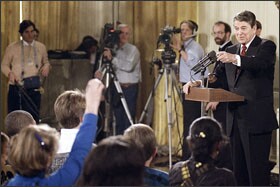
Mr. Obama is not the first president to address schoolchildren directly—Ronald Reagan and George H.W. Bush made such speeches during their terms in office—nor is he the first to draw controversy.
The elder President Bush’s 1991 speech set off a similar partisan war, with Democrats accusing the Republican of using children as political pawns and demanding that then-Secretary of Education Lamar Alexander—a Republican who is now a U.S. senator from Tennessee—explain why the Education Department spent more than $20,000 on the event. (“Democrats Question Use of E.D. Funds for Bush Address,” October 9, 1991.)
The current controversy began online Tuesday afternoon after Florida GOP Chairman Jim Greer issued a press release headlined “Greer Condemns Obama’s Attempt to Indoctrinate Students.”
Mr. Greer said in the release: “As the father of four children, I am absolutely appalled that taxpayer dollars are being used to spread President Obama’s socialist ideology,” and “I do not support using our children as tools to spread liberal propaganda.”
By Wednesday afternoon, many bloggers were criticizing both the president’s planned speech and the suggested classroom activities. Many local administrators were grappling with whether to show the speech, take part in the classroom activities, and cope with parental calls that children be allowed to opt out.
“I think it’s really unfortunate that politics has been brought into this,” White House Deputy Policy Director Heather Higginbottom said. “It’s simply a plea to students to really take their learning seriously. Find out what they’re good at. Set goals. And take the school year seriously.”
The American Association of School Administrators has not issued formal guidance to its members on Mr. Obama’s speech, but did communicate with all of its state-level directors to make sure they were aware of it, said spokeswoman Amy Vogt.
“The decision to air the president’s speech will be a local decision, depending on individual schools’ instructional demands/schedules, and our members are addressing this at the local level,” she said in an e-mail Wednesday.
School leaders’ responses vary.
Virginia and South Carolina, for example, have encouraged local school districts to make their own decisions on whether to let teachers show the speech.
In the 200,000-student Houston Independent School District, individual classroom teachers will decide whether to build a lesson around President Obama’s speech. Teachers who do so will send home letters to parents saying students have the option to forgo the lesson and be given alternative work, said district spokesman Norm Uhl.
Such opting-out isn’t unprecedented, he said, and he noted that the district has gotten calls from parents who are both supportive and not supportive of the choice.
“We had parents calling with concerns, and when parents are concerned about curriculum, just like with sex education, we like to give them a choice,” Mr. Uhl said.
The 49,000-student Atlanta public school system has encouraged its teachers to show the president’s address in their classes and incorporate it into social studies lessons.
Students and parents who have concerns will be free to opt out, just as students can opt out of saying the Pledge of Allegiance, said schools spokesman Keith Bromery.
“We routinely do not allow politicians during election times to come in the schools to promote themselves,” he said. But Mr. Bromery also said: “This is not a campaign. This is the president addressing a segment of his population, pretty much like he does when he goes on television at 9 p.m. We don’t see this in any way as being partisan or being part of the campaign.”
Such an outbreak of anger about the president’s speech is not surprising in the current polarized political climate, said Jeffrey Henig, a professor of political science and education at Teachers College, Columbia University.
“Most Americans, even most Republican Americans, would never have thought it was a concern for the president to talk directly to students,” he said. “And they wouldn’t have thought it was a concern to raise notions of civic concern and of community responsibility.”