
Law & Courts

Guidance Offered on Guarding Student Privacy in School Data

By Sarah D. Sparks — November 05, 2010 3 min read
  • Save to favorites
  • Print

The U.S. Department of Education has launched a campaign to help school officials channel the flood of student data generated in federal accountability reporting and state longitudinal databases without leaking students’ or teachers’ private information.

“With the emphasis on [the No Child Left Behind Act], we’ve seen a real expansion of the information on students that’s being released to the public,” said Marilyn M. Seastrom, the chief statistician and director of the statistical-standards program at the department’s National Center for Education Statistics. Both NCLB and the more recent fiscal-stimulus law required states to collect steadily more student data to monitor schools’ progress.

“At the same time,” Ms. Seastrom said, “we have laws at the federal level, individual states have their own laws, and we have just good data ethics on protecting the privacy of these children.”

She said the department plans this winter to propose amendments to update the Family Educational Rights and Privacy Act, or FERPA, to address new longitudinal databases and interagency data sharing, among other things. In the meantime, the department has formed a new privacy-technical-assistance center, housed at the NCES, to help district and state officials plan to use and share their longitudinal student data safely.“As a practitioner, I think this is going to be really helpful because we grapple with a lot of FERPA questions every day that we don’t have answers to,” said Margaret R. McLeod, the executive director of student services for Alexandria, Va., city schools and a member of the advisory board for the Education Department’s research arm, the Institute of Education Sciences, which includes the NCES.

Nearly every state has built or is building a longitudinal database capable of tracking individual students’ academic achievement from year to year, in some cases from preschool through college and into the workforce. Yet if the troves of new data—and the technology available for linking all the information—create a huge opportunity for researchers and educators to track student progress, they also create problems for administrators trying to shoehorn their use into federal and state privacy laws enacted before personal computers.

In a 2009 study, Joel R. Reidenberg, a law professor and the founding academic director of the Center on Information Law and Policy at Fordham University’s law school, in New York City, found no state had absolutely secure student data, and many collected more information and held it longer than needed for research purposes. (“Report Finds States on Course to Build Pupil-Data Systems,” Dec. 2, 2009.)

“There certainly are important policy reasons that people may need to use these data, particularly in things like education, to make critical policy decisions,” Mr. Reidenberg said, “but there are also policy reasons we may say, even though it may be interesting and useful, we’re not going to do it.”

Sheara Krvaric, a lawyer with the Washington-based Federal Education Group, a law firm specializing in education, said, in spite of new regulations released in the past year designed to clarify FERPA requirements, many school officials remain inclined to hold back data they collect because of privacy concerns. Ms. Krvaric said nearly every state and district she has worked with has voiced concerns about running afoul of federal data-privacy law when using or sharing student data.

Guidance Coming

“Some of the fears of these districts are well placed,” she said, “because there are all these logistical hurdles.”

Researchers voice frustration with school officials’ hesitancy. At the National Board for Education Sciences meeting last week, board member Adam Gamoran, the director of the Wisconsin Center for Education Research, at the University of Wisconsin-Madison, argued that states should be required to share student data with researchers as a condition of receiving federal grants to build databases.

That’s what the new Privacy Technical Assistance Center, started two weeks ago, is designed to correct, said Emily Anthony, an NCES research scientist and the center’s program officer. It is developing training materials for educators and researchers using student data and for information officers setting up the databases. It will conduct four site visits a year to states, districts, and outside research partners and set up a database to track the most common privacy questions.

It also plans to release six guidance briefs—three next month and three in the spring—on basic questions about privacy, ways to manage electronic student records, and a profile of privacy protections in all 50 states.
A version of this article appeared in the November 10, 2010 edition of Education Week as Help Offered on Guarding Student Privacy in School Data

Events

This content is provided by our sponsor. It is not written by and does not necessarily reflect the views of Education Week's editorial staff.
Sponsor
Special Education Webinar
Bridging the Math Gap: What’s New in Dyscalculia Identification, Instruction & State Action
Discover the latest dyscalculia research insights, state-level policy trends, and classroom strategies to make math more accessible for all.
Content provided by TouchMath
This content is provided by our sponsor. It is not written by and does not necessarily reflect the views of Education Week's editorial staff.
Sponsor
School Climate & Safety Webinar
Belonging as a Leadership Strategy for Today’s Schools
Belonging isn’t a slogan—it’s a leadership strategy. Learn what research shows actually works to improve attendance, culture, and learning.
Content provided by Harmony Academy
This content is provided by our sponsor. It is not written by and does not necessarily reflect the views of Education Week's editorial staff.
Sponsor
School & District Management Webinar
Too Many Initiatives, Not Enough Alignment: A Change Management Playbook for Leaders
Learn how leadership teams can increase alignment and evaluate every program, practice, and purchase against a clear strategic plan.
Content provided by Otus

EdWeek Top School Jobs

Teacher Jobs
Search over ten thousand teaching jobs nationwide — elementary, middle, high school and more.
View Jobs
Principal Jobs
Find hundreds of jobs for principals, assistant principals, and other school leadership roles.
View Jobs
Administrator Jobs
Over a thousand district-level jobs: superintendents, directors, more.
View Jobs
Support Staff Jobs
Search thousands of jobs, from paraprofessionals to counselors and more.
View Jobs

Read Next

Law & Courts Supreme Court Backs Parents in School Gender Disclosure Fight
The Supreme Court restored an injunction blocking California policies on student gender transitions
8 min read
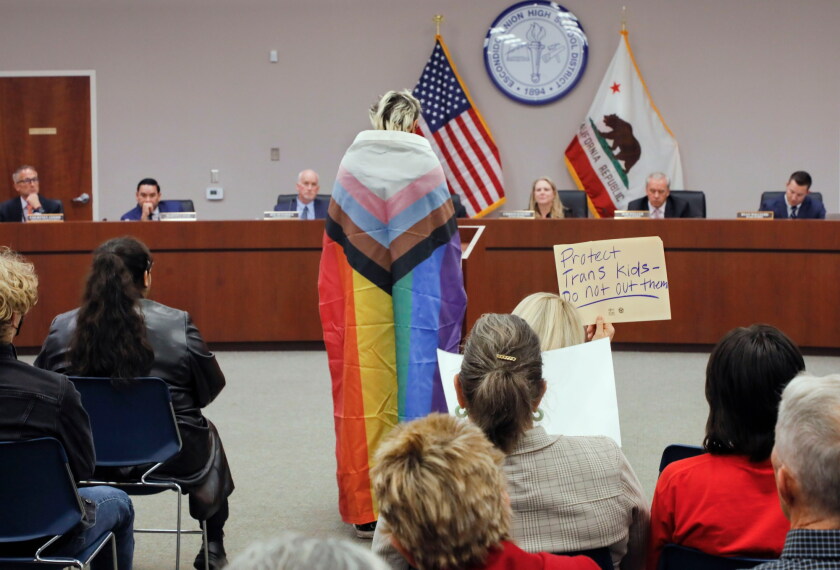
Teacher’s aide Amelia Mester, wrapped in a Pride flag, urges Escondido Union High School District not to have employees notify parents if they believe a student may be transgender in November 2025. A policy on the issue in the city’s elementary school district is the subject of a federal class-action lawsuit in which a judge just sided against the district.
Teacher’s aide Amelia Mester, wrapped in a Pride flag, urges Escondido Union High School District not to have employees notify parents if they believe a student may be transgender at a meeting in November 2025. Two parents and two teachers from the district sued in 2023, challenging California state guidance concerning student gender transitions and parental notification. The U.S. Supreme Court has now reinstated a lower-court decision overturning those state policies.
Charlie Neuman for The San Diego Union-Tribune/TNS
Law & Courts Appeals Court Allows Louisiana Ten Commandments Displays to Proceed
The court said it was premature to rule on the constitutionality of La. Ten Commandments displays.
3 min read
Students work under Ten Commandments and Bill of Rights posters on display in a classroom at Lehman High School in Kyle, Texas, Thursday, Oct. 16, 2025.
Students work under Ten Commandments and Bill of Rights posters on display in a classroom at Lehman High School in Kyle, Texas, Oct. 16, 2025. A federal appeals court has lifted a lower-court injunction blocking a Louisiana law that requires Ten Commandments displays, clearing the way for the law to take effect.
Eric Gay/AP
Law & Courts Social Media Companies Face Legal Reckoning Over Mental Health Harms to Children
Some of the biggest players from Meta to TikTok are getting a chance to make their case in courtrooms around the country.
6 min read
Social Media Kids Trial 26050035983057
Meta CEO Mark Zuckerberg leaves court after testifying in a landmark trial over whether social media platforms deliberately addict and harm children, on Feb. 18, 2026, in Los Angeles.
AP Photo/Damian Dovarganes
Law & Courts Supreme Court Strikes Trump Tariffs in Case Brought by Educational Toy Companies
Two educational toy companies were among the leading challengers to the president's tariff policies
3 min read
Members of the Supreme Court sit for a new group portrait following the addition of Associate Justice Ketanji Brown Jackson, at the Supreme Court building in Washington, Oct. 7, 2022. Bottom row, from left, Associate Justice Sonia Sotomayor, Associate Justice Clarence Thomas, Chief Justice of the United States John Roberts, Associate Justice Samuel Alito, and Associate Justice Elena Kagan. Top row, from left, Associate Justice Amy Coney Barrett, Associate Justice Neil Gorsuch, Associate Justice Brett Kavanaugh, and Associate Justice Ketanji Brown Jackson.
Members of the U.S. Supreme Court sit for a new group portrait following the addition of Justice Ketanji Brown Jackson, at the court building in Washington, Oct. 7, 2022. On Feb. 20, 2026, the court ruled 6-3 to strike down President Donald Trump's broad tariff policies, ruling that they were not authorized by the federal statute that he cited for them.
J. Scott Applewhite/AP
