Opinion
School & District Management Opinion

An Apology to Secretary Duncan

By Jennifer L. Jennings — May 06, 2013 1 min read
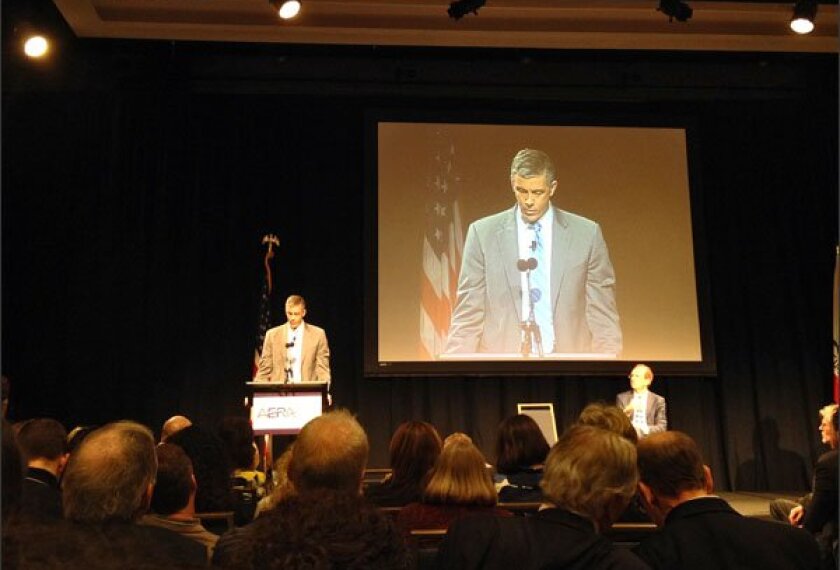
U.S. Secretary of Education Arne Duncan addresses the AERA's annual meeting on April 30.
  • Save to favorites
  • Print

Includes updates and/or revisions.

I agree with U.S. Secretary of Education Arne Duncan on just about nothing. I think Race to the Top is an evidence-free mess. I think the idea of a test worth teaching to is a willful misunderstanding of the science of testing. And I can’t agree with Duncan’s insistence that the cheating scandals that have garnered widespread attention in recent months are a parable about “rotten” school cultures and not a reflection on the incentives that we’ve forced upon teachers.

But as I sat on the floor of a packed ballroom in San Francisco at the annual meeting of the American Educational Research Association last month, I was embarrassed—no, humiliated—when some of my colleagues booed the secretary of education as he approached the microphone for his keynote speech. It is one thing to disagree with some of the Obama administration’s policies, to bring countervailing data to the table, and to engage in reasoned—and, one would hope, enlightened—conversation. It is another thing entirely to abdicate our most sacred responsibility as researchers—a commitment to ideas, to data, to truth, to real debate—at the altar of one-upmanship.

I was embarrassed—no, humiliated—when some of my colleagues booed the secretary of education when he approached the microphone for his keynote speech.”

What saddens me is that the educational policy debate has become an overwhelming chorus of boos, of shout-downs, and of bitter personal insults, rather than a real debate about ideas and data and first principles. Unfortunately, this mirrors the direction that most American political debates have leaned in recent years. It is toxic. It is unnecessary. And it is not befitting of a community of researchers who stand in front of students on most days of the week and call ourselves educators.

I have no senior standing, official office, or public mandate with which to offer this apology, but nonetheless: I’m sorry. I’m sorry that a faceless minority of the educational research community lacked the courage to meet you with ideas rather than with the heckling that is so easy to deploy when you are sitting among hundreds of others, none of whom will ever be called personally to account for their actions.

You had the grace, the guts, and the patience not to reciprocate.

If there is one lesson from this conference, Secretary Duncan, you showed America’s educational researchers that we can have a different debate—one in which we rely on ideas and open disagreement and reason, and not on schoolyard bravado.

A version of this article appeared in the May 15, 2013 edition of Education Week as An Apology to Secretary Duncan

Events

College & Workforce Readiness Webinar Data-Driven and District-Ready: What EdWeek Research Tells Us About the CTE Market
Discover how to sharpen your positioning in a fast-moving market of CTE with actionable strategies grounded in EdWeek Research Center data.
Classroom Technology Live Online Discussion A Seat at the Table: The Rewiring of Childhood With Jonathan Haidt
Jonathan Haidt, Catherine Price, and Adam Swinyard join Peter DeWitt on how to get students off devices and back to the basics of childhood.
Professional Development K-12 Essentials Forum Getting Professional Development to Stick
Join this free virtual event to explore best practices, funding, format, and timing for teacher and principal PD.

EdWeek Top School Jobs

Teacher Jobs
Search over ten thousand teaching jobs nationwide — elementary, middle, high school and more.
View Jobs
Principal Jobs
Find hundreds of jobs for principals, assistant principals, and other school leadership roles.
View Jobs
Administrator Jobs
Over a thousand district-level jobs: superintendents, directors, more.
View Jobs
Support Staff Jobs
Search thousands of jobs, from paraprofessionals to counselors and more.
View Jobs

Read Next

School & District Management Closing a School? Don't Expect to Save Money, a New Study Warns
The hope is that closing schools can reduce fixed costs. A new study looks into whether that happens.
5 min read
This is an aerial shot of a large public high school complex shot on a Sunday with nobody around. This image features multiple buildings, a running track, football fields, baseball diamonds, tennis courts parking lots and a residential neighborhood surrounding the image. Shot from the open window of a small plane.
Illustration by Education Week + Getty
School & District Management Quiz Quiz Yourself: How Much Do You Know About Events and PD for K-12 Educators?
From peer-led sessions to AI training, see how well you understand today’s K-12 professional development priorities.
School & District Management School Board Conflict Surged During the Pandemic. Has It Gone Away?
New research reveals how school boards navigated heightened levels of conflict in recent years.
5 min read
Seminole County, Fla., deputies remove parent Chris Mink of Apopka from an emergency meeting of the Seminole County School Board in Sanford, Fla., Thursday, Sept. 2, 2021. Mink, the parent of a Bear Lake Elementary School student, opposes a call for mask mandates for Seminole schools and was escorted out for shouting during the standing-room only meeting.
Seminole County, Fla., deputies remove parent Chris Mink of Apopka from an emergency meeting of the county school board in Sanford, Fla., Sept. 2, 2021, after he opposed a call for mask mandates and shouted. A new report gives a national picture of how school board conflict, including between boards and their communities, rose during the pandemic.
Joe Burbank/Orlando Sentinel via AP
School & District Management Opinion The 3 Predicable Struggles That Thwart Education Leadership Teams
Even highly capable leadership teams can struggle to translate their strengths into school impact.
4 min read
Screenshot 2026 06 08 at 7.13.09 AM
Canva
