Education

Achievement Gap between Disabled and Nondisabled Students

By Holly Kosiewicz — December 24, 2008 1 min read
  • Save to favorites
  • Print

Since the passage of the No Child Left Behind Act in 2002, researchers, policy makers, and educators have devoted increased attention to academic achievement of students with disabilities. While various studies have shown that students with different learning disabilities have benefitted academically from curricula and teaching methods tailored to meet their needs, most research finds significant achievement gaps between disabled and nondisabled students.

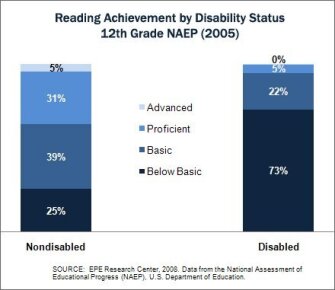
A recent study by the EPE Research Center, Special Education in America, used the National Assessment of Educational Progress (NAEP) to compare the reading performance of 12th graders with and without disabilities. While five percent of disabled students scored at or above proficiency, 36 percent of nondisabled students attained the same measure of achievement, a gap of 31 percentage points. The majority of disabled students (73 percent) tested below the basic level on NAEP. Other research examined in the center’s report, however, finds that the levels of academic proficiency vary greatly within the special education population. Notably, a student’s particular disability diagnosis (e.g., hearing impairment versus mental retardation) consistently emerges as strong predictor of achievement.

For more state-by-state data on special education and other topics, search the EPE Research Center’s Education Counts database.
BRIC ARCHIVE

Events

This content is provided by our sponsor. It is not written by and does not necessarily reflect the views of Education Week's editorial staff.
Sponsor
College & Workforce Readiness Webinar
Smarter Tools, Stronger Outcomes: Empowering CTE Educators With Future-Ready Solutions
Open doors to meaningful, hands-on careers with research-backed insights, ideas, and examples of successful CTE programs.
Content provided by Pearson
Reading & Literacy Webinar Supporting Older Struggling Readers: Tips From Research and Practice
Reading problems are widespread among adolescent learners. Find out how to help students with gaps in foundational reading skills.
This content is provided by our sponsor. It is not written by and does not necessarily reflect the views of Education Week's editorial staff.
Sponsor
Reading & Literacy Webinar
Improve Reading Comprehension: Three Tools for Working Memory Challenges
Discover three working memory workarounds to help your students improve reading comprehension and empower them on their reading journey.
Content provided by Solution Tree

EdWeek Top School Jobs

Teacher Jobs
Search over ten thousand teaching jobs nationwide — elementary, middle, high school and more.
View Jobs
Principal Jobs
Find hundreds of jobs for principals, assistant principals, and other school leadership roles.
View Jobs
Administrator Jobs
Over a thousand district-level jobs: superintendents, directors, more.
View Jobs
Support Staff Jobs
Search thousands of jobs, from paraprofessionals to counselors and more.
View Jobs

Read Next

Education Opinion The Opinions EdWeek Readers Care About: The Year’s 10 Most-Read
The opinion content readers visited most in 2025.
2 min read
Collage of the illustrations form the top 4 most read opinion essays of 2025.
Education Week + Getty Images
Education Quiz Did You Follow This Week’s Education News? Take This Quiz
Test your knowledge on the latest news and trends in education.
1 min read
Education Quiz How Did the SNAP Lapse Affect Schools? Take This Weekly Quiz
Test your knowledge on the latest news and trends in education.
1 min read
Education Quiz New Data on School Cellphone Bans: How Much Do You Know?
Test your knowledge on the latest news and trends in education.
1 min read
