Education

Increasing Equality with Wealth Neutral School Financing

By Erin M. Pollard — August 13, 2008 1 min read
  • Save to favorites
  • Print

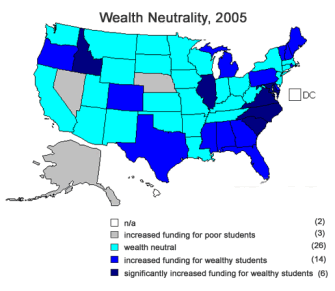
The majority of local school funding is determined by property taxes; thus, school districts in wealthier areas are traditionally able to raise more funds than schools in poorer areas. Because some scholars and policy makers believe that the amount of money spent per student is tied to academic achievement, many states have made efforts to make their school funding wealth neutral. They increase the amount of state aid to students in poorer districts to meet the same level of funding as wealthy districts are able to provide locally. The EPE Research Center calculated wealth neutrality in Quality Counts 2008, an index based on the correlation between units of wealth and total spending per student, finding that 26 states in 2005 were reasonably wealth neutral. This means that in half the states approximately the same amount of money was spent on students in poorer districts as students in wealthier districts. Three states funded poorer districts considerably more than wealthy districts and 20 states did not have school districts that were wealth neutral. Hawaii and the District of Columbia are single school district jurisdictions, so it was not possible to calculate the index.

For more information on wealth neutrality and other state-by-state data, search EPE’s Education Counts database.

SOURCE: EPE Research Center, 2008.
BRIC ARCHIVE

Events

This content is provided by our sponsor. It is not written by and does not necessarily reflect the views of Education Week's editorial staff.
Sponsor
College & Workforce Readiness Webinar
Smarter Tools, Stronger Outcomes: Empowering CTE Educators With Future-Ready Solutions
Open doors to meaningful, hands-on careers with research-backed insights, ideas, and examples of successful CTE programs.
Content provided by Pearson
This content is provided by our sponsor. It is not written by and does not necessarily reflect the views of Education Week's editorial staff.
Sponsor
Reading & Literacy Webinar
Improve Reading Comprehension: Three Tools for Working Memory Challenges
Discover three working memory workarounds to help your students improve reading comprehension and empower them on their reading journey.
Content provided by Solution Tree
Recruitment & Retention Webinar EdRecruiter 2026 Survey Results: How School Districts are Finding and Keeping Talent
Discover the latest K-12 hiring trends from EdWeek’s nationwide survey of job seekers and district HR professionals.

EdWeek Top School Jobs

Teacher Jobs
Search over ten thousand teaching jobs nationwide — elementary, middle, high school and more.
View Jobs
Principal Jobs
Find hundreds of jobs for principals, assistant principals, and other school leadership roles.
View Jobs
Administrator Jobs
Over a thousand district-level jobs: superintendents, directors, more.
View Jobs
Support Staff Jobs
Search thousands of jobs, from paraprofessionals to counselors and more.
View Jobs

Read Next

Education Opinion The Opinions EdWeek Readers Care About: The Year’s 10 Most-Read
The opinion content readers visited most in 2025.
2 min read
Collage of the illustrations form the top 4 most read opinion essays of 2025.
Education Week + Getty Images
Education Quiz Did You Follow This Week’s Education News? Take This Quiz
Test your knowledge on the latest news and trends in education.
1 min read
Education Quiz How Did the SNAP Lapse Affect Schools? Take This Weekly Quiz
Test your knowledge on the latest news and trends in education.
1 min read
Education Quiz New Data on School Cellphone Bans: How Much Do You Know?
Test your knowledge on the latest news and trends in education.
1 min read
