
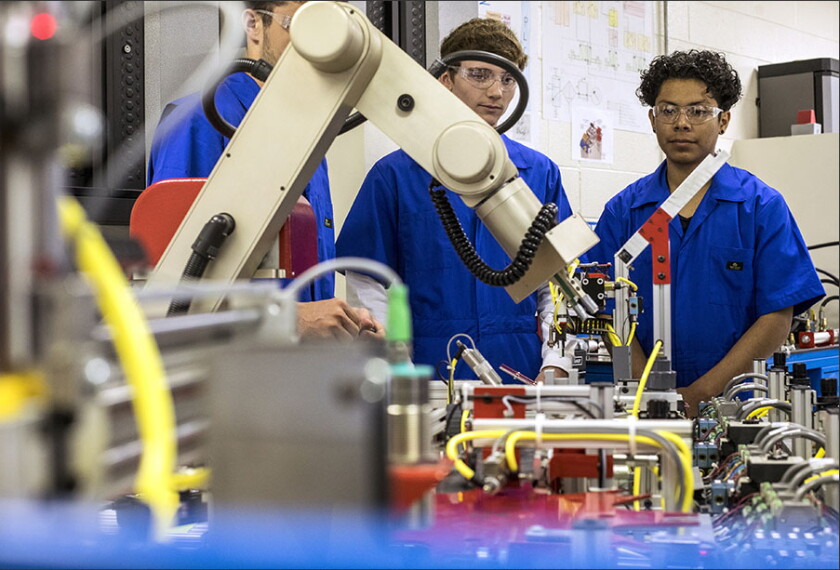
Career and technical education has risen on the educational radar in the past decade, transforming itself from a college alternative into a new kind of college pathway.
What is the definition of career and technical education?
Career and technical education–commonly known as career-tech ed or CTE–describes classes that are designed to prepare students for work.
How is career and technical education different from vocational education?
In some ways, it’s not that different. In many high schools, you can still find the same voc-ed classes that existed half a century ago. They prepare students for jobs that don’t typically require college degrees, such as child care, welding, cosmetology, or plumbing.
But in important ways, CTE is very different than your grandfather’s voc ed. Many programs now focus on areas typically associated with associate or bachelor’s degrees, such as engineering or business. Because career-tech-ed classes of all kinds are increasingly seen as roads to additional study after high school, they are meant to be more academically rigorous than those of a previous generation.
How many students are really opting for career technical education programs?
A lot. About 8.3 million high school students—nearly half the U.S. high school population—were enrolled in one or more CTE courses in 2016-17, according to the most recent data collected for the just-reauthorized Carl D. Perkins Career and Technical Education Act, the main federal law that provides funding for CTE programs. That’s up from 7.6 million in 2007-08.
Nearly half of the students in CTE classes are CTE “concentrators,” which typically means that they take two or more related courses in a particular career area.
Isn’t career-tech ed mostly for boys? What about girls?
Actually, that’s an outdated notion. Nearly half of the students enrolled in high school CTE courses are female. Gender-based patterns by subject matter persist, however. Girls far outnumber boys in health sciences and human services, and boys dominate in areas like information technology, manufacturing, and architecture.
What about minority and low-income students?
In the past, voc ed was often a dumping ground for students who weren’t perceived as “college material,” which often meant low-income students and students of color. Adults in schools “tracked” students into two groups: college-bound and non-college-bound. They funneled the second group into voc-ed-classes that too often led to low-paying, dead-end jobs.
Career-tech-ed has gotten much better, but its students are still disproportionately from low-income households and racial minority groups. In 2014-15, 54 percent were from economically disadvantaged families. Fifty-two percent were white, 24 percent were Hispanic, 16 percent were African-American, and only 4 percent were Asian.
Why is CTE becoming more focused on postsecondary degrees? I thought the whole point of CTE was to let students choose to skip college and go right to work.
Two big forces were central in bringing about that shift: New labor-market realities and a troubling past. Let’s take the second one first.
The “tracking” we talked about earlier—where educators classified some students as “not college material” and placed them in voc ed classes—limited students’ earnings and social mobility. Equity activists pressed for change, leading to a “college for all” movement that urged all students to attend four-year institutions.
Important changes in the labor market support the need for college, too. A shifting—and increasingly automated—economy offers few jobs for those without some kind of postsecondary training or degree.
Within the last decade, however, low college-completion rates led to a rethinking of the “college for all” movement. With only about half of college students actually completing bachelor’s degrees, policymakers began calling for a richer set of options for students who didn’t want to go the four-year-college route.
Recognizing these trends, career and technical education reshaped itself as a new kind of pathway: one that includes some form of postsecondary training. That could mean earning certification or credentials in good-paying fields like cybersecurity or robotics, or it could mean getting an associate or bachelor’s degree.
The revamping of CTE means new designs for high school programs, too. The best programs aim to keep the doors to college open by requiring rigorous college-prep classes for CTE students, while also providing them with hands-on learning that lets them apply academics to real-world problems, like designing underwater exploration devices in a marine biology program.
Does career and technical education help students finish high school? And does it influence college-going?
Statistics show that students who take two or three related courses in career-tech ed are more likely to graduate from high school on time than students in general. But they’re not more likely to enroll in college.
If career-and-technical-education students stop with only a certification or associate degree, can they earn as much money as they could with a bachelor’s degree?
Yes. But there’s an important caveat here: It depends on the student’s field of study. In some kinds of jobs, earnings are limited without a four-year degree. But in others, students with only a certification or two-year degree can expect to earn as much or more than those with bachelor’s degrees.
Medical technicians, for instance, can anticipate lifetime earnings of $2.2 million with only a two-year degree, according to a recent study, while elementary and middle-school teachers with bachelor’s degrees have average lifetime earnings of $1.7 million.


