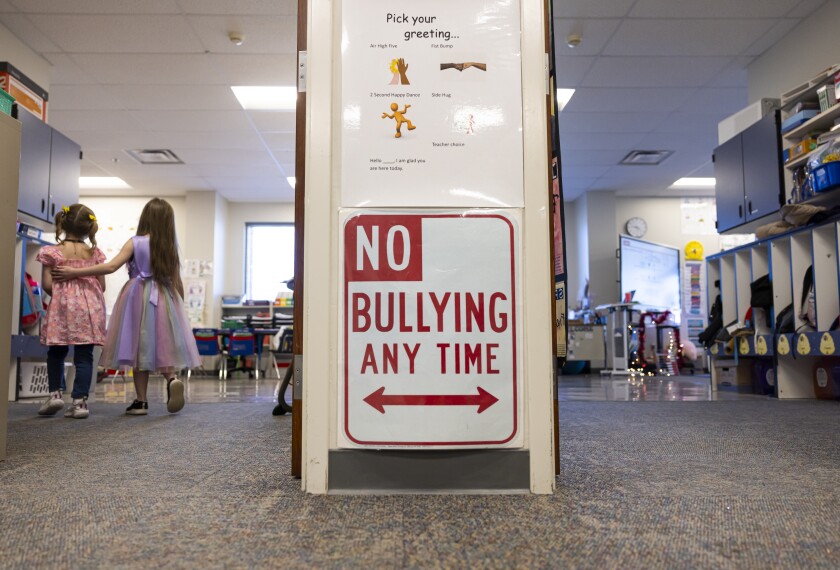
Teachers and principals are noticing that older elementary students are struggling to manage their emotions and behaviors.
Their poor self-regulation skills put them at a disadvantage when they move on to middle school and might be a reason why educators report that their middle and high school students are struggling to direct their own learning, advocate for themselves, and take responsibility for their education.
While these are skills that kids acquire and develop over time, experts say the COVID pandemic had a lasting effect on children’s self-regulation skills. The increase in kids’ screen time is also likely affecting students’ social and behavioral development, experts say.
In a Feb. 13 Education Week K-12 Essentials Forum panel, an elementary school principal and a social-emotional learning expert discussed what steps schools need to take to help students learn to regulate their emotions and become more independent thinkers and decisionmakers. The panelists were Jana Clark, the principal of Boyd Elementary in Boyd, Texas; and David Adams, the CEO of the Urban Assembly, a nonprofit school support organization that focuses on social-emotional learning.
Here are three takeaways from their discussion.
1. Help students name the emotions and the skills that they need to learn
Elementary students are still learning and developing social-emotional skills. That’s why it’s vital for them to be able to name the emotions that they’re feeling and learn the skills they can use to cope with those emotions, Adams said. Those emotions can range from anger to sadness to fear.
To deal with emotions, Adams recommends students learn to talk about concepts such as empathy, compassion, grit, and self-management.
“We need to ensure students have visibility of these concepts, so that they know what they’re doing when they’re doing it,” he said. “Language helps students to form ideas and then use them effectively when they need to retrieve them in order to solve problems.”
With secondary students who are learning to be more independent, it’s also important for them to be able to name the skills that they’re supposed to be working on, Adams said.
The structure of middle and high school is designed to give students more freedom and independence, the panelists said. For instance, instead of having to walk in a line to get from one place to another, secondary students have the freedom to get to their next class entirely on their own.
With that kind of independence for students built into their daily experiences, secondary schools should then be clear about the expectations they have for students, Adams said.
“We need to name things like responsibility,” he said. “We need to name things like goal-setting, self-management, so it’s clear what it is that we’re expecting and what it is that we’re developing [in the students].”
2. Adults need to model the behaviors students are learning
Naming the emotions and the skills that students are learning is just one part of the equation, the panelists said. Educators should also model these skills so students can see them in action.
For instance, teachers could say, “I’m feeling a little frustrated right now. I’m going to take a breath so I can re-engage in the task at hand,” Adams said.
Or when a teacher sees a student push another, they might ask the first student why they did that, and the student might say it’s because they’re frustrated. The teacher could dig deeper and ask why the student was frustrated, and it might be because the other student was in their space, Clark said.

“It’s important for teachers to talk [about] those things out loud, to model it for the class,” she added.
The challenge is that for the adults in the room, doing that can sometimes be outside their comfort zone, Clark said.
Teachers might feel like they’re not supposed to tell students when they’re frustrated or overwhelmed, but it can be a learning opportunity for students to understand how to get from frustration back to productivity, the panelists said.
3. Give students space to practice the social-emotional skills they’re learning
Students also need the time and support to practice their social-emotional skills, according to the panelists.
At Boyd Elementary, every month there’s a different social-emotional skill that the school emphasizes, Clark said. In February, the skill is compassion, and for the whole month, they encourage students and staff to show compassion toward others and talk about ways they’ve done that.
“There are some things that we can do as campus leadership to be sure that it’s not just a poster on the wall, and it’s not just a word,” Clark said.
In secondary schools, it’s important to create an environment where students can safely demonstrate and practice their independence, Adams said.
One natural way to do that is through student leadership groups or other student-led initiatives, Clark said. Student leaders have a finger on the pulse of the social-emotional needs in the school.