School & District Management

Chicago Schools’ Chief Executive Will Step Down

By Robert C. Johnston — June 13, 2001 2 min read
  • Save to favorites
  • Print

Paul G. Vallas’ six-year run as the high-profile chief executive officer of the Chicago public schools ended last week with the much-anticipated announcement that he will resign.

The news was the second shoe dropping in a leadership shakeup that began late last month, when Gery J. Chico stepped down as the president of the city’s school board. (“Change Afoot for Chicago’s School Team,” June 6, 2001.)

Speculation that Mr. Vallas was on the way out had grown recently, owing largely to Chicago Mayor Richard M. Daley’s public criticism of some stagnant and declining test scores.

Mr. Daley, who appointed both top district leaders in 1995 under a state-mandated mayoral takeover of the schools, was more complimentary at the June 7 press briefing where he accepted Mr. Vallas’ resignation. It wasn’t clear when it would be effective.

The mayor called Mr. Vallas “the best chief executive in the history” of the city’s schools, and he praised overall improvement in reading and mathematics scores and higher student-attendance rates.

“Teachers, students, and principals will tell you there’s a new spirit in the Chicago public schools,” Mayor Daley added. “The old sense of defeatism and failure is a thing of the past.”

For his part, Mr. Vallas denied that the mayor had asked him to leave. “These jobs are not forever,” he told local reporters. “Six years is a long time.”

Mr. Vallas, who previously was Mr. Daley’s budget director, said he would stay on board for awhile to help with the transition. As of press time last Friday, the mayor hadn’t revealed his choices to replace Mr. Chico and Mr. Vallas.

School watchers in Chicago said the leading contender for Mr. Chico’s post appeared to be Michael Scott, the president of the Chicago Park District. As for a Vallas replacement, Chicago Library Commissioner Mary A. Dempsey appeared to be at the front of the pack.

‘Real Pressure’

Mr. Vallas became a national figure after being put in charge of the 432,000-student district, the nation’s third largest.

Under the Chico-Vallas administration, the automatic promotion of students to the next grade was ended, and thousands of students were sent to summer school in a push to raise their achievement. Mr. Vallas had high expectations for all students, and expected other administrators to demand results, observers say.

“He put real pressure on schools like I’d never seen,” said Barbara Radner, the director of the Center for Urban Education at DePaul University in Chicago. “People knew you couldn’t fool this guy.”

The district has also produced six years of balanced budgets and managed $2.6 billion in school construction projects.

Critics of Mr. Vallas direct their harshest attacks at what they contend is a proliferation of shallow curricula foisted on students in the cause of raising test scores.

“There’s some concern the mayor will replace one person without education expertise with another,” said Julie Woestehoff, the executive director of Parents United for Responsible Education, a local advocacy group. “We need a real education vision. We hope it’s the direction that the mayor wants to go.”

A version of this article appeared in the June 13, 2001 edition of Education Week as Chicago Schools’ Chief Executive Will Step Down

Events

This content is provided by our sponsor. It is not written by and does not necessarily reflect the views of Education Week's editorial staff.
Sponsor
College & Workforce Readiness Webinar
Smarter Tools, Stronger Outcomes: Empowering CTE Educators With Future-Ready Solutions
Open doors to meaningful, hands-on careers with research-backed insights, ideas, and examples of successful CTE programs.
Content provided by Pearson
This content is provided by our sponsor. It is not written by and does not necessarily reflect the views of Education Week's editorial staff.
Sponsor
Professional Development Webinar
Recalibrating PLCs for Student Growth in the New Year
Get advice from K-12 leaders on resetting your PLCs for spring by utilizing winter assessment data and aligning PLC work with MTSS cycles.
Content provided by Otus
School Climate & Safety Webinar Strategies for Improving School Climate and Safety
Discover strategies that K-12 districts have utilized inside and outside the classroom to establish a positive school climate.

EdWeek Top School Jobs

Teacher Jobs
Search over ten thousand teaching jobs nationwide — elementary, middle, high school and more.
View Jobs
Principal Jobs
Find hundreds of jobs for principals, assistant principals, and other school leadership roles.
View Jobs
Administrator Jobs
Over a thousand district-level jobs: superintendents, directors, more.
View Jobs
Support Staff Jobs
Search thousands of jobs, from paraprofessionals to counselors and more.
View Jobs

Read Next

School & District Management A Cold Front Is Sweeping the Country. Can Schools' Heating Keep Up?
A spate of frigid temperatures across much of the country will present a test for schools' aging heating systems.
5 min read
20260122 AMX US NEWS CPS CANCELS CLASS FRIDAY DUE 1 TB
A crossing guard assists students as they arrive for classes at Chalmers STEAM Elementary school on Jan. 22, 2026, in Chicago. Extreme cold hitting much of the United States in the coming days could test schools' aging infrastructure and force school closures. Chicago Public Schools called off classes for Friday, Jan. 23.
Antonio Perez/ Chicago Tribune
School & District Management How Principals Are Coaching the Next Generation of School Leaders
Mentors give aspiring school leaders an unvarnished view of the principalship.
6 min read
Photo of school officials having conversation.
iStock
School & District Management How 4 Superintendents Are Bracing for Federal Funding Uncertainty Under Trump
Superintendent of the Year finalists discussed how they're preparing for potential cuts.
3 min read
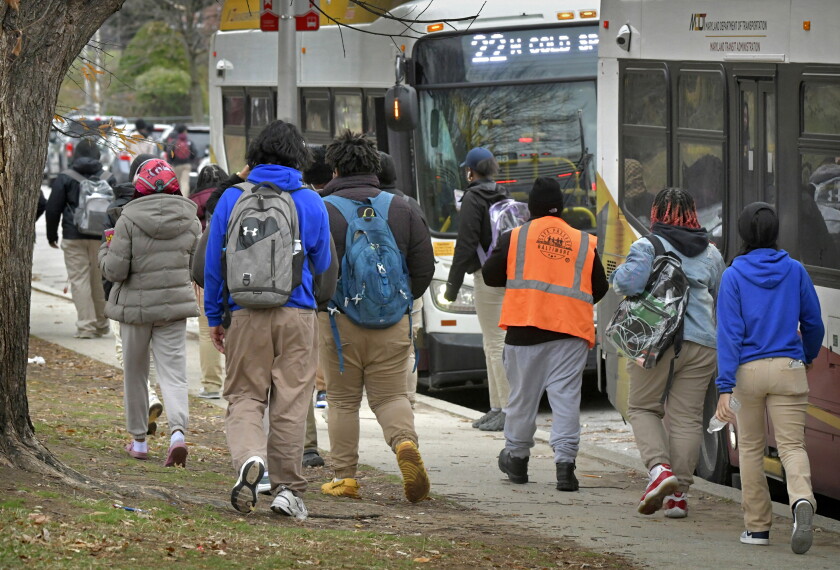
Students at Merganthaler Vocational-Technical High School board MTA buses at the end of the school day on Dec. 13, 2024 , in Baltimore. federally funded programs allows students to access resources they might otherwise not get—like tutoring and after-school programs, according to Baltimore Superintendent Sonja Santelises.
Students at Merganthaler Vocational-Technical High School board buses at the end of the school day on Dec. 13, 2024 , in Baltimore. Federally funded programs in the city's schools allow students access to services they might otherwise not get, such as tutoring and after-school programs, Baltimore Superintendent Sonja Santelises said at a recent panel discussion of the finalists for AASA's Superintendent of the Year award.
Amy Davis/Baltimore Sun/TNS
School & District Management Q&A Why This Leader Is Willing to Risk Losing His Job to Support Immigrant Students
This small Vermont district defies backlash to support immigrant families.
6 min read
A Somali flag, right, flies alongside the United States and Vermont flags outside the Winooski School District building, Wednesday, Dec. 10, 2025, in Winooski, Vt.
A Somali flag, right, flies alongside the United States and Vermont flags outside the Winooski School District building, Wednesday, Dec. 10, 2025, in Winooski, Vt. The district's effort to show support for Somali students drew intense backlash.
Amanda Swinhart/AP