
School & District Management

D.C. Set to Impose Teacher-Firing Initiative

By Stephen Sawchuk — October 10, 2008 3 min read
  • Save to favorites
  • Print

Unable to overcome a stalemate with the teachers’ union over a controversial pay proposal, District of Columbia schools Chancellor Michelle A. Rhee is moving to strengthen principals’ ability to dismiss teachers deemed ineffective.

“We cannot waste any more time in our quest to ensure superior educators in every classroom,” Ms. Rhee said while unveiling her plans earlier this month.

Neither the school district nor the Washington Teachers’ Union has formally declared an impasse in the contract negotiations—an event that would trigger third-party arbitration—but both parties are examining the option.

“We cannot waste any more time in our quest to ensure superior educators in every classroom,” Michelle A. Rhee says.

The announcement, for now, scuttles Ms. Rhee’s plan to use private foundation funding as the basis for pay bonuses that would have put Washington teachers among the nation’s highest-paid.

Under her outline, principals will implement a little-known procedure allowing them to place ineffective teachers on a 90-day improvement plan. Those who did not improve would face dismissal.

Ms. Rhee will also move to launch a performance-based teacher-evaluation process that would be based primarily on teachers’ contributions to student learning.

She also plans to dismiss teachers who fail to meet the federal No Child Left Behind Act’s “highly qualified” standard and to encourage principals to use the district’s rules permitting them to consider factors beyond teachers’ seniority when cutting staff positions.

Since the announcement of Ms. Rhee’s teacher-pay proposal in July, the plan has attracted attention from policymakers across the country. (“Pay-for-Tenure Swap for D.C. Teachers Under Debate,” Aug. 27, 2008.)

No Compromise

Teachers choosing the plan’s “red” tier would receive generous boosts according to a traditional salary schedule based on teachers’ experience and credentials. Under the “green” tier, base pay would be supplemented by up to $20,000 annually in performance bonuses based on improved student achievement. But teachers would have to give up tenure protections for a year—and risk dismissal—to participate.

The proposal proved internally divisive among WTU members and prompted union President George Parker to seek an appeals process for teachers who opted for the green tier and were not granted tenure. But Ms. Rhee and Mr. Parker were unable to compromise on language for the process.

Now, Mr. Parker argues that the performance-pay element should be decoupled from the issue of tenure.

“The concept of wanting to give teachers higher pay is a great concept, but when you link it to things that have nothing to do with education, I think we have to oppose that,” he said last week.

Ms. Rhee has long said she would put in place a “Plan B” for teacher-quality improvements if she could not secure a timely contract. But Mr. Parker criticized the fallback proposals for their emphasis on dismissals, and he suggested the union would resist them.

“You cannot fire your way into an outstanding school system; you have to develop and build great teachers,” he said.

Earlier this year, Ms. Rhee fired 70 teachers who were not able to meet the “highly qualified” standard, an action that prompted a lawsuit from the WTU. To be deemed highly qualified, teachers must hold a bachelor’s degree, be fully certified, and demonstrate subject-matter competency.

Although a poll commissioned by the American Federation of Teachers showed a majority of Washington teachers opposed the two-tiered pay plan, supporters of the proposed contract expressed frustration at the thought of more accountability without the opportunity for bonuses.

“I wish we would have had more time and information, and I wish [the proposal] had been brought to a vote,” said Zakia Haight, 30, an eight-year early-childhood teacher. “Before, it was just [green-tier participants] on probation. Now, everybody’s going to be on probation.”
A version of this article appeared in the October 15, 2008 edition of Education Week as D.C. Set to Impose Teacher-Firing Initiative

Events

This content is provided by our sponsor. It is not written by and does not necessarily reflect the views of Education Week's editorial staff.
Sponsor
College & Workforce Readiness Webinar
Smarter Tools, Stronger Outcomes: Empowering CTE Educators With Future-Ready Solutions
Open doors to meaningful, hands-on careers with research-backed insights, ideas, and examples of successful CTE programs.
Content provided by Pearson
Recruitment & Retention Webinar EdRecruiter 2026 Survey Results: How School Districts are Finding and Keeping Talent
Discover the latest K-12 hiring trends from EdWeek’s nationwide survey of job seekers and district HR professionals.
This content is provided by our sponsor. It is not written by and does not necessarily reflect the views of Education Week's editorial staff.
Sponsor
Professional Development Webinar
Recalibrating PLCs for Student Growth in the New Year
Get advice from K-12 leaders on resetting your PLCs for spring by utilizing winter assessment data and aligning PLC work with MTSS cycles.
Content provided by Otus

EdWeek Top School Jobs

Teacher Jobs
Search over ten thousand teaching jobs nationwide — elementary, middle, high school and more.
View Jobs
Principal Jobs
Find hundreds of jobs for principals, assistant principals, and other school leadership roles.
View Jobs
Administrator Jobs
Over a thousand district-level jobs: superintendents, directors, more.
View Jobs
Support Staff Jobs
Search thousands of jobs, from paraprofessionals to counselors and more.
View Jobs

Read Next

School & District Management How 4 Superintendents Are Bracing for Federal Funding Uncertainty Under Trump
Superintendent of the Year finalists discussed how they're preparing for potential cuts.
3 min read
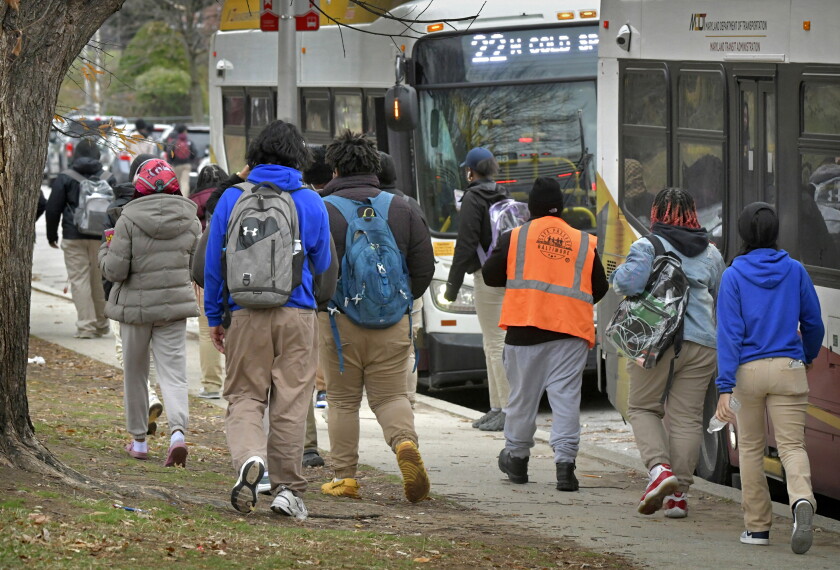
Students at Merganthaler Vocational-Technical High School board MTA buses at the end of the school day on Dec. 13, 2024 , in Baltimore. federally funded programs allows students to access resources they might otherwise not get—like tutoring and after-school programs, according to Baltimore Superintendent Sonja Santelises.
Students at Merganthaler Vocational-Technical High School board buses at the end of the school day on Dec. 13, 2024 , in Baltimore. Federally funded programs in the city's schools allow students access to services they might otherwise not get, such as tutoring and after-school programs, Baltimore Superintendent Sonja Santelises said at a recent panel discussion of the finalists for AASA's Superintendent of the Year award.
Amy Davis/Baltimore Sun/TNS
School & District Management Q&A Why This Leader Is Willing to Risk Losing His Job to Support Immigrant Students
This small Vermont district defies backlash to support immigrant families.
6 min read
A Somali flag, right, flies alongside the United States and Vermont flags outside the Winooski School District building, Wednesday, Dec. 10, 2025, in Winooski, Vt.
A Somali flag, right, flies alongside the United States and Vermont flags outside the Winooski School District building, Wednesday, Dec. 10, 2025, in Winooski, Vt. The district's effort to show support for Somali students drew intense backlash.
Amanda Swinhart/AP
School & District Management How These 3 States Are Building a Principal Pipeline
Principal apprenticeship programs aim to remove barriers to school leadership.
5 min read
Principal and apprentice having a conversation in school courtyard.
E+
School & District Management Opinion 4 Practical Steps Leaders Can Take to Support Student Learning
When it comes to best practice for data-driven instruction, teachers will take clues from leaders.
3 min read
Screenshot 2025 12 18 at 8.01.20 AM
Canva
