School & District Management

Extra Benefits Tied to Extracurriculars

By Michelle Galley — October 18, 2000 2 min read
  • Save to favorites
  • Print

Students who take part in extracurricular activities such as band, school plays, academic clubs, and sports generally do better in high school, and even beyond, than those who don’t, according to an ongoing long-term study of more than 1,000 former Michigan 6th graders.

Participation in extracurricular activities such as school plays, as these students at Walter Johnson High School in Montgomery County, Md., were doing last week, is linked to better grades and lower truancy rates in an ongoing study.
—Allison Shelley.

The activities are linked to better grades, lower rates of truancy, stronger feelings of attachment to a school, and higher rates of college attainment, according to the Michigan Study of Adolescent Life Transitions.

The study began in 1983 with a group of 1,800 6th graders from 10 school districts in southeastern Michigan. A majority of the students are white, and they come from working- and middle-class families.

For administrators, the study’s lesson is clear, said researcher Bonnie Barber, an associate professor of family studies and human development at the University of Arizona in Tucson.

“When funding gets tight, don’t cut activities. Don’t cut band or orchestra,” said Ms. Barber, who is leading the study along with Jacquelynne S. Eccles, a professor of psychology and education at the University of Michigan in Ann Arbor.

Well-Rounded Students

The study relates numerous extracurricular activities to positive, and sometimes negative, behaviors.

For example, participation in “prosocial activities,” such as attending church, volunteering, and taking part in community service, was accompanied by better academic performance and higher rates of college enrollment for those students, compared with their peers who did not participate.

Likewise, membership on team sports correlated with such positive outcomes as better grade point averages and college attendance. But student athletes in the study also were more likely to drink alcohol than students who chose other types of extracurricular activities.

Ms. Barber said the results were controlled for students’ academic ability, as gauged by their scores on an aptitude test, and their mothers’ education level.

The researchers have collected eight waves of data on the student participants through self-administered surveys and school records, including grades, absences, and disciplinary actions. Some 1,400 of the original students participated in the most recent wave of data, collected in 1996, when most of the participants were 24 years old.

In an unpublished paper on those data, the researchers report that students who had participated in extracurricular activities of any kind were more likely to have graduated from college than those who had not.

In addition, sports participation in 10th grade was positively related to being on a career path following graduation. The researchers found no other correlations between careers and the other activities studied.

The researchers are collecting a ninth wave of data this year.

Funding for the study has come from the National Institute of Child Health and Human Development, the National Institute of Mental Health, the National Science Foundation, the Spencer Foundation, and the W.T. Grant Foundation.


Interesting Ideas? Send suggestions for possible Research section stories to Debra Viadero at Education Week, 6935 Arlington Road, Suite 100, Bethesda, MD, 20814; e-mail: dviadero@epe.org. Coverage of research is underwritten in part by a grant from the Spencer Foundation.

Events

This content is provided by our sponsor. It is not written by and does not necessarily reflect the views of Education Week's editorial staff.
Sponsor
College & Workforce Readiness Webinar
Smarter Tools, Stronger Outcomes: Empowering CTE Educators With Future-Ready Solutions
Open doors to meaningful, hands-on careers with research-backed insights, ideas, and examples of successful CTE programs.
Content provided by Pearson
This content is provided by our sponsor. It is not written by and does not necessarily reflect the views of Education Week's editorial staff.
Sponsor
Professional Development Webinar
Recalibrating PLCs for Student Growth in the New Year
Get advice from K-12 leaders on resetting your PLCs for spring by utilizing winter assessment data and aligning PLC work with MTSS cycles.
Content provided by Otus
School Climate & Safety Webinar Strategies for Improving School Climate and Safety
Discover strategies that K-12 districts have utilized inside and outside the classroom to establish a positive school climate.

EdWeek Top School Jobs

Teacher Jobs
Search over ten thousand teaching jobs nationwide — elementary, middle, high school and more.
View Jobs
Principal Jobs
Find hundreds of jobs for principals, assistant principals, and other school leadership roles.
View Jobs
Administrator Jobs
Over a thousand district-level jobs: superintendents, directors, more.
View Jobs
Support Staff Jobs
Search thousands of jobs, from paraprofessionals to counselors and more.
View Jobs

Read Next

School & District Management How Principals Are Coaching the Next Generation of School Leaders
Mentors give aspiring school leaders an unvarnished view of the principalship.
6 min read
Photo of school officials having conversation.
iStock
School & District Management How 4 Superintendents Are Bracing for Federal Funding Uncertainty Under Trump
Superintendent of the Year finalists discussed how they're preparing for potential cuts.
3 min read
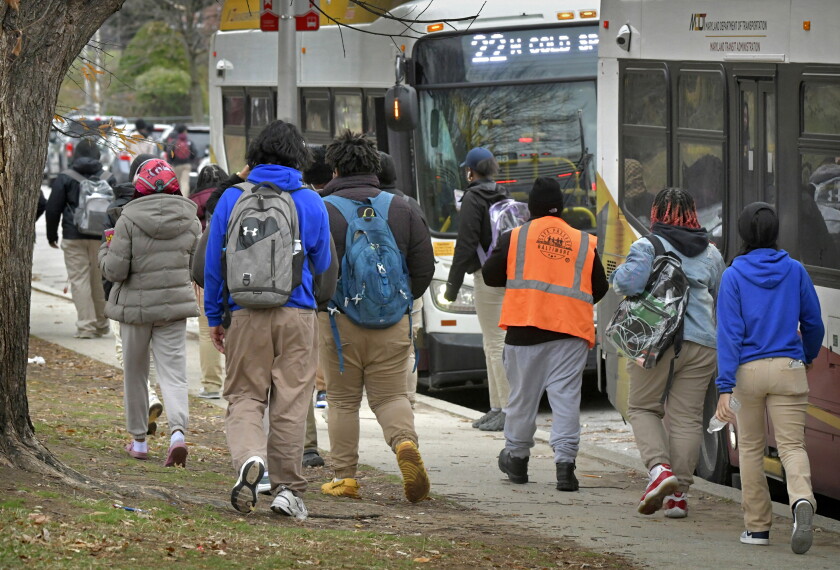
Students at Merganthaler Vocational-Technical High School board MTA buses at the end of the school day on Dec. 13, 2024 , in Baltimore. federally funded programs allows students to access resources they might otherwise not get—like tutoring and after-school programs, according to Baltimore Superintendent Sonja Santelises.
Students at Merganthaler Vocational-Technical High School board buses at the end of the school day on Dec. 13, 2024 , in Baltimore. Federally funded programs in the city's schools allow students access to services they might otherwise not get, such as tutoring and after-school programs, Baltimore Superintendent Sonja Santelises said at a recent panel discussion of the finalists for AASA's Superintendent of the Year award.
Amy Davis/Baltimore Sun/TNS
School & District Management Q&A Why This Leader Is Willing to Risk Losing His Job to Support Immigrant Students
This small Vermont district defies backlash to support immigrant families.
6 min read
A Somali flag, right, flies alongside the United States and Vermont flags outside the Winooski School District building, Wednesday, Dec. 10, 2025, in Winooski, Vt.
A Somali flag, right, flies alongside the United States and Vermont flags outside the Winooski School District building, Wednesday, Dec. 10, 2025, in Winooski, Vt. The district's effort to show support for Somali students drew intense backlash.
Amanda Swinhart/AP
School & District Management How These 3 States Are Building a Principal Pipeline
Principal apprenticeship programs aim to remove barriers to school leadership.
5 min read
Principal and apprentice having a conversation in school courtyard.
E+
