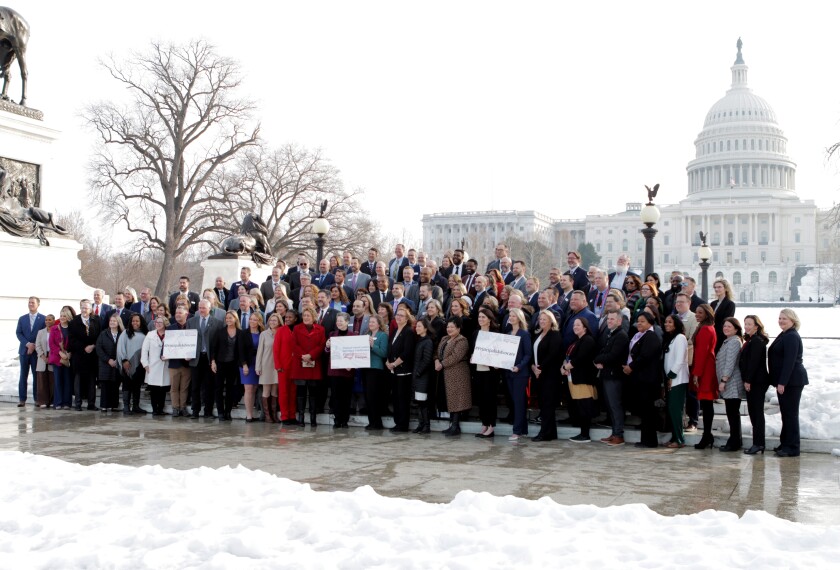
With Congress seemingly deadlocked on reauthorizing the main federal K-12 education law, state school leaders feel they are being asked by the federal government to blaze a trail on school improvement and innovation while looking over their shoulders.
For the most part, those gathered at the Council of Chief State School Officers’ legislative conference last week have gladly stepped into what they see as the power vacuum left by Washington, with praise from federal officials.
But the consistent drumbeat that Congress is too paralyzed to reauthorize the Elementary and Secondary Education Act this year—five years after reauthorization was due—seemed to embody the school chiefs’ consternation with federal lawmakers, even as they came to town in part to lobby their elected leaders.
At the same time, federal budget decisions with major ramifications for education funding loom, and those ramifications could hit states at the beginning of next year.
“This is such an exciting time to be in this field, and it’s so frustrating that Congress is gridlocked at this time,” said Massachusetts education Commissioner Mitchell Chester, one of the 37 elected and appointed state education chiefs who attended the annual conference here March 25-27.
But as long as states stress new accountability systems as the primary hinge for their new initiatives, several state school officers expressed the view that the U.S. Department of Education will be inclined to give them its blessing.
Message to Districts
That approach became something of a mantra for New Mexico’s secretary of education, Hanna Skandera, who said that instead of pushing for more federal funds, she kept asking districts and state education programs: “Where’s your data?”
June Atkinson, North Carolina’s superintendent of public instruction, indicated that she was stressing programs related to early childhood, career and technical education—an area where students graduate significantly higher than the state average—and federal School Improvement Grants to turn around low-performing schools.
“See where you are getting the largest return on investment,” Ms. Atkinson said.
But the looming political chaos surrounding the federal budget, including a potential $3.5 billion cut to federal education funding after Jan. 2 to major programs such as special education and Title I aid for disadvantaged students, dampened chiefs’ enthusiasm. This cut, known as “sequestration,” would be due to the inability of the congressional “supercommittee” to reach a deal on deficit reduction in 2011.
Additional concerns over the expiration of federal tax cuts in 2013 and the need to raise the federal debt ceiling have created a uniquely pressurized budget environment for state chiefs, noted CCSSO Executive Director Gene Wilhoit.
Illinois schools chief Christopher Koch said that federal budget inaction will, for example, make it harder for him to help his districts, which must weigh teacher layoffs in March and April, even as he plans to reward successful schools and target struggling ones for interventions under his state’s second-round waiver request.
“There’s just not going to be a lot of money,” he said.
Congressional and federal Education Department officials also argued during a March 26 panel over exactly which policy “guardrails” should be in place to guide state education reforms under a reauthorized ESEA. Maine’s commissioner, Stephen Bowen, observed of Washington, “I think we saw ... why nothing gets done here.”
James Guthrie, Nevada’s incoming chief, also voiced the broad concern that Congress may eventually decide that U.S. Secretary of Education Arne Duncan overstepped his authority in granting ESEA waivers.
‘Building the Airplane’
But Jason Glass, Iowa’s director of education, said even though states were “building the airplane going down the runway” and “grabbing parts” to fit their individual states’ education climates, chiefs should never expector wait for political conditions to be optimal.
Instead, he mused that business-management terms could unfairly crowd out the ideas of professional autonomy and high prestige that characterize countries with successful track records in professional development such as Finland and South Korea.
“Those are not terms that I see in the American discussion very strongly,” Mr. Glass said.
At a March 26 discussion with Mr. Duncan, where Ohio schools Superintendent Stan Heffner said he was worried about the difficulty of convincing the public of the importance of the new common-core academic standards. If states and the federal government fail to do a better job explaining why rigorous academic standards at a national level are vital, Mr. Heffner said, “we’re going to fall short.”
Some Optimism
But Kentucky Commissioner Terry Holliday had a generally positive view of his situation.
Within two to three years, he expects state revenues to recover to 2008 levels. An 8.5 percent increase in Kentucky’s sales-tax revenue in February, for example, bolstered his spirits on that front.
Despite the comatose ESEA negotiations, he said federal officials actually appear to agree on most of the major issues and stressed that states were excited about their upcoming work.
“Let’s get the reauthorization done,” Mr. Holliday said.