Like school districts across the country, the Northwest district, just outside St. Louis, has been limping through the year with too few custodians, food-service and childcare workers. Then its leaders hit on a new, COVID-driven idea: They hired students to fill those jobs.
The district organized a job fair in early November, publicizing the event with announcements on the public-address system, and with emails sent to every student in 10th grade or older. In a room off the high school’s cafeteria, about 25 students sat at tables with district officials. Some were “interview-ready, articulate, and confident,” while others were nervous and stammered a bit, said Kim Hawk, the district’s chief operating officer.
Nearly all got jobs. Northwest hired 20 students to work part-time, filling the nine positions it had open in maintenance, food service, and before- and after-care. The teenagers started their jobs last week. Now, the district is drawing notice for trying a new tactic to manage one part of the staffing shortage that’s hobbling districts nationwide.
“It’s funny that this would be innovative,” said Northwest Superintendent Desi Kirchhofer. “It’s a solution that’s been there all along: students. But we didn’t think about it before. Now, we have to think differently.”
Emily Downs is one of the students hired to do custodial work. A sophomore, she’s cleaning classrooms and offices at Valley Middle School, where she was a student only two years ago. Emily is happy for the chance to earn $10.15 per hour and have a flexible work schedule that allows her to leave early when she needs to babysit her sister or attend her church youth group.
At 15, she also loves the free guaranteed ride to work: She just hops the bus from her high school as it makes its afternoon rounds and hops off at the middle school.
The new job “is a really good opportunity,” Emily said, “because it gets me started into seeing what working is like, seeing the work world before I’m 18, and trying to get a larger-scale job.”

Struggle to provide competitive pay
The Northwest district has taken some flak for its decision to hire students. When it posted an announcement of the job fair on its Facebook page, several community members objected to the pay, noting that Missouri’s minimum wage is $10.30 an hour.
“Perhaps if these positions paid a living wage you wouldn’t have to resort to hiring students” one person posted. “It is slave labor.”
Those sentiments highlight the difficulty of the district’s position. Mark Catalana, Northwest’s chief of human resources, said the district is paying students the same hourly wage it paid adults who held those jobs: $9.75 and up for food service, $10.54 to $14.68 for before- and after-care, and $10.15 and up for custodial work.
As a public school district, Northwest is exempt from state minimum-wage laws, Catalana said, but isn’t comfortable with leaving it at that. Pay rates are already set for this school year and couldn’t be changed, he said, but district leaders hope to work with their board of education to increase pay for the budget year that begins July 1, so they can better compete with increases built in to the state’s minimum wage law, he said.
It’s tough for the school district to compete with employers in its community, too, Hawk said. Many have raised wages in hopes of filling vacancies, she said. Northwest has been advertising for custodial, food-service and childcare workers for a year, she said, but has attracted only a handful. Her daughter quit a lifeguarding job to work for Walmart, where she could earn more hourly and was guaranteed a pay hike for each of her first three months on the job, Hawk said.
“Almost every little restaurant and gas station in the area has a help-wanted sign up,” Hawk said.
Staff shortages plague districts and are getting worse
Districts across the country have been hobbled all year by shortages of teachers, aides, bus drivers, and other workers. In an October survey by the EdWeek Research Center, 40 percent of district leaders and principals said staff shortages in the fall were “very severe” or “severe.”
By late November, half of principals and district leaders reported that those shortages had worsened since earlier in the fall, and nearly 4 in 10 said they hadn’t gotten any better. Fifteen percent said they’d had to shut down or limit in-person instruction because of vacant positions.
Most school district jobs, however, require specialized skill sets teenagers lack. Districts have used students to get the word out about job openings—California’s Morongo Unified sent home “hiring now” flyers in students’ lunchboxes—but Northwest appears to be the first to hire students into jobs that adults typically hold.
Schools have a long history of letting students work, said Henry Tran, who studies staffing shortages, particularly in rural areas, as an associate professor of education leadership and policy at the University of South Carolina. But typically those jobs—helping out in the office, serving as a crossing guard—are for volunteer experience or class credit.
Hiring students raises key questions
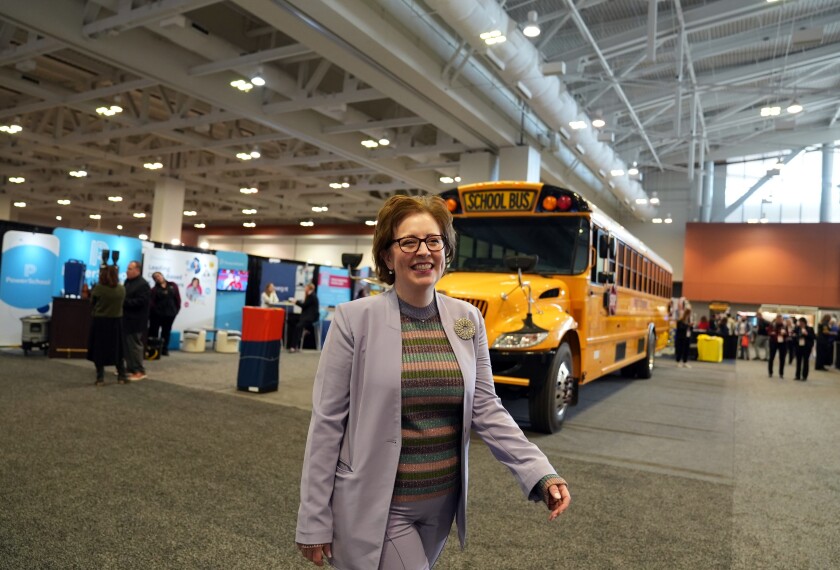
Using students in paid positions, however, raises key issues. Some can be logistical. Northwest realized it had to find a way to get all of the teenagers fingerprinted, part of the security process required to work in public schools. It ended up loading them all onto a yellow school bus and driving them to the vendor, Hawk said, using the time on the bus for an impromptu job orientation.
But more serious questions can crop up, too. Students working in office settings might be in a position to see confidential documents, such as student records, Tran said, which would violate student-privacy laws. Districts also run the risk that students could fall victim to sexual harassment, since they are dealing with adults in positions of trust who are now also their bosses.
But hiring students is problematic, Tran said, because it doesn’t solve the district’s underlying problem.
“It doesn’t address the real issues: Why are people leaving?” Tran said. “And why are new individuals not joining? It can look like a district is using child labor to avoid paying livable wages for these positions.”
It’s a thorny problem, especially in the current economic climate. Kirchhofer, the superintendent, noted that the district hiked pay for substitute teachers from $95 to $145 per day last year, and still can’t seem to find enough substitutes.
“It’s tough right now,” he said. “We just have to get creative, find new ways to do things.”