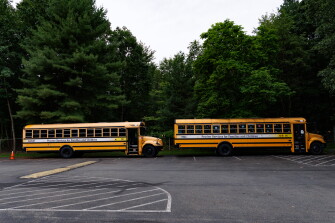

When children in rural Pennsylvania board a specially outfitted school bus next spring, they won’t sit with their backpacks in their laps, headed to class.
Instead, they’ll enter a sensory-friendly space designed to help the littlest learners in Monroe County familiarize themselves with tools that can help them manage big emotions.
Aside from the classic yellow exterior, they’ll hardly know they’re on a bus at all.
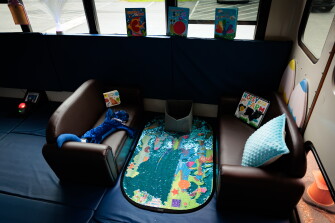
The inside of the bus was gutted by staff of Pocono Services for Families and Children, which administers the local Head Start program, and stripped of the traditional gray seats.
Then, staff installed blue foam gym mats across the floor and up the walls to create a safe space and comfortable tactile surface—a sensory tool literally built into the bus’ structure.
A projector shines inside, making it appear as if the bus ceiling is a calming night sky, replete with stars, constellations, and streaks of the Northern Lights. There are small leather sofas and a table where children can sit and play with toys or practice deep breathing—a key technique for overcoming big emotions. There’s a tent children can crawl into, where they can sit on small inflatable seats to block out outside noise and lights.
The mobile sensory room—fashioned after a similar, stationary space at one of the county’s three early-childhood centers serving children ages 3-5—is intended to expose children early and often to healthy coping skills and emotional-regulation tools before they adopt unhealthy habits, said Justin Ortiz, a grant specialist for Pocono Services for Families and Children.
Such sensory rooms are supposed to help children manage their emotions so they can calm down, focus, and return to learning clearheaded.
“As adults, we have the freedom to fulfill our emotional needs—we can go take a walk or sit in the sun—but kids don’t always have that same autonomy, but we ask them to be emotionally regulated,” Ortiz said. “If teaching them these sensory skills early helps them, I see it as a wraparound approach that sets them up for success long term, both in and out of school.”

The sensory bus takes a preventive approach to misbehavior
Student misbehavior—tantrums or emotional outbursts, defiance, and disrespect toward teachers and classmates—has become more common in classrooms, and the frequency and intensity of the disruptions have increased since the pandemic, according to educator surveys and research in recent years.
More than 8 in 10 public schools say they’re seeing stunted behavioral and social-emotional development in their students, according to May 2024 data from the National Center for Education Statistics’ School Pulse Panel, which surveys a nationally representative group of more than 1,500 schools from every state and the District of Columbia. They also say student misbehavior is hurting learning and teacher and staff morale.
The ability to manage emotions, behavior, and attention is a skill humans acquire and develop over time, and the early-elementary period is prime time for learning and practicing it, Stephanie Jones, a professor of early-childhood development at Harvard University and the director of the Ecological Approaches to Social Emotional Learning, or EASEL, Laboratory, told Education Week recently.

Leaders in Monroe County, located more than two hours north of Philadelphia, are hopeful the sensory bus can help kids in their early-childhood program develop some of those skills.
The bus is equipped with “sensory toys,” like fidget spinners, books with textured pictures, blocks, and weighted stuffed animals, designed to help kids channel their feelings into play, rather than outbursts, and help them return to emotional equilibrium. The toys can also help kids build fine motor skills and improve focus—both key skills for children in early-childhood programs to begin honing before entering the K-12 system.
The sensory bus will travel to early-childhood sites on a schedule
The bus will travel to the far corners of the county where early-childhood programs don’t yet have sensory rooms in their buildings and can’t afford to create them.
The county’s family-services program had two school buses, but only used one, so Ortiz thought transforming one of them into a mobile sensory room could benefit everyone at a fraction of the cost of setting up a room at each of the county’s early-childhood centers.
When the sensory bus hits the streets for Head Start students to use in the spring, there will likely be a schedule with set times when it is available at the county’s different early-childhood centers, said Anne O’Malley, the Pocono organization’s mental health director, in an interview this month prior to her retirement.
The schedule will give students structure and something to look forward to each week, she added.
“The vision for the bus is really to be like an extension of the classroom,” O’Malley said. “We do have some sensory tools in our classrooms, but this is an additional therapeutic space that goes beyond that.”
Community members and groups can also rent the sensory bus for their own events, Ortiz said.
Whenever the bus is in use—aside from driving time—the motor is shut off. The inside fans and LED lights are solar-powered to be more environmentally friendly, Ortiz said.
The fans, though, aren’t enough to cool the bus when it’s hot outside, which is why Pocono Services is waiting until spring, when temperatures tend to be milder, to launch it. But Ortiz is already eyeing his next improvement project: securing funding to install air conditioning so the bus is usable year-round.
“I want this to be as accessible as possible,” he said, “so that all of our kids have access to the space and tools they need to be successful.”