Student Well-Being & Movement From Our Research Center

How Much High Schoolers Think Their Educators Care About Them

By Arianna Prothero — April 26, 2024 2 min read
Horizontal banner image of group of multiracial teenage high school students standing against blue background wall. Student belonging.
  • Save to favorites
  • Print

Schools are earning mixed reviews from high school students on two key indicators of how well they encourage a sense of belonging.

That’s according to a recent survey by the EdWeek Research Center, which polled a nationally representative sample of 1,056 students in grades 9-12 in February and March.

The survey asked students whether the adults in their school care about their well-being and success and whether students feel like they are accepted and welcomed in their school community.

Although more than half of students answered positively to both questions, there are some concerning trends in the data. A significant proportion of students indicated that they feel disconnected—a troubling sign given the challenges schools are facing with student disengagement and chronic absenteeism.

A majority of students—57 percent—say the adults in their school care about them at least a moderate amount, but 1 in 5 students say the adults care little or not at all about their well-being and success.

Students are much more likely to say they feel accepted and welcomed in their school community overall, with 86 percent agreeing with that statement. That percentage drops slightly for students who are not heterosexual or students who come from low-income families.

Students who feel connected to school are more likely to attend and perform well and less likely to misbehave and feel sad and hopeless. There are even health benefits well into adulthood linked to a strong connection to school as an adolescent.

Schools are using a variety of strategies to bolster a sense of belonging among their students.
See also

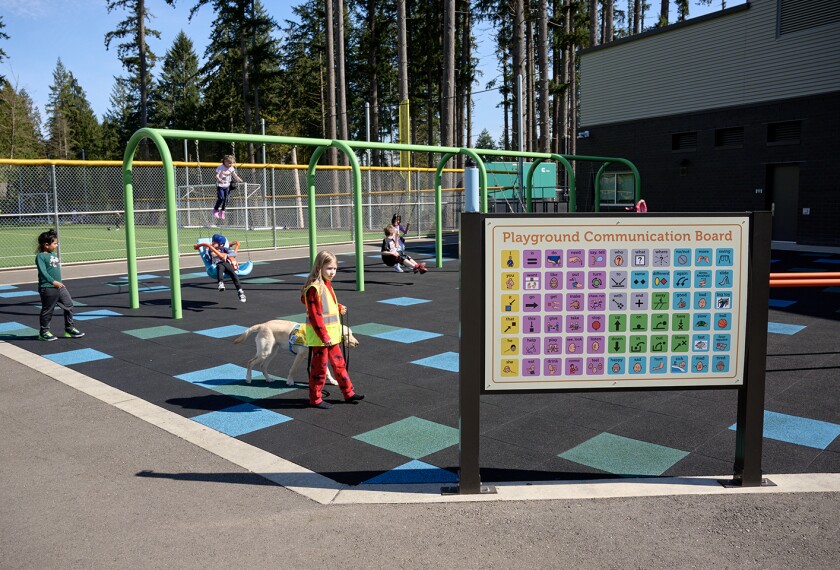
Students at Ruby Bridges Elementary School in Woodinville, Wash., play during recess on April 2, 2024. Students have access to cards with images and words on them so all students, including those who do not speak, can communicate on the playground.
Meron Menghistab for Education Week

Educators at Thomas Kelly College Preparatory have homed in on freshman year as a key time to make sure students have a strong connection to the Chicago high school.

“If you’re a 9th grader, nothing is more important to you than belonging,” Grace Gunderson, a counselor at the 1,700-student school who leads its newly formed freshman success team, said in a recent Education Week special report. “If we can get those kids involved in band, or ‘Hey, I play on the soccer team,’ or ‘Hey, I always eat lunch in Ms. Gunderson’s office,’ now, they have a connection. They have a reason to keep coming to school.”

The 2021 Youth Risk Behavior Survey, which is administered by the U.S. Centers for Disease Control and Prevention, found that students feeling connected to their school was associated with a lower prevalence of several risk factors, such as poor mental health, drug use, and missing school because students felt unsafe. In that survey, 61 percent of high schoolers reported feeling connected to peers and the adults in their schools.

A more recent survey of middle and high school students by YouthTruth, a nonprofit that surveys students and families for school districts, asked specifically about students’ connections to their teachers. The results of that survey aligned closely with the EdWeek Research Center findings.

On both of the survey questions, the EdWeek Research Center’s analysis did not find any statistically significant differences among students by race or gender.

Taken together, the data in the charts below show that while high schools have room for improvement in ensuring that all students feel that they belong and are connected to the adults in their schools, there is a solid foundation to build from.

education week logo subbrand logo RC RGB

Data analysis for this article was provided by the EdWeek Research Center. Learn more about the center’s work.

Events

This content is provided by our sponsor. It is not written by and does not necessarily reflect the views of Education Week's editorial staff.
Sponsor
School & District Management Webinar
Too Many Initiatives, Not Enough Alignment: A Change Management Playbook for Leaders
Learn how leadership teams can increase alignment and evaluate every program, practice, and purchase against a clear strategic plan.
Content provided by Otus
This content is provided by our sponsor. It is not written by and does not necessarily reflect the views of Education Week's editorial staff.
Sponsor
Artificial Intelligence Webinar
Beyond Teacher Tools: Exploring AI for Student Success
Teacher AI tools only show assigned work. See how TrekAi's student-facing approach reveals authentic learning needs and drives real success.
Content provided by TrekAi
This content is provided by our sponsor. It is not written by and does not necessarily reflect the views of Education Week's editorial staff.
Sponsor
College & Workforce Readiness Webinar
Building for the Future: Igniting Middle Schoolers’ Interest in Skilled Trades & Future-Ready Skills
Ignite middle schoolers’ interest in skilled trades with hands-on learning and real-world projects that build future-ready skills.
Content provided by Project Lead The Way

EdWeek Top School Jobs

Teacher Jobs
Search over ten thousand teaching jobs nationwide — elementary, middle, high school and more.
View Jobs
Principal Jobs
Find hundreds of jobs for principals, assistant principals, and other school leadership roles.
View Jobs
Administrator Jobs
Over a thousand district-level jobs: superintendents, directors, more.
View Jobs
Support Staff Jobs
Search thousands of jobs, from paraprofessionals to counselors and more.
View Jobs

Read Next

Student Well-Being & Movement Opinion Why a Good School Needs Both Coaches and Referees
If teachers are forced into being referees, they can't fill that role properly or coach well, either.
6 min read
The United States Capitol building as a bookcase filled with red, white, and blue policy books in a Washington DC landscape.
Luca D'Urbino for Education Week
Student Well-Being & Movement Q&A Cellphones: The 'Most Formidable Adversary' Schools Have Ever Faced
The Spokane schools in Washington paired cellphone restrictions with expanded extracurricular activities.
5 min read
Students at Glover Middle School in Spokane, Wash. make bookmarks and snowflakes during Falcon Time on Dec. 3, 2025.
Students at Glover Middle School in Spokane, Wash. make bookmarks and snowflakes during Falcon Time on Dec. 3, 2025. The district has sought to encourage students to spend less time on devices.
Kaylee Domzalski/Education Week
Student Well-Being & Movement Want Kids to Have Better SEL Skills? Try Using Sports
In a panel discussion, district leaders and an expert discuss why sports is a great place to learn life skills.
3 min read
Students play basketball at Parkway Sports & Health Science Academy on Feb. 21, 2025 in La Mesa, Calif.
Students playing basketball at Parkway Sports & Health Science Academy on Feb. 21, 2025, in La Mesa, Calif. Some schools are using sports as a way to help students develop social-emotional skills.
Ariana Drehsler for Education Week
Student Well-Being & Movement How a District Used Data to Fight Students' Gambling and Vaping
School officials figured out when kids faced the most pressure and worked from there.
3 min read
A panel on risky behaviors and district challenges kicks off at the National Conference on Education in Nashville, Tenn. on Feb. 12, 2026. At the podium is Ashley Dawson, senior project coordinator of children's programs at AASA. At the table, from left: Michael Vuckovich, superintendent of the Windber Area school district; Korie Duryea, the district's special education director; and Jessica Shuster, the director of education.
School officials from Windber, Pa., discussed their fight against student vaping and gambling in a Feb. 12, 2026, panel at the National Conference on Education in Nashville, Tenn. At the table are, from left, Superintendent Michael Vuckovich; Korie Duryea, the district's special education director; and Jessica Shuster, the director of education. Ashley Dawson, senior project coordinator of children's programs at AASA, The School Superintendents Association and conference host, is at the podium.
Kaylee Domzalski/Education Week
