Opinion Blog

Ask a Psychologist

Helping Students Thrive Now

Angela Duckworth and other behavioral-science experts offer advice to teachers based on scientific research. Read more from this blog.

Student Well-Being & Movement Opinion

Am I the Only One Who’s Confused? How to Help Students Raise a Hand

Teachers can start by revealing when they don’t know something
By Tenelle Porter — October 25, 2023 2 min read
How do I help students who are afraid to ask questions?
  • Save to favorites
  • Print

How do I help students who are afraid to ask questions?

Raising a hand in class is hard. Here’s what you can do to make it easier—I wrote a piece about the topic for Character Lab as a Tip of the Week:

“Look at the results. What should our alpha level be to correct for multiple comparisons?”

I stared at the statistics problem on the whiteboard and saw a cornucopia of symbols and numbers but nothing that looked remotely like an “a,” let alone an “alpha.” All around me, pencils scratched out calculations as my classmates got to work. I pretended to start my own calculations as my heart thudded and my face flushed hot.

“If I don’t know the answer to this question,” I thought, “I don’t belong in this class.”

It turns out I’m not alone. In a study of over 1,000 high school students recruited by Character Lab Research Network, about 40 percent said they regularly hesitated to admit if they didn’t know something or were confused in class. The struggles were especially strong among girls and were most common in math.

Why? We tend to believe that you can’t be good at math unless you’re really, really smart. The more we think we need to be “brilliant” to succeed (or at least look successful), the harder it is to reveal what we don’t know to others.

But if students don’t feel comfortable voicing their questions in school, they will miss opportunities to learn from peers and teachers—the very opportunities that can make them brilliant. As they begin to equate not knowing with incompetence, they may stop asking questions altogether.

To help teens overcome this resistance, you can validate their feelings by sharing times you have felt reluctant to ask—like my story about statistics class.

I wound up sticking it out in stats—with a little help from my classmate Liz. Still in a panic, I glanced up from my paper and saw a hand shoot into the air. “What do you mean by alpha level?” Liz asked.

“Good question,” the teacher said. Now the learning could begin.

Don’t hide what you don’t know. The more you conceal your questions, the scarier it becomes to ask for help.

Do be brave and share your questions with the world. Try this experiment with your students for a week: When someone uses a word or makes an unfamiliar reference, admit it instead of pretending to know. Then talk about your experiences with one another at the end of each class. You may be surprised at how much you learn and how much braver you become.

Related Tags:

The opinions expressed in Ask a Psychologist: Helping Students Thrive Now are strictly those of the author(s) and do not reflect the opinions or endorsement of Editorial Projects in Education, or any of its publications.

Events

This content is provided by our sponsor. It is not written by and does not necessarily reflect the views of Education Week's editorial staff.
Sponsor
Artificial Intelligence Webinar
AI in Schools: What 1,000 Districts Reveal About Readiness and Risk
Move beyond “ban vs. embrace” with real-world AI data and practical guidance for a balanced, responsible district policy.
Content provided by Securly
This content is provided by our sponsor. It is not written by and does not necessarily reflect the views of Education Week's editorial staff.
Sponsor
Recruitment & Retention Webinar
K-12 Lens 2026: What New Staffing Data Reveals About District Operations
Explore national survey findings and hear how districts are navigating staffing changes that affect daily operations, workload, and planning.
Content provided by Frontline Education
Education Funding Webinar Congress Approved Next Year’s Federal School Funding. What’s Next?
Congress passed the budget, but uncertainty remains. Experts explain what districts should expect from federal education policy next.

EdWeek Top School Jobs

Teacher Jobs
Search over ten thousand teaching jobs nationwide — elementary, middle, high school and more.
View Jobs
Principal Jobs
Find hundreds of jobs for principals, assistant principals, and other school leadership roles.
View Jobs
Administrator Jobs
Over a thousand district-level jobs: superintendents, directors, more.
View Jobs
Support Staff Jobs
Search thousands of jobs, from paraprofessionals to counselors and more.
View Jobs

Read Next

Student Well-Being & Movement Millions of Students Attend Schools Near Toxic Sites, a New Study Shows
The study explores schools' proximity to hazardous sites and students' exposure to pollutants.
4 min read
The Fifth Ward Elementary School and residential neighborhoods sit near the Denka Performance Elastomer Plant, back, in Reserve, La., Friday, Sept. 23, 2022. Less than a half mile away from the elementary school, the plant makes synthetic rubber, emitting chloroprene, listed as a carcinogen in California, and a likely one by the Environmental Protection Agency.
The Fifth Ward Elementary School and nearby residential neighborhoods in Reserve, La., pictured here on Sept. 23, 2022, sit near a synthetic rubber plant that has emitted chloroprene, which California lists as a carcinogen. New research finds thousands of schools are located within a quarter mile of such environmental hazard sites.
Gerald Herbert/AP
Student Well-Being & Movement 3 Driving Questions to Create a Sense of Belonging in Schools
Students who feel they belong in their school are more likely to show up and learn.
5 min read
MVCS 1981
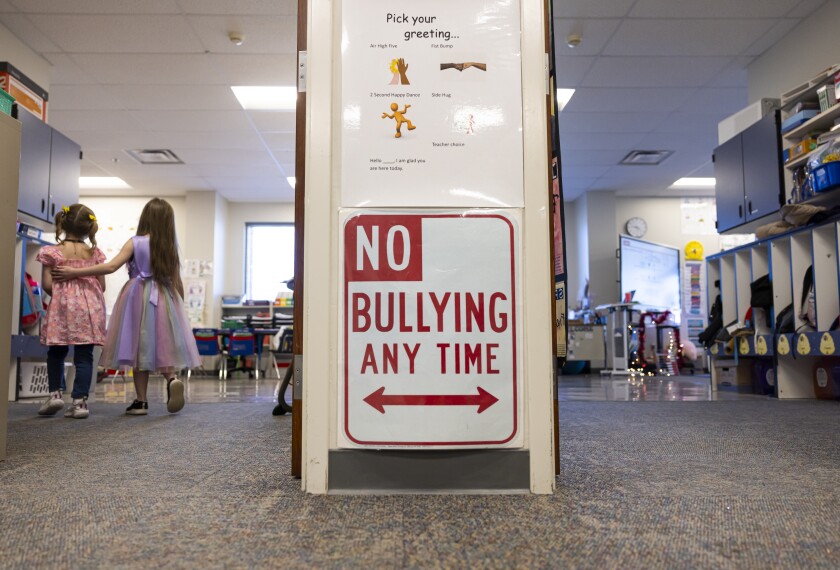
A sign discouraging bullying is seen as two students walk into a classroom at a school in Colorado Springs, Colo., on Feb. 12, 2026. Experts say creating a sense of belonging in school can help curb problems like bullying.
Kevin Mohatt for Education Week
Student Well-Being & Movement Opinion Why a Good School Needs Both Coaches and Referees
If teachers are forced into being referees, they can't fill that role properly or coach well, either.
6 min read
The United States Capitol building as a bookcase filled with red, white, and blue policy books in a Washington DC landscape.
Luca D'Urbino for Education Week
Student Well-Being & Movement Q&A Cellphones: The 'Most Formidable Adversary' Schools Have Ever Faced
The Spokane schools in Washington paired cellphone restrictions with expanded extracurricular activities.
5 min read
Students at Glover Middle School in Spokane, Wash. make bookmarks and snowflakes during Falcon Time on Dec. 3, 2025.
Students at Glover Middle School in Spokane, Wash. make bookmarks and snowflakes during Falcon Time on Dec. 3, 2025. The district has sought to encourage students to spend less time on devices.
Kaylee Domzalski/Education Week
