The “My Name, My Identity” initiative is a collaboration between the Santa Clara County Office of Education (SCCOE) and the National Association for Bilingual Education (NABE). Dr. Yee Wan, Director of Multilingual Education Services for Santa Clara County Office of Education, had the idea for the campaign given her own personal experience of being called the wrong name. She explains the ties between one’s name and one’s identity.
What’s in a name?
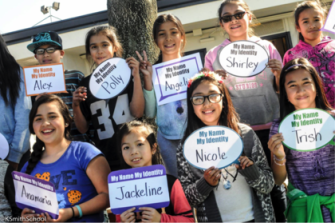
As children we learn to identify people and objects by their name; young children are immediately encouraged to learn the correct names for objects. Our name has great importance; it is what introduces us to the world. It is how we navigate through the world. And there is much we can do in a local context to support this idea.
Reports like The name-pronunciation effect: Why people like Mr. Smith more than Mr. Colquhoun questions whether people with easy-to-pronounce names are often raised higher in personal estimation because their names are easier to pronounce. While “impression formation depends on a variety of cues,” including ethnicity and gender, the study removed those variables to demonstrate the “potency of processing ease in impression formation” and its effect on “how we evaluate others”. The study suggests that snap judgments are made based on how well we recognize and pronounce someone’s name.
However, this should not be the case—we can all learn to say a person’s name correctly if we take the time. Consider the alternative: What does it say when people do not bother to learn our correct name? That is the question that sparked the “My Name, My Identity” initiative.
To Know My Name is to Know Me
When I moved from Mainland China to the United States as an international student at 17, I immediately enrolled in an English as a second language (ESL) course. Shortly after starting the course, my teacher elected to call me “Winnie” instead of “Yee,” and the name caught on with my classmates.
I really did not have the courage to tell her, “I’m not Winnie. Can you call me Yee?” I respected her so much that I just didn’t feel that it was the right thing for me to do.
But at the same time, I felt as though she had not taken the time to get to know me. Because my name is Yee. It means friendship in Chinese.
I was born in mainland China, and my name was given to me by my parents. My name connects me to my family members who live outside of the United States. I visit them every year. Losing my name means losing connection to some of my close family who I care deeply about and my identity because I communicate with them in Chinese.
Take the Time to Know Your Students
While it may seem a little thing to some, mispronouncing a student’s name does have an impact on their identity. By mispronouncing a name, it may indicate you are not taking the time to get to know that individual. What does this tell them? What effect might this have on academic progress? How does this impact their sense of belonging at school?
The goal of the “My Name, My Identity” initiative, is to build a more inclusive, respectful culture by asking educators and community members to make a pledge honoring students, neighbors, and co-workers identities by promising to learn how to pronounce their names correctly.
In the context of global education, we talk about how important it is for students to feel proud of who they are and to have the ability to connect with people from different languages and backgrounds locally, and also around the world. Names may have deep and important ties to both family history and culture, and making the extra effort to use a person’s preferred name and pronounce it correctly is a small step that can create a big impact.
Everyone has the right to be acknowledged as an individual. Everyone has a right to be called by the name that represents their identity. Together we can build a respectful and caring culture in school communities that value diversity.
Visit mynamemyidentity.org make a pledge, and share your name story or that of your children on the “My Name, My Identity” Facebook page, or by following @mynamemyid_ and using the hashtag #mynamemyid on Twitter.
Image courtesy of the author.

