Opinion
School & District Management Opinion

When Teachers Burn Out, We Burn Out: A Principal’s Strategy for Staff Morale

By anticipating dips in teacher morale, we can plan timely interventions
By S. Kambar Khoshaba — August 13, 2024 2 min read
Human crowd surrounding a giant protective umbrella on blue background.
  • Save to favorites
  • Print

Principals truly care about their staff. We really do. That is why so many of us regularly read about best practices and strategies that will help maintain a positive morale among staff members. Since weathering the pandemic storm, teacher morale seems to have sunk to unprecedented depths.

Much like teachers reflect the morale of students or parents worry about their saddest child, principals empathize with the staff they supervise and can begin to experience similar feelings. When teachers burn out, principals burn out, too.

How do we establish and maintain a sustained positive morale throughout the year? We know there will be dips into the valley of low morale from time to time, but how do we lessen the depth of those valleys and establish longer periods of positivity?

About This Series

In this biweekly column, principals and other authorities on school leadership—including researchers, education professors, district administrators, and assistant principals—offer timely and timeless advice for their peers.

One theory I have is that if you can predict a trend, then you can influence it. It is similar to when you know there is a certain time of the day when you need to eat or you’ll not feel well. My staff knows that I usually eat lunch at 11:30 a.m. On days when I have meetings at that time, I prepare a snack to avoid being “h-angry” around noon.

The same thing holds true with staff morale. Last year, we surveyed my staff to determine the ebbs and flow of morale: Which months were typically highest? Which months were typically lowest? November and March peaked as our two worst months for burnout.

To prepare for that inevitability, this year, we are planning teacher-recognition days on Fridays during those months to establish a burnout-resistant work setting. Ideas that we typically save for Teacher Appreciation Week—written cards of appreciation from students, treats, and time off from meetings—will now be spread out when morale needs a bump.

Some of our staff members have a hard time getting excited about a new school year. To address this, we are planning a first-day pep rally to get both students and staff revved up with school spirit. Seeing our students happy and excited fills our faculty’s emotional tanks.

This year, one of our main pillars is to focus on creating a sense of belonging for both staff and students. One strategy is to celebrate their contributions to our school community more frequently. We will do this with our new “Stallion Inspiration” awards, which allow staff members to nominate students who have either overcome a significant adversity or displayed exceptional character. After selecting the top five names from the nominated list, we will share their stories at a faculty meeting. In addition, students will then have the opportunity to recognize the teacher who has inspired them at our school.

We don’t have to wait for Teacher Appreciation Week to celebrate our staff. Some strategies might be big or formal, while others might involve less planning. The little things add up: Helping teachers build self-efficacy is important, and it goes a long way toward improving staff morale.

The point is that bad morale is like a disease. We do not want to numb it for a temporary relief. We need to get to the heart of the issue and cure it.

The mission to improve the morale of teachers can be frustrating because our staffs are a diverse collection of individuals, and the ways to improve their morale are equally diverse. I encourage you to stay the course by highlighting your staff in unique and genuine ways. If we don’t do this for them, then teachers may not have the same motivation or skills to pass it along to students.

A version of this article appeared in the August 28, 2024 edition of Education Week as When Teachers Burn Out, We Burn Out: A Principal’s Strategy for Staff Morale

Events

Student Well-Being & Movement K-12 Essentials Forum How Schools Are Teaching Students Life Skills
Join this free virtual event to explore creative ways schools have found to seamlessly integrate teaching life skills into the school day.
This content is provided by our sponsor. It is not written by and does not necessarily reflect the views of Education Week's editorial staff.
Sponsor
Special Education Webinar
Bridging the Math Gap: What’s New in Dyscalculia Identification, Instruction & State Action
Discover the latest dyscalculia research insights, state-level policy trends, and classroom strategies to make math more accessible for all.
Content provided by TouchMath
This content is provided by our sponsor. It is not written by and does not necessarily reflect the views of Education Week's editorial staff.
Sponsor
School & District Management Webinar
Too Many Initiatives, Not Enough Alignment: A Change Management Playbook for Leaders
Learn how leadership teams can increase alignment and evaluate every program, practice, and purchase against a clear strategic plan.
Content provided by Otus

EdWeek Top School Jobs

Teacher Jobs
Search over ten thousand teaching jobs nationwide — elementary, middle, high school and more.
View Jobs
Principal Jobs
Find hundreds of jobs for principals, assistant principals, and other school leadership roles.
View Jobs
Administrator Jobs
Over a thousand district-level jobs: superintendents, directors, more.
View Jobs
Support Staff Jobs
Search thousands of jobs, from paraprofessionals to counselors and more.
View Jobs

Read Next

School & District Management Opinion Why Bad Bunny’s Half-Time Performance Was a Case Study for School Leadership
The megastar’s show was an invitation in a challenging moment. Did you catch it?
3 min read
A group of diverse educators have a discussion around a large apple shaped table. A large hand holds the apple steady and word bubbles fill the background.
Kotryna Zukauskaite for Education Week
School & District Management Texas Leader Named Superintendent of the Year
The 2026 superintendent of the year has led his district through rapid growth amid a local housing boom.
2 min read
Superintendent Roosevelt Nivens speaks after being announced as AASA National Superintendent of the Year in Nashville, Tenn. on Feb. 12, 2026.
Superintendent Roosevelt Nivens of the Lamar Consolidated schools in Texas speaks after being named National Superintendent of the Year in Nashville, Tenn. on Feb. 12, 2026, at the National Conference on Education sponsored by AASA, The School Superintendents Association.
Kaylee Domzalski/Education Week
School & District Management On Capitol Hill, Relieved Principals Press for Even More Federal Support
With the fiscal 2026 budget maintaining level K-12 funding, principals look to the future.
7 min read
In this image provided by NAESP, elementary school principals gathered on Capitol Hill recently to meet with their state's congressional delegations in Washington
Elementary school principals gathered on Capitol Hill on Feb. 11, 2026,<ins data-user-label="Madeline Will" data-time="02/12/2026 11:53:27 AM" data-user-id="00000175-2522-d295-a175-a7366b840000" data-target-id=""> </ins>to meet with their state's congressional delegations in Washington. They advocated for lawmakers to protect federal K-12 investments.
John Simms/NAESP
School & District Management Q&A Solving Chronic Absenteeism Isn't 'One-Size-Fits-All,' This Leader Says
Proactive, sensitive communication with families can make a big difference.
7 min read
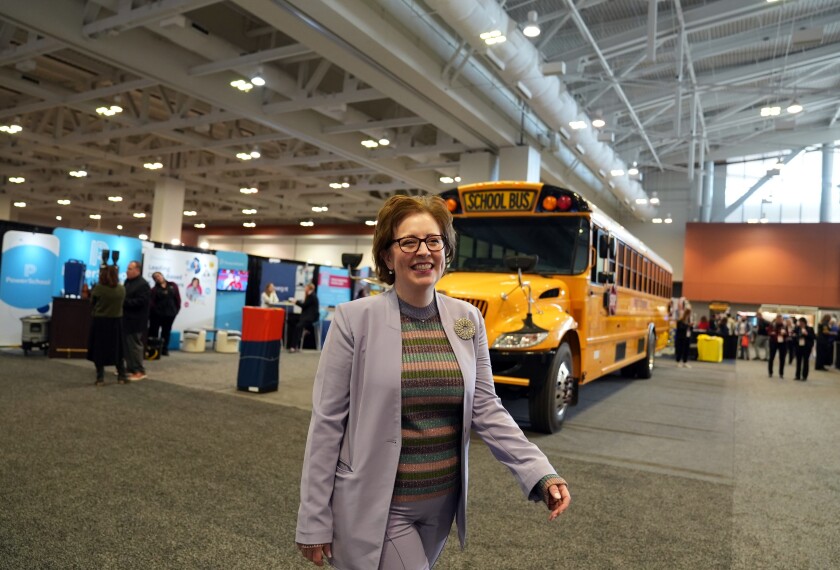
Superintendent Mary Catherine Reljac walks around the exhibition hall of the National Conference on Education in Nashville, on Feb. 12, 2026. Reljac is the superintendent for Fox Chapel Area School District in Pennsylvania.
Mary Catherine Reljac walks around the exhibition hall of the National Conference on Education in Nashville on Feb. 12, 2026. Reljac, the superintendent for Fox Chapel Area school district in Pennsylvania, is working to combat chronic absenteeism through data analysis and tailored student support.
Kaylee Domzalski/Education Week