Opinion
School & District Management Opinion

Zero Due at Signing: How to Improve Education on the Cheap

By Matt Warner — May 20, 2008 3 min read
  • Save to favorites
  • Print

The marketing slogan “zero due at signing” is often used to entice cash-poor buyers who are eager to purchase a big-ticket item, like a new car, without many upfront costs. Of course, the consumer will eventually pay in one way or another. With state budget-shortfall estimates totaling nearly $39 billion this year, many state lawmakers can probably sympathize with cash-poor buyers. In a climate of belt-tightening, shiny new state-sponsored programs may never leave the showroom.

This will likely leave traditional advocates of education reform feeling frustrated. Over the past two decades, improving education usually meant big dollar signs. Rolls-Royce reforms like class-size reduction and prekindergarten initiatives have cruised through legislatures with the promise of improving student outcomes. But given current budget constraints, would-be champions of such popular reforms will have to park their plans or find some way to defer the costs.

There is an upside to a slowdown in these pricey programs. States will at least be able to avoid the buyers’ remorse they must feel after spending billions in the past two decades on ineffective education initiatives. The American Legislative Exchange Council’s 14th annual “Report Card on American Education” high-beams these state efforts to buy their way out of K-12 underperformance. The report shows how state spending on education has increased 54 percent in constant dollars since the mid-1980s. The result of this investment is an overall class-size reduction of 15 percent, but little change in achievement outcomes. A whopping 71 percent of public school 8th graders are still performing below proficiency in reading, and 69 percent are performing below proficiency in math, according to the 2007 National Assessment of Educational Progress.

Reforms like school choice improve educational outcomes without breaking the bank.

Fortunately, there’s a better way to reform education. Buy a Honda, or at least the education reform equivalent of a Honda—school choice. Reforms like school choice improve educational outcomes without breaking the bank. Choice programs are designed to redirect existing expenditures to schools of parents’ choosing, public or private, so they cost little or nothing to operate and save millions of dollars in the long run. One reason for the savings is that many programs only allow parents to redirect a portion of what state and local governments are currently spending on the student. Others set the maximum at current expenditures or the cost of private school tuition, whichever is less. Every time the tuition is less, that’s a cost savings to state and local governments. Since the early 1990s, school choice programs have saved close to half a billion dollars for the state and local governments that administer them.

Florida’s school choice program for special-needs students, for example, has saved government $139 million since 1999, when it began. Moreover, parents involved with the program report a 93 percent rate of satisfaction with their new schools, compared with 33 percent satisfaction for public schools. But parent satisfaction isn’t the only encouraging result of school choice programs. Research suggests that kids get better test scores, attend more-integrated schools, and report less bullying. Such results are driving more states toward adopting new programs. Georgia’s legislature, after passing a special-needs program in 2007, has returned this year to adopt a program that encourages corporations to support kids in need of better school choices. A review of the law reveals a projected government savings of $6,600 per participating student. It’s a win-win for Georgia’s kids and taxpayers. Without the luxury of budget surpluses this year, states ought to take school choice for a test drive.

Events

This content is provided by our sponsor. It is not written by and does not necessarily reflect the views of Education Week's editorial staff.
Sponsor
College & Workforce Readiness Webinar
Smarter Tools, Stronger Outcomes: Empowering CTE Educators With Future-Ready Solutions
Open doors to meaningful, hands-on careers with research-backed insights, ideas, and examples of successful CTE programs.
Content provided by Pearson
This content is provided by our sponsor. It is not written by and does not necessarily reflect the views of Education Week's editorial staff.
Sponsor
Professional Development Webinar
Recalibrating PLCs for Student Growth in the New Year
Get advice from K-12 leaders on resetting your PLCs for spring by utilizing winter assessment data and aligning PLC work with MTSS cycles.
Content provided by Otus
School Climate & Safety Webinar Strategies for Improving School Climate and Safety
Discover strategies that K-12 districts have utilized inside and outside the classroom to establish a positive school climate.

EdWeek Top School Jobs

Teacher Jobs
Search over ten thousand teaching jobs nationwide — elementary, middle, high school and more.
View Jobs
Principal Jobs
Find hundreds of jobs for principals, assistant principals, and other school leadership roles.
View Jobs
Administrator Jobs
Over a thousand district-level jobs: superintendents, directors, more.
View Jobs
Support Staff Jobs
Search thousands of jobs, from paraprofessionals to counselors and more.
View Jobs

Read Next

School & District Management Former Iowa Superintendent Pleads Guilty to Falsely Claiming U.S. Citizenship
The former Des Moines superintendent admitted to falsely claiming to be a U.S. citizen on a federal form and illegally possessing firearms.
4 min read
Ian Roberts, superintendent of Des Moines Public Schools, delivers an annual address at North High School in Des Moines, Iowa, Feb. 11, 2025.
Jon Lemons/Des Moines Public Schools via AP
School & District Management A Cold Front Is Sweeping the Country. Can Schools' Heating Keep Up?
A spate of frigid temperatures across much of the country will present a test for schools' aging heating systems.
5 min read
20260122 AMX US NEWS CPS CANCELS CLASS FRIDAY DUE 1 TB
A crossing guard assists students as they arrive for classes at Chalmers STEAM Elementary school on Jan. 22, 2026, in Chicago. Extreme cold hitting much of the United States in the coming days could test schools' aging infrastructure and force school closures. Chicago Public Schools called off classes for Friday, Jan. 23.
Antonio Perez/ Chicago Tribune
School & District Management How Principals Are Coaching the Next Generation of School Leaders
Mentors give aspiring school leaders an unvarnished view of the principalship.
6 min read
Photo of school officials having conversation.
iStock
School & District Management How 4 Superintendents Are Bracing for Federal Funding Uncertainty Under Trump
Superintendent of the Year finalists discussed how they're preparing for potential cuts.
3 min read
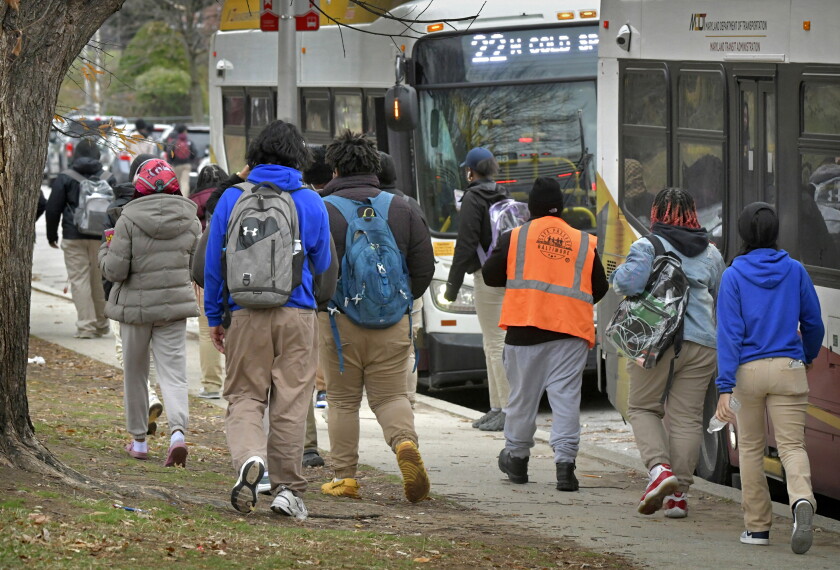
Students at Merganthaler Vocational-Technical High School board MTA buses at the end of the school day on Dec. 13, 2024 , in Baltimore. federally funded programs allows students to access resources they might otherwise not get—like tutoring and after-school programs, according to Baltimore Superintendent Sonja Santelises.
Students at Merganthaler Vocational-Technical High School board buses at the end of the school day on Dec. 13, 2024 , in Baltimore. Federally funded programs in the city's schools allow students access to services they might otherwise not get, such as tutoring and after-school programs, Baltimore Superintendent Sonja Santelises said at a recent panel discussion of the finalists for AASA's Superintendent of the Year award.
Amy Davis/Baltimore Sun/TNS