School & District Management

Study Finds U.S. Losing Its Postsecondary Edge

By Sarah D. Sparks — September 20, 2011 2 min read
  • Save to favorites
  • Print

The United States still leads the world in having a college-educated workforce, but it is the only country among the world’s leading economies whose incoming workers are less educated than those retiring, according to a new study by the Organization for Economic Cooperation and Development.

Released last week, the OECD’s “Education at a Glance 2011” report compares education systems in the Group of Twenty, or G-20, economies, which include 19 countries and the European Union.

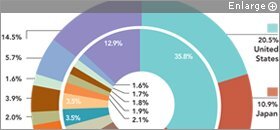
It finds that in 2009, Americans accounted for more than one in every four of the 225 million people with postsecondary degrees in the G-20 countries. But a closer look at the statistics reveals a deep generational divide among degree-holders: Americans make up more than a third of all postsecondary degree holders, ages 55 to 64, but only one-fifth of those ages 25 to 34.

“It’s not that the United States is doing worse; it’s that other countries are starting to do what the United States has been doing for a very long time,” said Andreas Schleicher, who heads the indicators and analysis division at the OECD’s Directorate for Education, in a briefing on the report. “There’s been a quite dramatic expansion of the pool of qualified people.”

A Piece of the Pie

Among the world’s leading economies, the United States accounts for 35.8 percent of all postsecondary degreeholders between the ages of 55 and 64 (inner ring). Among 25-to-34-year-old postsecondary degree-holders, the U.S. share accounts for 20.5% (outer ring).
BRIC ARCHIVE

SOURCE: Organization for Economic Cooperation and Development

China, in particular, has been gaining ground in education. Chinese between 25 and 34 held nearly triple the global share of postsecondary degrees, 18.3 percent, compared to its older workers, who represent only 6.9 percent of postsecondary degrees in their age group.

China on the Rise

Moreover, China’s educational edge is likely to grow. In 2009 China had 36.6 percent of the world’s students entering college, compared with the United States’ 12.9 percent share, and China accounted for 42.6 percent of the world’s students graduating high school, compared with 9.9 percent for American students.

Because of its well-educated older workers, the United States still ranks in the top five most-educated countries among the G-20, but it drops to 15th among those ages 25 to 34—a decline that could deeply affect the nation’s economic well-being, as prior research shows education has a greater effect on a person’s earnings than factors such as race or gender.

Educational attainment can play a role in a country’s politics and social fabric, too. The OECD study also found that 14-year-olds who scored higher on the International Civic and Citizenship Education Study were more likely to vote and to favor gender equality than those with lower civics education.

Mr. Schleicher said higher education in the United States is more expensive than that in other countries, and U.S. students feel a greater sense of risk in taking on student loans.

He added, however: “Tuition that U.S. students pay is still low in comparison to the benefits that you get.” After accounting for gender, age and income, adults with higher education reported they were “more satisfied with life, engaged in society and likely to report that they are in good health.”

Related Tags:

A version of this article appeared in the September 21, 2011 edition of Education Week as U.S. Educational Edge Seen to Be Shrinking

Events

This content is provided by our sponsor. It is not written by and does not necessarily reflect the views of Education Week's editorial staff.
Sponsor
College & Workforce Readiness Webinar
Smarter Tools, Stronger Outcomes: Empowering CTE Educators With Future-Ready Solutions
Open doors to meaningful, hands-on careers with research-backed insights, ideas, and examples of successful CTE programs.
Content provided by Pearson
This content is provided by our sponsor. It is not written by and does not necessarily reflect the views of Education Week's editorial staff.
Sponsor
Professional Development Webinar
Recalibrating PLCs for Student Growth in the New Year
Get advice from K-12 leaders on resetting your PLCs for spring by utilizing winter assessment data and aligning PLC work with MTSS cycles.
Content provided by Otus
School Climate & Safety Webinar Strategies for Improving School Climate and Safety
Discover strategies that K-12 districts have utilized inside and outside the classroom to establish a positive school climate.

EdWeek Top School Jobs

Teacher Jobs
Search over ten thousand teaching jobs nationwide — elementary, middle, high school and more.
View Jobs
Principal Jobs
Find hundreds of jobs for principals, assistant principals, and other school leadership roles.
View Jobs
Administrator Jobs
Over a thousand district-level jobs: superintendents, directors, more.
View Jobs
Support Staff Jobs
Search thousands of jobs, from paraprofessionals to counselors and more.
View Jobs

Read Next

School & District Management A Cold Front Is Sweeping the Country. Can Schools' Heating Keep Up?
A spate of frigid temperatures across much of the country will present a test for schools' aging heating systems.
5 min read
20260122 AMX US NEWS CPS CANCELS CLASS FRIDAY DUE 1 TB
A crossing guard assists students as they arrive for classes at Chalmers STEAM Elementary school on Jan. 22, 2026, in Chicago. Extreme cold hitting much of the United States in the coming days could test schools' aging infrastructure and force school closures. Chicago Public Schools called off classes for Friday, Jan. 23.
Antonio Perez/ Chicago Tribune
School & District Management How Principals Are Coaching the Next Generation of School Leaders
Mentors give aspiring school leaders an unvarnished view of the principalship.
6 min read
Photo of school officials having conversation.
iStock
School & District Management How 4 Superintendents Are Bracing for Federal Funding Uncertainty Under Trump
Superintendent of the Year finalists discussed how they're preparing for potential cuts.
3 min read
Students at Merganthaler Vocational-Technical High School board MTA buses at the end of the school day on Dec. 13, 2024 , in Baltimore. federally funded programs allows students to access resources they might otherwise not get—like tutoring and after-school programs, according to Baltimore Superintendent Sonja Santelises.
Students at Merganthaler Vocational-Technical High School board buses at the end of the school day on Dec. 13, 2024 , in Baltimore. Federally funded programs in the city's schools allow students access to services they might otherwise not get, such as tutoring and after-school programs, Baltimore Superintendent Sonja Santelises said at a recent panel discussion of the finalists for AASA's Superintendent of the Year award.
Amy Davis/Baltimore Sun/TNS
School & District Management Q&A Why This Leader Is Willing to Risk Losing His Job to Support Immigrant Students
This small Vermont district defies backlash to support immigrant families.
6 min read
A Somali flag, right, flies alongside the United States and Vermont flags outside the Winooski School District building, Wednesday, Dec. 10, 2025, in Winooski, Vt.
A Somali flag, right, flies alongside the United States and Vermont flags outside the Winooski School District building, Wednesday, Dec. 10, 2025, in Winooski, Vt. The district's effort to show support for Somali students drew intense backlash.
Amanda Swinhart/AP