Student Achievement

The Pandemic Was a ‘Wrecking Ball’ for K-12, and We’re Still Tallying the Damage

By Arianna Prothero — September 13, 2022 3 min read
Image of the concept of domino effect.
  • Save to favorites
  • Print

The pandemic was a disaster for K-12 schools on almost all fronts, from academics to mental health to special education services. That is what we do know.

But the extent of the damage is still coming into focus, and big gaps remain in our understanding of the full effect the pandemic has had on public education, concludes a new report from the Center on Reinventing Public Education.

What we do know, the report says, is sobering:

  • Students’ mental health and well-being suffered considerably, as rates of anxiety and depression rose among children and adolescents;
  • There was a 51 percent rate of increase over one year in suspected suicide attempts among girls ages 12 to 17;
  • One in 360 children have lost a parent or caregiver to COVID-19;
  • Students lost the equivalent of several months’ worth of learning in reading and math;
  • Income-based gaps in elementary math achievement grew by 20 percent;
  • and students with disabilities were cut off from crucial services for extended periods of time.

Those and other problems combined to create a “wrecking ball” that hit U.S. public education hard, the report says.
See Also

Tight crop of a student holding a pencil doing classwork or taking a test.
iStock/Getty Images Plus

The pandemic was much harder on some groups of students than others, with Black, Hispanic, and low-income students disproportionately affected. In schools where classes were fully remote during the 2020-21 school year, students in high poverty schools lost the equivalent of 22 weeks of instruction compared with 13 weeks in high-income schools. Black and Hispanic children, as well as those from other racial and ethnic minority groups were far more likely to lose a caregiver to COVID-19 than white children.

These issues are the result of an inequitable and inflexible system where adults were prioritized over children, and politics and fear drove the responses to the pandemic, the report says. Many students were given subpar learning options and families were cut off from crucial support.

The report, which the CRPE says is its inaugural State of the American Student report, is the culmination of data the group collected from a smorgasbord of reputable sources and synthesized over the course of the pandemic. CRPE plans to publish this report annually through 2027.

“The averages mask dire inequities and widely varied impact,” the report says. “Some students are catching up, but time is running out for others.”

And circumstances could be significantly worse than the data currently suggest. The report says the data may underestimate the inequitable impacts of the pandemic or even the long-term effects it will have on students.

The report warns: “[T]here are significant holes in our understanding of how the pandemic has affected various groups of students, especially those who are typically most likely to fall through the cracks in the American education system.”

For example, there’s limited data on how the pandemic affected certain groups of students, such as those with disabilities and English language learners. The report also notes that there is very little data on academic performance in certain subjects, such as science, civics, and foreign languages.

Overall, the report concludes the pace of recovery is not adequate. At its current speed, students of all races and income levels will graduate high school in the coming years ill prepared for college and careers.

Some key recommendations from the report include:

  • Spend money now. School districts and states should use federal COVID-relief funds on proven interventions such as well-designed tutoring and extra mental health support.
  • Create a system of accountability. States and school districts should promise to outline their academic recovery efforts and establish a timeline for reporting on their progress toward 5- and 10-year goals.
  • Research best practices. Education leaders and researchers must adopt a nationwide plan for research and development for the next five years.
  • Build more resilient school systems. Schools should continue to investigate and invest in promising practices so they are prepared to deliver quality education to students whatever the next crisis may be.
A version of this article appeared in the September 28, 2022 edition of Education Week as The Pandemic Was a ‘Wrecking Ball’ for K-12, And We’re Still Tallying the Damage

Events

This content is provided by our sponsor. It is not written by and does not necessarily reflect the views of Education Week's editorial staff.
Sponsor
Artificial Intelligence Webinar
AI in Schools: What 1,000 Districts Reveal About Readiness and Risk
Move beyond “ban vs. embrace” with real-world AI data and practical guidance for a balanced, responsible district policy.
Content provided by Securly
This content is provided by our sponsor. It is not written by and does not necessarily reflect the views of Education Week's editorial staff.
Sponsor
Recruitment & Retention Webinar
K-12 Lens 2026: What New Staffing Data Reveals About District Operations
Explore national survey findings and hear how districts are navigating staffing changes that affect daily operations, workload, and planning.
Content provided by Frontline Education
Education Funding Webinar Congress Approved Next Year’s Federal School Funding. What’s Next?
Congress passed the budget, but uncertainty remains. Experts explain what districts should expect from federal education policy next.

EdWeek Top School Jobs

Teacher Jobs
Search over ten thousand teaching jobs nationwide — elementary, middle, high school and more.
View Jobs
Principal Jobs
Find hundreds of jobs for principals, assistant principals, and other school leadership roles.
View Jobs
Administrator Jobs
Over a thousand district-level jobs: superintendents, directors, more.
View Jobs
Support Staff Jobs
Search thousands of jobs, from paraprofessionals to counselors and more.
View Jobs

Read Next

Student Achievement These Districts Turned Summer School Into an Inviting Destination for Students
Community partnerships helped with scheduling challenges. Themed programs heightened student interest.
6 min read
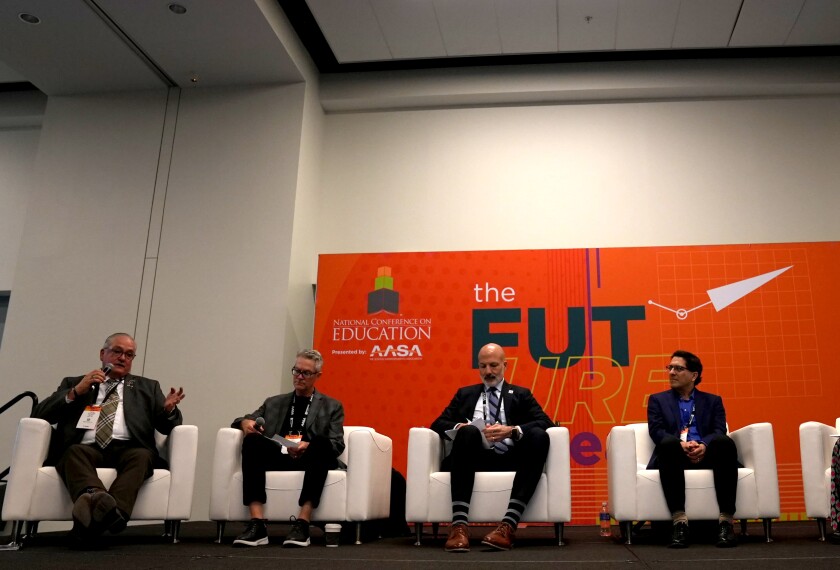
Panelists from left: Carlos Gonzalez, superintendent of the Roma Independent district in Texas; John Skretta, superintendent of Lincoln, Neb., schools; Joe Gothard, superintendent of Madison, Wis., schools; Ben Master, a senior policy researcher at the RAND Corp. speak on summer learning and student success at the National Conference on Education in Nashville, Tenn. on Feb. 13, 2026.
School superintendents, from left, Carlos Gonzalez, of Roma Independent in Texas; John Skretta, of Lincoln, Neb., and Joe Gothard, of Madison, Wis., along with Ben Master, a senior policy researcher at the RAND Corp., discuss summer learning and student success at the National Conference on Education in Nashville, Tenn., on Feb. 13, 2026.
Kaylee Domzalski/Education Week
Student Achievement The Case for Reading Tutoring Before 3rd Grade, Not After
New research suggests virtual tutoring can boost literacy learning before kids begin to struggle.
6 min read
First-graders in Chelsea, Mass. public schools meet with virtual tutors from Ignite Reading in 2025 as part of a study of the program.
First graders in Kelly Elementary School in Chelsea, Mass. meet with virtual tutors from Ignite Reading in 2025 as part of a study of the program. The Chelsea district is now targeting 1st graders for tutoring to make sure all of them meet reading benchmarks by the end of the year.
Courtesy of Chelsea Public Schools
Student Achievement Spotlight Spotlight on Prevention Over Remediation: The Role of Strong Tier 1 Instruction in MTSS
This Spotlight highlights how effective Tier 1 instruction in grades K–5 can improve literacy and math outcomes.
Student Achievement Opinion When Parents Question Grades, They Aren't Asking About Rigor
Clear expectations matter more to parents than complexity when it comes to student grades.
Thomas R. Guskey
5 min read
Screen Shot 2026 01 17 at 7.17.48 AM
Canva
