Special Report
Student Well-Being & Movement

Video Game ‘Stealth Assessments’ Gauge Social Skills

By Benjamin Herold — June 02, 2014 2 min read
BRIC ARCHIVE
  • Save to favorites
  • Print

When it comes to measuring social and emotional skills such as persistence, traditional assessments are often “too simplified, abstract, and decontextualized,” according to Valerie J. Shute, a professor in the educational psychology and learning systems department at Florida State University in Tallahassee.

That’s why Ms. Shute promotes the idea of “stealth assessments” that are unobtrusively woven into the fabric of video games in order to measure in real time how players are progressing toward a variety of targets—not just for content learning, but also for checking progress on so-called 21st century skills.

“There’s no better system than games to provide challenging problems without completely overwhelming people,” Ms. Shute wrote in an email. “Stealth assessment considers [the] process of failing and trying again as a source of evidence for persistence.”

Here’s how the process is intended to work: First, a game will track in real time how long a player spends on a difficult problem or how often a player is willing to retry a problem at which he or she has previously failed. Based on that information, the game can then offer encouragement or adjust the types of problems presented to that player, seeking to find the sweet spot that will be challenging enough to promote learning but not so difficult as to discourage continued effort.

The result, Ms. Shute and others believe, will be digital games that can not only measure qualities like persistence, or grit, but actually nurture them.

The first round of such games have already been developed, including Newton’s Playground, a digital game created by Ms. Shute with support from the Seattle-based Bill & Melinda Gates Foundation.

Newton’s Playground aims to improve high school students’ conceptual understanding of everyday physics—and to help bolster their conscientiousness, a long set of factors that includes persistence and creativity. A recent research study published by Ms. Shute found solid evidence in support of the first goal. Her team also found evidence that the measures of persistence woven into Newton’s Playground were valid when measured against traditional indicators.

Gauging Tenacity

Another video game example is Tenacity, which was developed by the Games+Learning+Society center at the University of Wisconsin-Madison. That game aims to help students regulate their attention and awareness by monitoring their own breathing. Researchers say that skill is a key building block of learning.

There are barriers to using games to assess social and emotional skills: For one, the games themselves are expensive to build, at least if they’re meant to be engaging to the typical teenager. There are also questions about traditional psychometric concerns: How do educators know if developers’ claims about what their games can assess are in fact true? And perhaps most significantly, said Kurt Squire, an associate professor at UW-Madison and the director of Games+Learning+Society, questions remain about the extent to which the type of persistence shown in a video game is relevant in the real world.

“Grit seems to me to be an interaction between a person, a context, and a particular task,” Mr. Squire wrote in an email. “There may be limits in how well a game can measure or foster a ‘generalized grit'—although there may also be a very clever or brilliant game designer who can do just that.”
Coverage of school climate and student behavior and engagement is supported in part by grants from the Atlantic Philanthropies, the NoVo Foundation, the Raikes Foundation, and the California Endowment. Education Week retains sole editorial control over the content of this coverage.

Events

This content is provided by our sponsor. It is not written by and does not necessarily reflect the views of Education Week's editorial staff.
Sponsor
School & District Management Webinar
Too Many Initiatives, Not Enough Alignment: A Change Management Playbook for Leaders
Learn how leadership teams can increase alignment and evaluate every program, practice, and purchase against a clear strategic plan.
Content provided by Otus
This content is provided by our sponsor. It is not written by and does not necessarily reflect the views of Education Week's editorial staff.
Sponsor
Artificial Intelligence Webinar
Beyond Teacher Tools: Exploring AI for Student Success
Teacher AI tools only show assigned work. See how TrekAi's student-facing approach reveals authentic learning needs and drives real success.
Content provided by TrekAi
This content is provided by our sponsor. It is not written by and does not necessarily reflect the views of Education Week's editorial staff.
Sponsor
College & Workforce Readiness Webinar
Building for the Future: Igniting Middle Schoolers’ Interest in Skilled Trades & Future-Ready Skills
Ignite middle schoolers’ interest in skilled trades with hands-on learning and real-world projects that build future-ready skills.
Content provided by Project Lead The Way

EdWeek Top School Jobs

Teacher Jobs
Search over ten thousand teaching jobs nationwide — elementary, middle, high school and more.
View Jobs
Principal Jobs
Find hundreds of jobs for principals, assistant principals, and other school leadership roles.
View Jobs
Administrator Jobs
Over a thousand district-level jobs: superintendents, directors, more.
View Jobs
Support Staff Jobs
Search thousands of jobs, from paraprofessionals to counselors and more.
View Jobs

Read Next

Student Well-Being & Movement 3 Driving Questions to Create a Sense of Belonging in Schools
Students who feel they belong in their school are more likely to show up and learn.
5 min read
MVCS 1981
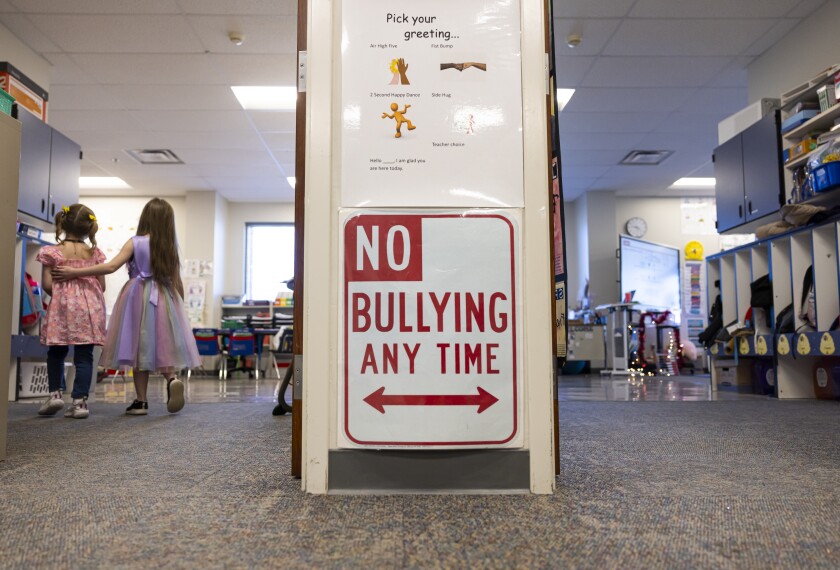
A sign discouraging bullying is seen as two students walk into a classroom at a school in Colorado Springs, Colo., on Feb. 12, 2026. Experts say creating a sense of belonging in school can help curb problems like bullying.
Kevin Mohatt for Education Week
Student Well-Being & Movement Opinion Why a Good School Needs Both Coaches and Referees
If teachers are forced into being referees, they can't fill that role properly or coach well, either.
6 min read
The United States Capitol building as a bookcase filled with red, white, and blue policy books in a Washington DC landscape.
Luca D'Urbino for Education Week
Student Well-Being & Movement Q&A Cellphones: The 'Most Formidable Adversary' Schools Have Ever Faced
The Spokane schools in Washington paired cellphone restrictions with expanded extracurricular activities.
5 min read
Students at Glover Middle School in Spokane, Wash. make bookmarks and snowflakes during Falcon Time on Dec. 3, 2025.
Students at Glover Middle School in Spokane, Wash. make bookmarks and snowflakes during Falcon Time on Dec. 3, 2025. The district has sought to encourage students to spend less time on devices.
Kaylee Domzalski/Education Week
Student Well-Being & Movement Want Kids to Have Better SEL Skills? Try Using Sports
In a panel discussion, district leaders and an expert discuss why sports is a great place to learn life skills.
3 min read
Students play basketball at Parkway Sports & Health Science Academy on Feb. 21, 2025 in La Mesa, Calif.
Students playing basketball at Parkway Sports & Health Science Academy on Feb. 21, 2025, in La Mesa, Calif. Some schools are using sports as a way to help students develop social-emotional skills.
Ariana Drehsler for Education Week
