
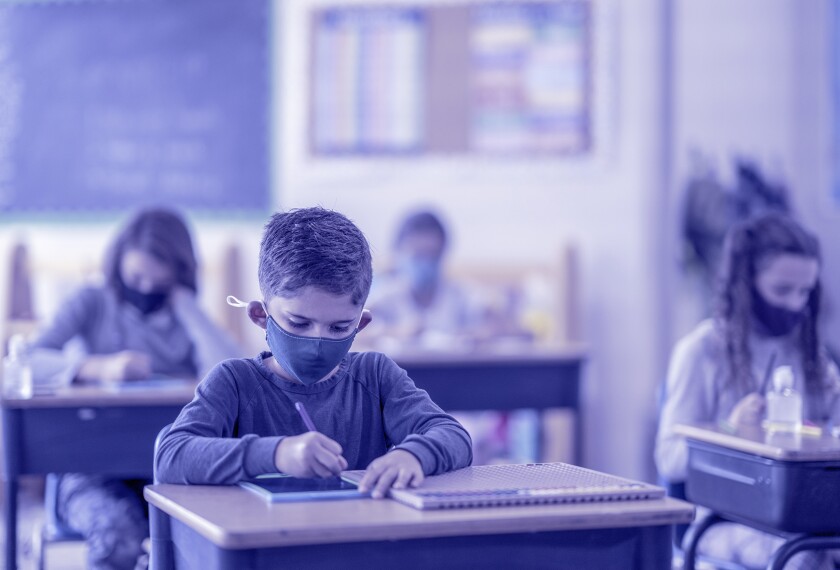
There’s more than one way to bring students back to class, but it’s not yet clear which models for in-person instruction can keep students and staff safest.
As of February, 43 percent of students had returned to full-time in-person learning and another 26 percent were using a hybrid remote schedule, according to a new analysis by a coalition including the COVID Collaborative and the Evidence Project at the Center on Reinventing Public Education. The report echoes evidence in the latest Centers for Disease Control and Prevention guidelines that suggests schools can operate safely with at least partial in-person instruction during the pandemic, provided they use mitigation measures such as sanitation, mask-wearing, and quarantining of students and staff who become infected with the coronavirus, which causes the potentially deadly respiratory illness COVID-19.
For in-person instruction, the CDC, World Health Organization, and others consider the lowest-risk models to use small cohorts of students (generally 10 or fewer) taught in small, physically distanced classes and kept in alternating or staggered schedules to avoid groups of students or teachers mixing during the day. Students and teachers do not share any materials, and any frequently touched surfaces are cleaned daily or between uses. School-based COVID-19 outbreaks often have occurred during schedule overlaps, such as when groups of children come together at lunch.
While this is the gold standard, most schools have neither the staff nor the space to maintain the lowest level of risk for in-person learning. In general, districts have opted for one of a handful of different models for hybrid in-person schedules, including:
- Split days, in which half of students attend in-person classes in the morning while the other half learn remotely. The groups switch during the lunch period, when classes are cleaned and disinfected.
- Shift schedules, in which cohorts of students are assigned to attend in-person classes on certain days of the week or alternating weeks, while other cohorts learn remotely.
- Teacher shifting, particularly in secondary schools where students previously would have switched classes, in which cohorts of students remain in a single class while teachers switch classrooms to provide instruction in core subject areas like math or reading. In these models, any electives become remote-only.

So far, U.S. and international studies have mostly lumped all kinds of hybrid schedules for remote and in-person instruction together under one category of hybrid instruction, making it difficult to tease out whether specific schedules are safer for particular communities or groups of students.
One study of school districts in Michigan and Washington released in February found that offering in-person or hybrid instruction didn’t significantly boost outbreaks when community infection rates were low or moderate. But the states defined those categories of instructional models broadly. In Michigan, for example, hybrid districts included mostly those that provided general education students with in-person instruction two to three days a week, or those that phased in in-person schooling forstudents with high-needs —including English-language learners and those receiving special education services. In-person districts had to offer general education students full-time, in-person class, but typically also had a portion of students who opted to use hybrid or remote instruction during the pandemic. Study co-author Dan Goldhaber of the University of Washington noted that the states did not record enough information on individual district reopening models to allow researchers to compare transmission rates by model.
“While it may be natural to assume that removing students from contexts in which they are in close quarters in school buildings will allow for greater social distancing and COVID mitigation practices, the counterfactual for students and school personnel who are not in public school buildings is not necessarily a safer environment,” Goldhaber and his colleagues noted. They pointed to parents’ use of so-called “learning pods” to support remote instruction in hybrid schedules, noting, “these pods may be in private homes or other contexts that do not require or allow for social distancing and mitigation strategies. Moreover, it is likely that individuals mix across and beyond their pods, as students in a pod then socialize with other children or family members outside of school hours.”
Similarly, Ibukun Akinboyo, the medical director for pediatric infection prevention at Duke University Hospital and co-author of a study of COVID-19 transmission in North Carolina schools, found that, among the districts that had in-person instruction, some used four-day schedules of in-person classes for all children, while others used cohorts of students that traded off each week. Akinboyo and her colleagues did not compare infection rates or outbreaks across different types of plans, only between districts that had some in-person instruction and those that had none, she said, “however, despite the variety in plans, transmission has been minimal in schools.”
“The overwhelming evidence suggests that schools can provide in-person education safely even in communities with high transmission rates,” Akinboyo said.
The newly released CRPE report found similar evidence from a series of studies of German schools, which found that when schools moved to full-time in-person instruction, community infection rates declined. Researchers say that’s in part because students were in a more contained and controlled setting.
However, epidemiologists such as William Hanage of Harvard’s T.H. Chan School of Public Health have voiced concern that alternating schedules expand the networks of people and places that students and teachers are exposed to, boosting the risks of exposure. For example, a full-day, in-person schedule could have more students in the same building, but students attending two days a week may also attend a child-care center or stay with other family during other days. If students in the full-time schedule are kept in small cohorts, they may be exposed to fewer new people overall over the course of a week than students attending more than one location.
Even districts that ask teachers to shift classes rather than students to limit contact can risk virus exposure if they do not properly train staff to implement the schedules safely. One CDC study released last month of coronavirus clusters in Georgia elementary schools found that adults were more likely to infect each other or children than children were to infect adults.
Bottom line, the study noted, districts must provide significantly more training and support for staff to implement social distancing and other protocols needed for new schedules and hybrid models.
As more districts return to in-person instruction, states and the federal government have started to take a closer look at how different kinds of hybrid scheduling models could safeguard against transmission and improve learning. In response to an executive order from President Joe Biden in January, the Education Department’s research arm, the Institute of Education Sciences is launching a detailed nationwide survey on the use and frequency of different in-person, hybrid, and remote instructional models across different schools and students


