Blog

Your Education Road Map

Politics K-12

Politics K-12 kept watch on education policy and politics in the nation’s capital and in the states. This blog is no longer being updated, but you can continue to explore these issues on edweek.org by visiting our related topic pages: Federal, States.

Federal

7 Takeaways for Educators From Biden’s State of the Union

By Evie Blad — March 02, 2022 3 min read
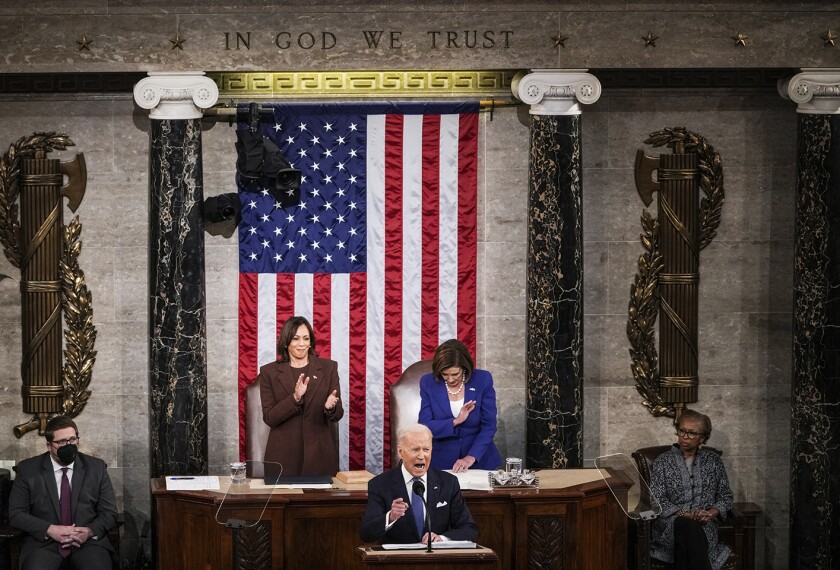
President Joe Biden delivers his first State of the Union address to a joint session of Congress at the Capitol, Tuesday, March 1, 2022, in Washington as Vice President Kamala Harris applauds and House speaker Nancy Pelosi of Calif., looks on.
  • Save to favorites
  • Print

President Joe Biden’s first State of the Union address mentioned students and schools alongside pressing national issues like COVID-19 recovery and foreign relations.

But maybe you’re a stressed out educator who was too busy to watch? We’ve got your back. Here’s a cheat sheet of K-12 education mentions in the address. Read complete coverage of the State of the Union here.

Mental health: Biden called for bipartisan action to respond to a national mental health crisis, paying particular attention to concerns about children and teens. He will propose $1 billion in new federal spending for school psychologists and counselors, and he wants to cut red tape to make it easier for schools to bill Medicaid for mental health services. “Let’s take on mental health,” Biden said. “Especially among our children, whose lives and education have been turned upside down.”

Tutoring and mentoring: In making the pitch that"we can all play a part in schools’ COVID-19 recovery,” Biden urged Americans to “sign up to be a tutor or a mentor.” His comments came as schools report staffing and volunteer shortages for things like after-school programs.

How parents can keep the pressure on: “The American Rescue Plan gave schools money to hire teachers and help students make up for lost learning,” Biden said. “I urge every parent to make sure your school does just that.” In a fact sheet, the administration said it would continue encouraging schools to spend relief funds on things like individual and small group instruction, more instructional staff, tutoring programs, and after-school and summer learning efforts. But some education advocates have lamented the lack of transparency in how schools spend $130 billion in aid provided through the American Rescue Plan. And organizations like the National Parents Union have urged families to speak up about how their schools use the funds.

COVID-19 and school closures: “Our schools are open,” Biden said. “Let’s keep it that way.” Republicans have raised school closures in midterm campaigns, and the Biden administration has stressed that schools have the tools they need to stay open, even if future variants emerge. Federal health officials gave schools in most of the country the green light to lift mask requirements in new guidance Friday.

Infrastructure: Biden touted measures in the $1.2 trillion bipartisan infrastructure bill he signed in November that will help expand broadband access and to close the “homework gap” for students without internet at home. The bill also provides some funding to replace major lead pipes that lead to schools.

Pre-K and college: Biden called for “pre-K for every 3- and 4-year-old,” a proposal that was part of his Build Back Better plan, which stalled in the Senate. It’s unclear how he may repackage some of those social spending priorities in another legislative push. He also called for expanding the maximum Pell grant for low-income students, a less- ambitious version of his previous proposal, which called for two years of free college for all Americans. And he made a pitch for increased support for historically Black colleges and universities.

Transgender students: Biden had a message for transgender young people: I will always have your back as your president, so you can be yourself and reach your God-given potential.” His administration has asserted that transgender student rights are protected under Title IX, but some advocates have called for more-aggressive action as states like Florida consider bills to limit discussion of gender identity in schools and as Texas moves to investigate gender-affirming care as child abuse.

Related Tags:

A version of this news article first appeared in the Politics K-12 blog.

Events

This content is provided by our sponsor. It is not written by and does not necessarily reflect the views of Education Week's editorial staff.
Sponsor
Artificial Intelligence Webinar
Managing AI in Schools: Practical Strategies for Districts
How should districts govern AI in schools? Learn practical strategies for policies, safety, transparency, and responsible adoption.
Content provided by Lightspeed Systems
This content is provided by our sponsor. It is not written by and does not necessarily reflect the views of Education Week's editorial staff.
Sponsor
Student Absenteeism Webinar
Removing Transportation and Attendance Barriers for Homeless Youth
Join us to see how districts around the country are supporting vulnerable students, including those covered under the McKinney–Vento Act.
Content provided by HopSkipDrive
This content is provided by our sponsor. It is not written by and does not necessarily reflect the views of Education Week's editorial staff.
Sponsor
Reading & Literacy Webinar
Two Jobs, One Classroom: Strengthening Decoding While Teaching Grade-Level Text
Discover practical, research-informed practices that drive real reading growth without sacrificing grade-level learning.
Content provided by EPS Learning

EdWeek Top School Jobs

Teacher Jobs
Search over ten thousand teaching jobs nationwide — elementary, middle, high school and more.
View Jobs
Principal Jobs
Find hundreds of jobs for principals, assistant principals, and other school leadership roles.
View Jobs
Administrator Jobs
Over a thousand district-level jobs: superintendents, directors, more.
View Jobs
Support Staff Jobs
Search thousands of jobs, from paraprofessionals to counselors and more.
View Jobs

Read Next

Federal Why K-12 Educators Are Alarmed About Proposed Student Loan Limits
They worry that the new loan limits could put a leak in the teacher and administrator pipeline.
4 min read
New graduates line up before the start of a college commencement at MetLife Stadium in East Rutherford, N.J, May 17, 2018. A proposed regulation could exclude education from a list of "professional" graduate degrees, limiting federal loans for students in the field.
Seth Wenig/AP
Federal Opinion We Shouldn’t Have to Choose Between Federal Overreach and Abandonment in K-12
Why is federal power being used to occupy our cities but not protect our students’ civil rights?
Sally Iverson
4 min read
Large hand making pressure over group of small, silhouetted figures. Oppressions, manipulation. Contemporary art collage. Photocopy effect. Concept of world crisis, business, economy, control
Education Week + iStock
Federal Ed. Dept. Hangs Banner of Charlie Kirk Alongside MLK Jr., Ben Franklin
It's part of a celebration of the nation's 250th anniversary.
1 min read
New banners of Booker T. Washington, Catharine Beecher and Charlie Kirk hang from the Department of Education, Sunday, March 1, 2026, in Washington.
New banners of Booker T. Washington, Catharine Beecher, and Charlie Kirk hang from the U.S. Department of Education on March 1, 2026, in Washington.
Allison Robbert/AP
Federal Ed. Dept. Wants to Revamp Assistance Program It Calls 'Duplicative,' 'Confusing'
The department's Comprehensive Centers have already been through a year of shakeups.
3 min read
A first grade classroom at a school in Colorado Springs, on Feb. 12, 2026.
A 1st grade classroom at a school in Colorado Springs, Colo., on Feb. 12, 2026. The U.S. Department of Education released a proposal to rework a decades-old program charged with helping states and school districts problem-solve and deploy new initiatives, calling the current structure “duplicative” and “confusing.”
Kevin Mohatt for Education Week