Federal

Afghan Education Shows Progress Amid the Rubble

By Kathleen Kennedy Manzo — April 18, 2006 4 min read
  • Save to favorites
  • Print

Afghanistan suffered another blow to its campaign to rebuild its ravaged school system last week when a rocket exploded on the grounds of a school in Asadabad, killing six children. But the spate of recent attacks on schools, teachers, and students has not threatened plans to open up educational opportunities for all children, especially girls, throughout the Southern Asian nation, observers say.

U.S. agencies, private donors, and international aid organizations have reported marked headway in building new schools, recruiting and training teachers, and providing basic instructional materials. And demand for education throughout much of the country has exceeded expectations.

“More than 4.3 million children are enrolled in schools; about 40 percent of those are girls,” said Hassan Mohamed, a senior technical adviser on education for CARE, a humanitarian organization. “That is significant progress since when the Taliban was in power, and in the history of the whole country, … we have never achieved such progress before.”

Such progress was among the goals for rebuilding Afghanistan in the months after the United States and its allies began military operations to topple the extremist Taliban government and weed out terrorists in October 2001. Building schools and expanding educational opportunities for boys and girls, officials and aid workers said, would help foster democracy in a nation where basic rights, especially for girls and women, had long been suppressed.

Now, as Education Minister Noor Mohammad Qarqeen kicked off the start of a new school year last month, he announced plans to build 1,000 new schools, according to the Pajhwok Afghan News, a national news service in the country. CARE officials said they would be working with the U.S. Agency for International Development, an independent federal agency that assists foreign nations, to open additional schools in rural areas over the next five years.

Security Biggest Issue

USAID has helped build nearly 500 schools, train some 11,000 teachers, and print and distribute 48 million textbooks in Pashto and Dari, according to the agency’s report on education issued in January.

Other aid organizations, such as UNICEF and the World Bank, have also reported progress in opening new schools.

“Today is another step toward the reconstruction of Afghanistan, toward a country that puts women and children first,” UNICEF Deputy Executive Director Rima Salah said at an education rally last month. The event, attended by dozens of residents in the region—the site of ancient stone carvings of Buddha that were destroyed by the Taliban—was broadcast on the organization’s Web site.

“There is a minority here that does not value education as much as you do,” Ms. Salah said, “but I’m sure you can be an example to them. They will not succeed in holding you back.”

But making education accessible and safe for all school-age children has proved challenging in a country still struggling to overcome poverty, sectarian and tribal strife, and the climate of fear fostered by the Taliban regime.

“The security issue is still the biggest issue in Afghanistan,” said Barry Rosen, the director of a curriculum and teacher-training project in Kabul sponsored by Teachers College, Columbia University. “Until and unless that situation is changed, it will be very hard to not just build schools but to also build the educational system to where teachers are actually teaching.”

About a dozen schools have been bombed, burned, or otherwise vandalized since last fall. The wave of attacks included one by suspected Taliban insurgents in which a teacher was beheaded in front of his family, reportedly for teaching girls.

Insurgents have also sent threatening letters to parents in some regions—primarily rural areas—warning that their children, especially girls, are in danger if they attend school.

Those threats and incidents have not dampened Afghanis’ enthusiasm for education, according to Mr. Mohamed of CARE.

“Even during the height of the Taliban regime, when the Taliban was against girls’ education, communities were willing to risk to send their girls to home schools and underground schools,” he said from his organization’s offices in Washington. “The violence doesn’t have a large-scale effect; it is mostly localized.”

Quality Questioned

More than 1 million school-age Afghan girls are not participating in education, according to UNICEF estimates. Thousands of students in rural areas attend school in tents or other rudimentary structures, according to news reports. And teachers have walked in some provinces to protest delays in getting paid.

Teachers College, meanwhile, has suspended its project in Afghanistan after a U.S.-financed program to draft curricula was halted because of debates over the content, Mr. Rosen said. The project had already produced and distributed curriculum and textbooks for 1st graders in mathematics, science, social studies, and the Dari and Pashto languages. Teachers College had also trained several hundred teachers in using the materials.

But while access to schooling has been growing, the quality of the facilities, teachers, and instructional programs are widely questioned. Classrooms are often crowded, teachers are poorly paid, and many have not had enough education themselves, Mr. Rosen said.

“The students are learning basic skills,” he said, “but how well and in what ways is another thing.”
Related Tags:

Events

This content is provided by our sponsor. It is not written by and does not necessarily reflect the views of Education Week's editorial staff.
Sponsor
School & District Management Webinar
Too Many Initiatives, Not Enough Alignment: A Change Management Playbook for Leaders
Learn how leadership teams can increase alignment and evaluate every program, practice, and purchase against a clear strategic plan.
Content provided by Otus
This content is provided by our sponsor. It is not written by and does not necessarily reflect the views of Education Week's editorial staff.
Sponsor
Artificial Intelligence Webinar
Beyond Teacher Tools: Exploring AI for Student Success
Teacher AI tools only show assigned work. See how TrekAi's student-facing approach reveals authentic learning needs and drives real success.
Content provided by TrekAi
This content is provided by our sponsor. It is not written by and does not necessarily reflect the views of Education Week's editorial staff.
Sponsor
College & Workforce Readiness Webinar
Building for the Future: Igniting Middle Schoolers’ Interest in Skilled Trades & Future-Ready Skills
Ignite middle schoolers’ interest in skilled trades with hands-on learning and real-world projects that build future-ready skills.
Content provided by Project Lead The Way

EdWeek Top School Jobs

Teacher Jobs
Search over ten thousand teaching jobs nationwide — elementary, middle, high school and more.
View Jobs
Principal Jobs
Find hundreds of jobs for principals, assistant principals, and other school leadership roles.
View Jobs
Administrator Jobs
Over a thousand district-level jobs: superintendents, directors, more.
View Jobs
Support Staff Jobs
Search thousands of jobs, from paraprofessionals to counselors and more.
View Jobs

Read Next

Federal Trump Talks Up AI in State of the Union, But Not Much Else About Education
The president didn't mention two of his cornerstone education policies from the past year.
4 min read
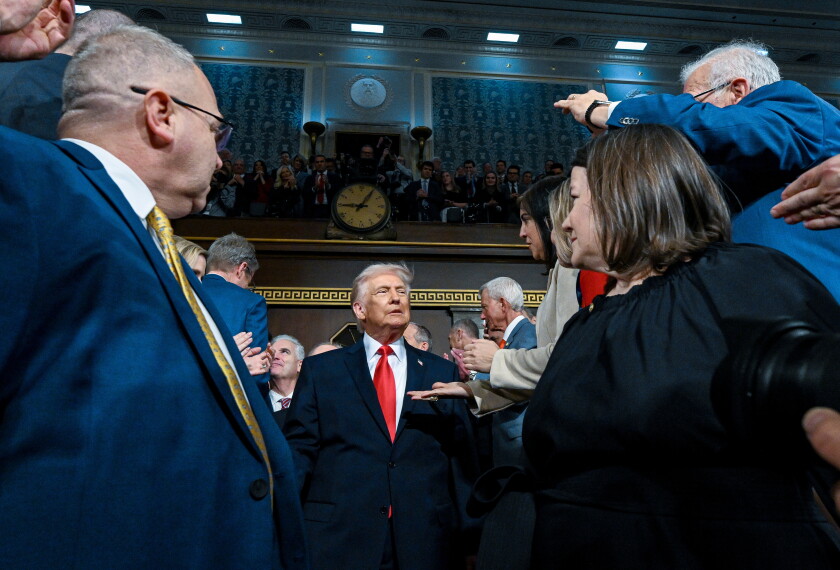
President Donald Trump enters to deliver the State of the Union address to a joint session of Congress in the House chamber at the U.S. Capitol in Washington, Tuesday, Feb. 24, 2026.
President Donald Trump enters to deliver the State of the Union address to a joint session of Congress in the House chamber at the U.S. Capitol in Washington, Tuesday, Feb. 24, 2026. The president devoted little time in the speech to discussing his education policies.
Kenny Holston/The New York Times via AP, Pool
Federal Education Department Will Send More of Its Programs to Other Agencies
Education grants for school safety, community schools, and family engagement will shift to Health and Human Services.
4 min read
Various school representatives and parent liaisons attend a family and community engagement think tank discussion at Lowery Conference Center on March 13, 2024 in Denver. One of the goals of the meeting was to discuss how schools can better integrate new students and families into the district. Denver Public Schools has six community hubs across the district that have serviced 3,000 new students since October 2023. Each community hub has different resources for families and students catering to what the community needs.
A program that helps state education departments and schools improve family engagement policies is among those the Trump administration will transfer from the U.S. Department of Education to the U.S. Department of Health and Human Services. In this photo, school representatives and parent liaisons attend a family and community engagement discussion on March 13, 2024, in Denver to discuss how schools can better integrate new students and families into the district.
Rebecca Slezak For Education Week
Federal New Trump Admin. Guidance Says Teachers Can Pray With Students
The president said the guidance for public schools would ensure "total protection" for school prayer.
3 min read
MADISON, AL - MARCH 29: Bob Jones High School football players touch the people near them during a prayer after morning workouts and before the rest of the school day on March 29, 2024, in Madison, AL. Head football coach Kelvis White and his brother follow in the footsteps of their father, who was also a football coach. As sports in the United States deals with polarization, Coach White and Bob Jones High School form a classic tale of team, unity, and brotherhood. (Photo by Jahi Chikwendiu/The Washington Post via Getty Images)
Football players at Bob Jones High School in Madison, Ala., pray after morning workouts before the rest of the school day on March 29, 2024. New guidance from the U.S. Department of Education says students and educators can pray at school, as long as the prayer isn't school-sponsored and disruptive to school and classroom activities, and students aren't coerced to participate.
Jahi Chikwendiu/Washington Post via Getty Images
Federal Ed. Dept. Paid Civil Rights Staffers Up to $38 Million as It Tried to Lay Them Off
A report from Congress' watchdog looks into the Trump Admin.'s efforts to downsize the Education Department.
5 min read
Commuters walk past the headquarters of the U.S. Department of Eduction, which were ordered closed for the day for what officials described as security reasons amid large-scale layoffs, on March 12, 2025, in Washington.
The U.S. Department of Education spent up to $38 million last year to pay civil rights staffers who remained on administrative leave while the agency tried to lay them off.
Mark Schiefelbein/AP
