Federal

Blueprint Drafted for Research to Aid American Indian Education

By Mary Ann Zehr — August 30, 2005 2 min read
  • Save to favorites
  • Print

Education researchers and Native American educators are drawing up a blueprint intended to guide research into interventions that will improve the academic achievement of American Indian students.

To obtain a copy of the research blueprint on American Indian education, e-mail Jonathan A. Levitt of the National Institutes of Health, at levittja@mail.nih.gov.

“Issues of language and culture make a difference in whether students are successful,” said William Demmert, an education professor at Western Washington University in Bellingham, who came up with the idea for the project. “We [Native Americans] believe research is important to understand what needs to be done.”

Mr. Demmert, who grew up in the Alaska Tlingit community, is a former director of education for the federal Bureau of Indian Affairs and a former education commissioner in Alaska.

He was among a group of about 50 researchers and American Indians who met here at the Department of Education on Aug. 17 to refine a draft that had been written after an initial meeting in March in Santa Fe, N.M. The project is being sponsored primarily by the Education Department and the National Institute of Child Health and Human Development, which is part of the National Institutes of Health.

The final blueprint is expected to be published in the fall 2006 issue of the Journal of American Indian Education, which is published by the Center for Indian Education at Arizona State University in Tempe.

The draft document calls for more studies using several national databases that for the first time have sufficient samples of American Indians to conduct fairly sophisticated statistical analyses of educational outcomes for that group. The results for the 2003 and 2005 National Assessment of Educational Progress, for example, for the first time contain reliable information about Native American students, according to researchers.

Next Steps

The blueprint calls for studies of how indigenous communities are using technology to support education and how its use might be expanded. It recommends more study of after-school activities and on how the lives of American Indian students outside of school affect their education.

In addition, the blueprint spells out some “next steps” for American Indian education, such as developing more high-quality prekindergarten programs that include parent education. It calls for the identification, study, and description of programs that are closing the achievement gap between Native Americans and other students and wide distribution of information about the programs.
Events

This content is provided by our sponsor. It is not written by and does not necessarily reflect the views of Education Week's editorial staff.
Sponsor
Artificial Intelligence Webinar
AI in Schools: What 1,000 Districts Reveal About Readiness and Risk
Move beyond “ban vs. embrace” with real-world AI data and practical guidance for a balanced, responsible district policy.
Content provided by Securly
This content is provided by our sponsor. It is not written by and does not necessarily reflect the views of Education Week's editorial staff.
Sponsor
Recruitment & Retention Webinar
K-12 Lens 2026: What New Staffing Data Reveals About District Operations
Explore national survey findings and hear how districts are navigating staffing changes that affect daily operations, workload, and planning.
Content provided by Frontline Education
Education Funding Webinar Congress Approved Next Year’s Federal School Funding. What’s Next?
Congress passed the budget, but uncertainty remains. Experts explain what districts should expect from federal education policy next.

EdWeek Top School Jobs

Teacher Jobs
Search over ten thousand teaching jobs nationwide — elementary, middle, high school and more.
View Jobs
Principal Jobs
Find hundreds of jobs for principals, assistant principals, and other school leadership roles.
View Jobs
Administrator Jobs
Over a thousand district-level jobs: superintendents, directors, more.
View Jobs
Support Staff Jobs
Search thousands of jobs, from paraprofessionals to counselors and more.
View Jobs

Read Next

Federal Ed. Dept. Wants to Revamp Assistance Program It Calls 'Duplicative,' 'Confusing'
The department's Comprehensive Centers have already been through a year of shakeups.
3 min read
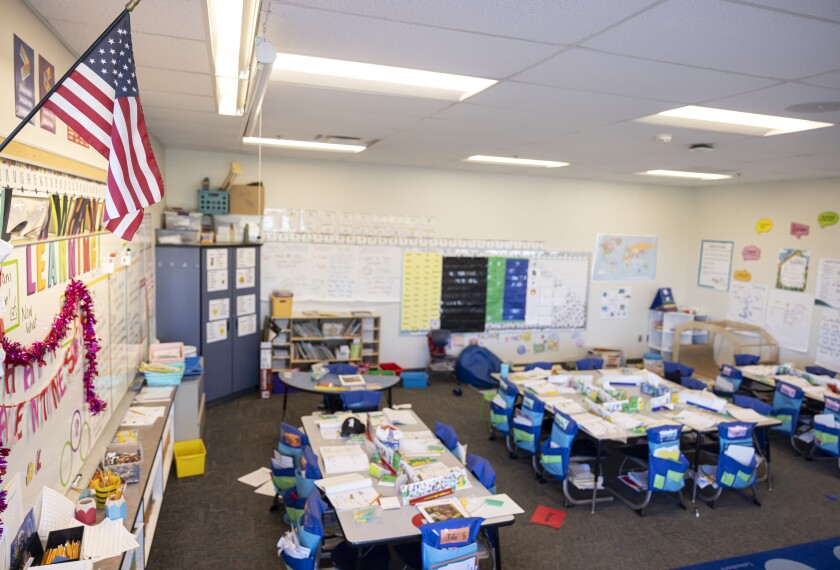
A first grade classroom at a school in Colorado Springs, on Feb. 12, 2026.
A 1st grade classroom at a school in Colorado Springs, Colo., on Feb. 12, 2026. The U.S. Department of Education released a proposal to rework a decades-old program charged with helping states and school districts problem-solve and deploy new initiatives, calling the current structure “duplicative” and “confusing.”
Kevin Mohatt for Education Week
Federal Will the Ed. Dept. Act on Recommendations to Overhaul Its Research Arm?
An adviser's report called for more coherence and sped-up research awards at the Institute of Education Sciences.
6 min read
The U.S. Department of Education building is pictured on Oct. 24, 2025, in Washington, D.C.
The U.S. Department of Education building in Washington is pictured on Oct. 24, 2025. A new report from a department adviser calls for major overhauls to the agency's research arm to facilitate timely research and easier-to-use guides for educators and state leaders.
Maansi Srivastava for Education Week
Federal Trump Talks Up AI in State of the Union, But Not Much Else About Education
The president didn't mention two of his cornerstone education policies from the past year.
4 min read
President Donald Trump enters to deliver the State of the Union address to a joint session of Congress in the House chamber at the U.S. Capitol in Washington, Tuesday, Feb. 24, 2026.
President Donald Trump enters to deliver the State of the Union address to a joint session of Congress in the House chamber at the U.S. Capitol in Washington, Tuesday, Feb. 24, 2026. The president devoted little time in the speech to discussing his education policies.
Kenny Holston/The New York Times via AP, Pool
Federal Education Department Will Send More of Its Programs to Other Agencies
Education grants for school safety, community schools, and family engagement will shift to Health and Human Services.
4 min read
Various school representatives and parent liaisons attend a family and community engagement think tank discussion at Lowery Conference Center on March 13, 2024 in Denver. One of the goals of the meeting was to discuss how schools can better integrate new students and families into the district. Denver Public Schools has six community hubs across the district that have serviced 3,000 new students since October 2023. Each community hub has different resources for families and students catering to what the community needs.
A program that helps state education departments and schools improve family engagement policies is among those the Trump administration will transfer from the U.S. Department of Education to the U.S. Department of Health and Human Services. In this photo, school representatives and parent liaisons attend a family and community engagement discussion on March 13, 2024, in Denver to discuss how schools can better integrate new students and families into the district.
Rebecca Slezak For Education Week

