Law & Courts

Federal Appeals Court Backs Socioeconomic-Based Admissions Plan for Boston ‘Exam Schools’

By Mark Walsh — April 29, 2021 3 min read
Image shows lady justice standing before an open law book and gavel.
  • Save to favorites
  • Print

A federal appeals court has refused to block the Boston school system from sending out acceptance letters for its selective “exam schools” under new admissions criteria for next academic year, ruling that the plan’s use of a socioeconomic measure to achieve greater racial diversity in those schools is likely constitutional.

The decision by a three-judge panel of the U.S. Court of Appeals for the 1st Circuit, in Boston, denied a request for an injunction by a group representing White and Asian American families.

“[T]here is no likely controlling reason why one cannot prefer to use facially neutral and otherwise valid admissions criteria that cause underrepresented races to be less underrepresented,” said the unanimous April 28 opinion in Boston Parent Coalition for Academic Excellence v. Boston School Committee.

The coalition challenged the admissions program for Boston Latin School, Boston Latin Academy, and John D. O’Bryant School of Mathematics and Science. The schools are highly selective, and for the last 20 years, admission has been based on a test, grade-point averages in mathematics and English-language arts, and student preferences.

But with disruptions caused by the COVID-19 pandemic, the Boston school committee established a working group to come up with an alternative admissions plan for the 2021-22 school year. Under the plan, grade-point average and other academic are still criteria, but students from low-income ZIP codes (based on income for families with children under 18) get a preference in filling 80 percent of the slots.

Among the goals of the plan is to increase racial, socioeconomic, and geographic diversity within the exam schools, though the plan did not explicitly use race as a factor.

The coalition challenged the plan under the 14th Amendment’s equal-protection clause (and a state constitutional provision), arguing that it was adopted with a racially discriminatory purpose. The group calls for admissions based on grade-point average only, which would likely boost White and Asian American students and result in fewer admissions of Black and Latinx students, court papers say.

A federal district court found that the use of socioeconomic criteria based on ZIP codes was “devoid of any anchor to race.”

As part of its appeal to the 1st Circuit court, the coalition sought the injunction to block acceptance letters based on the plan from going out. The appeals court denied the request, saying the plaintiffs themselves had delayed matters by waiting more than four months after the plan was adopted to file suit, and that the school system needed to proceed with admissions for next year. (The Boston school system’s website says the letters went out Wednesday, the same day as the decision.)

The appeals court’s ruling was not a final one on the merits, but it said the admissions plan was likely to be upheld under precedents that include now-retired U.S. Supreme Court Justice Anthony M. Kennedy’s concurrence in Parents Involved in Community Schools v. Seattle School District.

In that 2007 decision, Chief Justice John G. Roberts Jr. wrote a plurality opinion and Kennedy joined in the judgment that two school districts could not voluntarily adopt race-conscious plans for assigning students to schools.

Kennedy, in a concurrence that many lower courts have treated as the controlling opinion in Parents Involved, said school districts may pursue diversity without engaging in individual racial classification by drawing “attendance zones with general recognition of the demographics of neighborhoods.”

The 1st Circuit court panel in the Boston decision said, “One can readily see why a school system would prefer to curry citywide support for high-profile, pace-setting schools. And one can easily see why selective schools might favor students who achieve academic success without the resources available to those who are capable of paying for summer schooling, tutoring, and the like.”

Boston school officials “expressed a variety of concerns regarding how best to award seats in the Exam Schools,” the court said. “But the means they chose were race-neutral and apt.”

The decision comes as admissions plans at selective K-12 schools—either race-conscious or race-neutral—are under legal scrutiny. A lawsuit was filed recently challenging a race-conscious admissions plan for an elite math and science high school in Fairfax County, Va. And a lawsuit was filed in March challenging the racial effects of the New York City school system’s program of admissions for its selective schools.

Events

This content is provided by our sponsor. It is not written by and does not necessarily reflect the views of Education Week's editorial staff.
Sponsor
Artificial Intelligence Webinar
Managing AI in Schools: Practical Strategies for Districts
How should districts govern AI in schools? Learn practical strategies for policies, safety, transparency, and responsible adoption.
Content provided by Lightspeed Systems
Education Funding Webinar Congress Approved Next Year’s Federal School Funding. What’s Next?
Congress passed the budget, but uncertainty remains. Experts explain what districts should expect from federal education policy next.
This content is provided by our sponsor. It is not written by and does not necessarily reflect the views of Education Week's editorial staff.
Sponsor
Student Absenteeism Webinar
Removing Transportation and Attendance Barriers for Homeless Youth
Join us to see how districts around the country are supporting vulnerable students, including those covered under the McKinney–Vento Act.
Content provided by HopSkipDrive

EdWeek Top School Jobs

Teacher Jobs
Search over ten thousand teaching jobs nationwide — elementary, middle, high school and more.
View Jobs
Principal Jobs
Find hundreds of jobs for principals, assistant principals, and other school leadership roles.
View Jobs
Administrator Jobs
Over a thousand district-level jobs: superintendents, directors, more.
View Jobs
Support Staff Jobs
Search thousands of jobs, from paraprofessionals to counselors and more.
View Jobs

Read Next

Law & Courts Judge Ends School Desegregation Order at Trump Administration's Request
The decision ends decades of federal oversight to ensure schools' compliance with the order to desegregate.
Patrick Wall, The Times-Picayune | The New Orleans Advocate
4 min read
Louisiana Attorney General Liz Murrill speaks during a press conference on Monday, Aug. 5, 2024, in Baton Rouge, La. Murrill teamed up with the Trump administration to ask a judge to end a decades-old desegregation order under which the state's DeSoto Parish Schools were under federal oversight.
Hilary Scheinuk/The Advocate via AP
Law & Courts Appeals Court Blocks Ruling Bolstering Parental Rights Over Gender Identity
A federal appeals court blocked a groundbreaking ruling over the disclosure of students' gender identities.
4 min read
Students carrying pride flags and transgender flags leave Great Oak High School on Sept. 22, 2023, in Temecula, Calif., after walking out of the school in protest of the Temecula school district policy requiring parents to be notified if their child identifies as transgender.
Students carrying pride flags and transgender flags leave Great Oak High School on Sept. 22, 2023, in Temecula, Calif., after walking out of the school in protest of the Temecula school district policy requiring parents to be notified if their child identifies as transgender. But many districts in California follow a state policy limiting when schools can inform parents about a student's gender identity without the student's consent.
Anjali Sharif-Paul/The Orange County Register via AP
Law & Courts Appeals Court Halts Ruling Letting Teachers Disclose Students' Gender Identity
A federal appeals court has temporarily paused enforcement of the ruling but has not yet decided whether to grant a longer-term stay.
Kristen Taketa, The San Diego Union-Tribune
3 min read
Students carrying pride and transgender flags leave Great Oak High School in Temecula, Calif., on Sept. 22, 2023, after walking out of the school in protest of the Temecula school district policy requiring parents to be notified if their child identifies as transgender.
Anjali Sharif-Paul/The Orange County Register via AP
Law & Courts Schools Can’t Bar Teachers From Telling Parents If Kids Are Transgender, Judge Rules
The injunction bans any public school employee from misleading parents about their child’s gender presentation at school.
Kristen Taketa, The San Diego Union-Tribune
5 min read
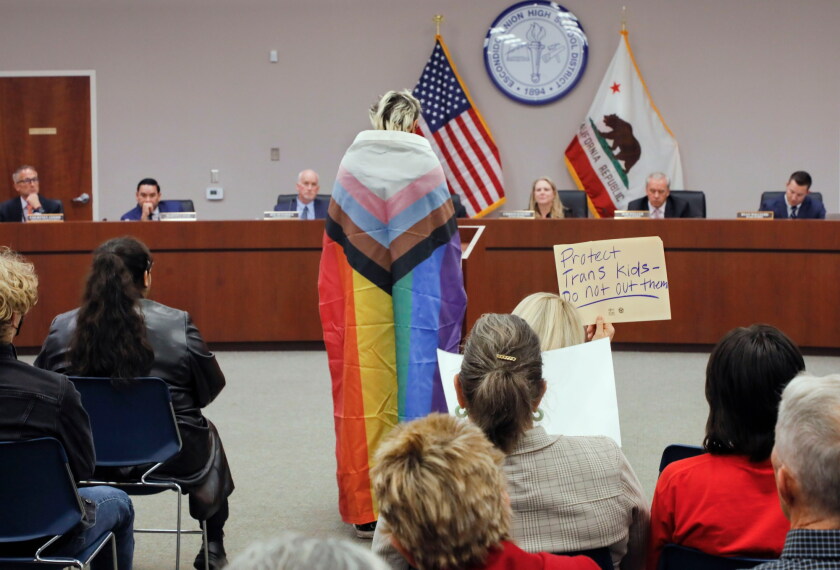
Teacher’s aide Amelia Mester, wrapped in a Pride flag, urges Escondido Union High School District not to have employees notify parents if they believe a student may be transgender in November 2025. A policy on the issue in the city’s elementary school district is the subject of a federal class-action lawsuit in which a judge just sided against the district.
Teacher’s aide Amelia Mester, wrapped in a Pride flag, urges Escondido Union High School District not to have employees notify parents if they believe a student may be transgender. A policy on the issue in the city’s elementary school district is the subject of a federal class-action lawsuit in which a judge just ruled against the district.
Charlie Neuman for The San Diego Union-Tribune/TNS