Federal

Federal Dietary Guidelines Encourage Physical Activity

By Jessica L. Tonn — January 19, 2005 3 min read
  • Save to favorites
  • Print

The U.S. departments of Agriculture and Health and Human Services released their joint 2005 dietary guidelines last week, urging Americans to better monitor their food consumption and raise their levels of physical activity to maintain healthier lifestyles and prevent chronic diseases.

“Dietary Guidelines for Americans 2005" is available online, as well as an executive summary, from the U.S. Department of Health and Human Services. ()

The new recommendations echo the arguments that physical education advocates have been making for a long time, said George Graham, a professor of kinesiology at Pennsylvania State University in University Park and a former president of the Reston, Va.-based National Association for Sport and Physical Education.

In response to the rise in obesity and obesity-related diseases in the United States, Secretary of Agriculture Ann M. Veneman said that “the new guidelines highlight the principle that Americans should keep their weight within healthful limits and engage in ample physical activity,” according to a USDA transcript of a Jan. 11 press conference to release the guidelines.

See Also

Read the related story,

Weighing Choices

The sixth edition of the guidelines, which are released every five years, pays particular attention to physical activity. It describes “ample physical activity” for children as at least 60 minutes of moderate physical activity on most, if not all, days. Adults are advised to engage in 30 minutes of moderate physical activity daily in order to prevent disease, and between 60 and 90 minutes per day to maintain healthy weight.

Physical Education

The NASPE recommends 150 minutes of physical education per week in elementary schools. For secondary schools, the organization recommends 220 minutes of weekly physical education.

But according to Mr. Graham, only about 8 percent of elementary schools and 7 percent of secondary schools currently meet the NASPE standards.

In addition, data compiled by the Atlanta-based federal Centers for Disease Control and Prevention from 1991 to 2003 indicate that 28 percent of American students attended a physical education class daily in 2003, down from 42 percent in 1991.

Dolly Lambdin, a senior lecturer at the University of Texas at Austin and the current president of the NASPE, expressed hope that the new guidelines would encourage more schools to upgrade their physical education programs.

“Children need to learn why physical activity is important, not simply what to do,” she said.

Qualified physical educators must teach recreation classes, she added, so that students can learn a range of skills and choose which best meet their needs and interests for the rest of their lives.

The new guidelines are “exciting” for physical educators, Ms. Lambdin said, because they emphasize, for the first time, the importance of physical activity, in addition to nutrition, for maintaining a healthy lifestyle.

Wellness Policies

The new dietary guidelines released last week reinforce federal efforts already under way to encourage healthier eating and increased exercise.

Under the Local Wellness Policy of the Child Nutrition and Women, Infants and Children (WIC) Reauthorization Act of 2004, all schools receiving federal funds for school lunch and breakfast programs are required to “establish a local school wellness policy … that, at a minimum, includes goals for nutrition education, physical activity and other school-based activities that are designed to promote student wellness.”

The law requires that those policies be in place by the beginning of the 2006-07 school year.

As it is, schools that participate in federal meals programs are already required to follow the federal dietary guidelines for the meals they serve students.

The 2005 guidelines recommend that children have diets rich in fruits, vegetables, and grains, and at least one-half of those grains should be whole. Children ages 2 through 8 should consume two cups of low-fat or nonfat milk daily, and youngsters older than 9 should have three cups.

Since 2000, schools have used the previous guidelines to design menus and nutrition programs.

As of 2001, 82 percent of elementary schools and 91 percent of secondary schools were meeting those dietary guidelines, said Christine Bushway, a spokeswoman for the School Nutrition Association, an Alexandria, Va.-based organization that has long encouraged school district meals programs to follow the federal government’s nutritional recommendations.

Changing over to the new guidelines in schools will take time, she said. But based on the data she has seen, “a lot of people are doing it already.”
A version of this article appeared in the January 19, 2005 edition of Education Week as Federal Dietary Guidelines Encourage Physical Activity

Events

This content is provided by our sponsor. It is not written by and does not necessarily reflect the views of Education Week's editorial staff.
Sponsor
School Climate & Safety Webinar
Belonging as a Leadership Strategy for Today’s Schools
Belonging isn’t a slogan—it’s a leadership strategy. Learn what research shows actually works to improve attendance, culture, and learning.
Content provided by Harmony Academy
This content is provided by our sponsor. It is not written by and does not necessarily reflect the views of Education Week's editorial staff.
Sponsor
School & District Management Webinar
Too Many Initiatives, Not Enough Alignment: A Change Management Playbook for Leaders
Learn how leadership teams can increase alignment and evaluate every program, practice, and purchase against a clear strategic plan.
Content provided by Otus
This content is provided by our sponsor. It is not written by and does not necessarily reflect the views of Education Week's editorial staff.
Sponsor
Artificial Intelligence Webinar
Beyond Teacher Tools: Exploring AI for Student Success
Teacher AI tools only show assigned work. See how TrekAi's student-facing approach reveals authentic learning needs and drives real success.
Content provided by TrekAi

EdWeek Top School Jobs

Teacher Jobs
Search over ten thousand teaching jobs nationwide — elementary, middle, high school and more.
View Jobs
Principal Jobs
Find hundreds of jobs for principals, assistant principals, and other school leadership roles.
View Jobs
Administrator Jobs
Over a thousand district-level jobs: superintendents, directors, more.
View Jobs
Support Staff Jobs
Search thousands of jobs, from paraprofessionals to counselors and more.
View Jobs

Read Next

Federal Trump Talks Up AI in State of the Union, But Not Much Else About Education
The president didn't mention two of his cornerstone education policies from the past year.
4 min read
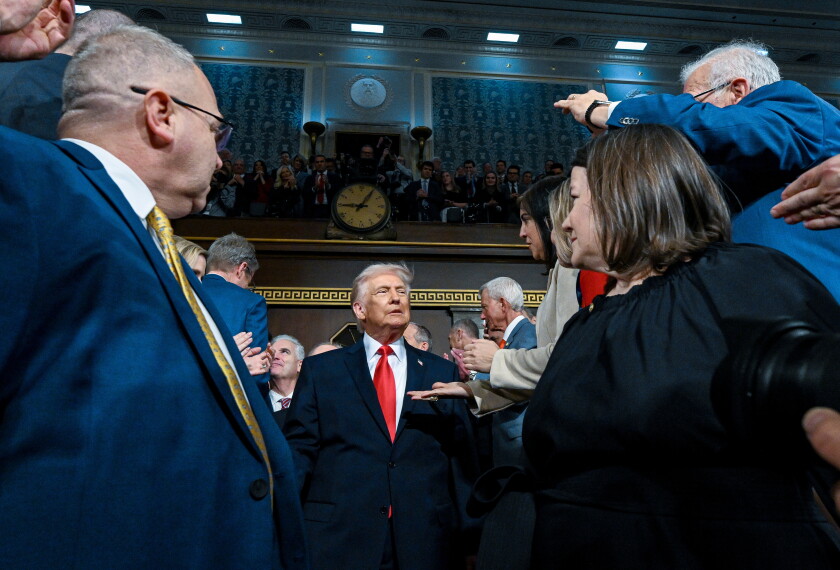
President Donald Trump enters to deliver the State of the Union address to a joint session of Congress in the House chamber at the U.S. Capitol in Washington, Tuesday, Feb. 24, 2026.
President Donald Trump enters to deliver the State of the Union address to a joint session of Congress in the House chamber at the U.S. Capitol in Washington, Tuesday, Feb. 24, 2026. The president devoted little time in the speech to discussing his education policies.
Kenny Holston/The New York Times via AP, Pool
Federal Education Department Will Send More of Its Programs to Other Agencies
Education grants for school safety, community schools, and family engagement will shift to Health and Human Services.
4 min read
Various school representatives and parent liaisons attend a family and community engagement think tank discussion at Lowery Conference Center on March 13, 2024 in Denver. One of the goals of the meeting was to discuss how schools can better integrate new students and families into the district. Denver Public Schools has six community hubs across the district that have serviced 3,000 new students since October 2023. Each community hub has different resources for families and students catering to what the community needs.
A program that helps state education departments and schools improve family engagement policies is among those the Trump administration will transfer from the U.S. Department of Education to the U.S. Department of Health and Human Services. In this photo, school representatives and parent liaisons attend a family and community engagement discussion on March 13, 2024, in Denver to discuss how schools can better integrate new students and families into the district.
Rebecca Slezak For Education Week
Federal New Trump Admin. Guidance Says Teachers Can Pray With Students
The president said the guidance for public schools would ensure "total protection" for school prayer.
3 min read
MADISON, AL - MARCH 29: Bob Jones High School football players touch the people near them during a prayer after morning workouts and before the rest of the school day on March 29, 2024, in Madison, AL. Head football coach Kelvis White and his brother follow in the footsteps of their father, who was also a football coach. As sports in the United States deals with polarization, Coach White and Bob Jones High School form a classic tale of team, unity, and brotherhood. (Photo by Jahi Chikwendiu/The Washington Post via Getty Images)
Football players at Bob Jones High School in Madison, Ala., pray after morning workouts before the rest of the school day on March 29, 2024. New guidance from the U.S. Department of Education says students and educators can pray at school, as long as the prayer isn't school-sponsored and disruptive to school and classroom activities, and students aren't coerced to participate.
Jahi Chikwendiu/Washington Post via Getty Images
Federal Ed. Dept. Paid Civil Rights Staffers Up to $38 Million as It Tried to Lay Them Off
A report from Congress' watchdog looks into the Trump Admin.'s efforts to downsize the Education Department.
5 min read
Commuters walk past the headquarters of the U.S. Department of Eduction, which were ordered closed for the day for what officials described as security reasons amid large-scale layoffs, on March 12, 2025, in Washington.
The U.S. Department of Education spent up to $38 million last year to pay civil rights staffers who remained on administrative leave while the agency tried to lay them off.
Mark Schiefelbein/AP
