Federal

How Much Federal Money Do Schools Need to Survive the Coming Financial Blow?

By Daarel Burnette II — April 21, 2020 2 min read
BRIC ARCHIVE
  • Save to favorites
  • Print

America’s public schools will need $70 billion for three consecutive years in the next round of federal stimulus spending to avoid painful cuts such as teacher layoffs, according to a new analysis.

That level of spending—from fiscal analyst Michael Griffith—would help blunt the dramatic budget cuts that districts will likely be forced to make because of the economic fallout brought on by the coronavirus pandemic.

The $13.5 billion CARES Act, as the first round of stimulus spending is known, will not spare most school districts from needing to make budget cuts this fall, he said.

See Also: Coronavirus Stimulus for Schools: Calculating What Your State Gets and What It May Need

Griffith said any new dollars should be targeted toward states with high rates of coronavirus infections and where school districts are more dependent on state aid. The existing CARES Act funds are being distributed based on the Title I, part A formula, which considers several factors including the size of districts, poverty rates, and levels of local and state aid.

The CARES Act for most states can only stave off budget cuts up to 8 percent, Griffith said. But most states now are projecting cuts next year anywhere from 8 percent in Kansas to 20 percent in Alaska. And those cuts will be felt most acutely in the K-12 sector, which is heavily reliant on state aid.

“There will be very few districts that will be pulling out of this quickly,” said Griffith, who will soon join the Learning Policy Institute as a senior school finance researcher and policy analyst.  “If there is another round of federal money going out, we can’t spend it all in the first year.”  

Congress is expected to reconvene in May to debate another stimulus package, but there seems to be little appetite, especially in the Senate, for a bailout of school districts considering the high unemployment rate.

As Education Week reported recently, Griffith has done a data analysis to show how much money the CARES Act provides states and allows users to determine how much money they think states should receive in the next round of stimulus funds.

As they fight the spread of the coronavirus, many states, have almost drained their rainy day funds to prop up local health departments, buy masks and ventilators, and send out unemployment checks. That means less money for schools in those states especially hard hit by the virus, Griffith said.

Ary Amerikaner, the vice president for P-12 policy, practice, and research for EdTrust, an advocacy organization that pushes for greater accountability and more equitable spending, said the next stimulus package should be used to extend the school year for struggling students and be in the range of $100 to $200 billion.

She thinks Congress should continue to use the Title I formula for sending out the aid because, she said, it’s familiar and pushes for equity between states and districts. Some advocates believe it to be a deeply flawed way to divvy up money for schools.

“Congress should be ensuring those dollars are spent on things that we know will accelerate learning for those students who are most impacted by the shutdown such as summer school, additional school, or tutoring,” she said.  
Events

This content is provided by our sponsor. It is not written by and does not necessarily reflect the views of Education Week's editorial staff.
Sponsor
School & District Management Webinar
Too Many Initiatives, Not Enough Alignment: A Change Management Playbook for Leaders
Learn how leadership teams can increase alignment and evaluate every program, practice, and purchase against a clear strategic plan.
Content provided by Otus
This content is provided by our sponsor. It is not written by and does not necessarily reflect the views of Education Week's editorial staff.
Sponsor
Artificial Intelligence Webinar
Beyond Teacher Tools: Exploring AI for Student Success
Teacher AI tools only show assigned work. See how TrekAi's student-facing approach reveals authentic learning needs and drives real success.
Content provided by TrekAi
This content is provided by our sponsor. It is not written by and does not necessarily reflect the views of Education Week's editorial staff.
Sponsor
College & Workforce Readiness Webinar
Building for the Future: Igniting Middle Schoolers’ Interest in Skilled Trades & Future-Ready Skills
Ignite middle schoolers’ interest in skilled trades with hands-on learning and real-world projects that build future-ready skills.
Content provided by Project Lead The Way

EdWeek Top School Jobs

Teacher Jobs
Search over ten thousand teaching jobs nationwide — elementary, middle, high school and more.
View Jobs
Principal Jobs
Find hundreds of jobs for principals, assistant principals, and other school leadership roles.
View Jobs
Administrator Jobs
Over a thousand district-level jobs: superintendents, directors, more.
View Jobs
Support Staff Jobs
Search thousands of jobs, from paraprofessionals to counselors and more.
View Jobs

Read Next

Federal Trump Talks Up AI in State of the Union, But Not Much Else About Education
The president didn't mention two of his cornerstone education policies from the past year.
4 min read
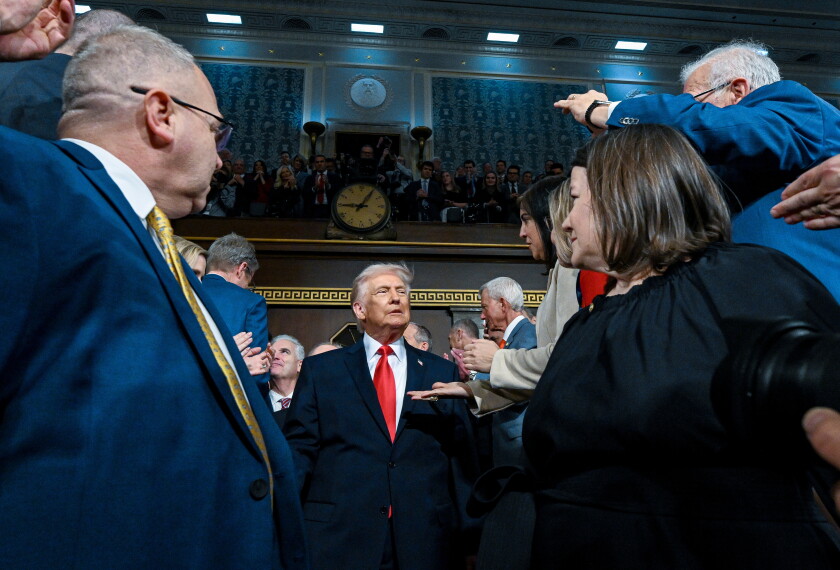
President Donald Trump enters to deliver the State of the Union address to a joint session of Congress in the House chamber at the U.S. Capitol in Washington, Tuesday, Feb. 24, 2026.
President Donald Trump enters to deliver the State of the Union address to a joint session of Congress in the House chamber at the U.S. Capitol in Washington, Tuesday, Feb. 24, 2026. The president devoted little time in the speech to discussing his education policies.
Kenny Holston/The New York Times via AP, Pool
Federal Education Department Will Send More of Its Programs to Other Agencies
Education grants for school safety, community schools, and family engagement will shift to Health and Human Services.
4 min read
Various school representatives and parent liaisons attend a family and community engagement think tank discussion at Lowery Conference Center on March 13, 2024 in Denver. One of the goals of the meeting was to discuss how schools can better integrate new students and families into the district. Denver Public Schools has six community hubs across the district that have serviced 3,000 new students since October 2023. Each community hub has different resources for families and students catering to what the community needs.
A program that helps state education departments and schools improve family engagement policies is among those the Trump administration will transfer from the U.S. Department of Education to the U.S. Department of Health and Human Services. In this photo, school representatives and parent liaisons attend a family and community engagement discussion on March 13, 2024, in Denver to discuss how schools can better integrate new students and families into the district.
Rebecca Slezak For Education Week
Federal New Trump Admin. Guidance Says Teachers Can Pray With Students
The president said the guidance for public schools would ensure "total protection" for school prayer.
3 min read
MADISON, AL - MARCH 29: Bob Jones High School football players touch the people near them during a prayer after morning workouts and before the rest of the school day on March 29, 2024, in Madison, AL. Head football coach Kelvis White and his brother follow in the footsteps of their father, who was also a football coach. As sports in the United States deals with polarization, Coach White and Bob Jones High School form a classic tale of team, unity, and brotherhood. (Photo by Jahi Chikwendiu/The Washington Post via Getty Images)
Football players at Bob Jones High School in Madison, Ala., pray after morning workouts before the rest of the school day on March 29, 2024. New guidance from the U.S. Department of Education says students and educators can pray at school, as long as the prayer isn't school-sponsored and disruptive to school and classroom activities, and students aren't coerced to participate.
Jahi Chikwendiu/Washington Post via Getty Images
Federal Ed. Dept. Paid Civil Rights Staffers Up to $38 Million as It Tried to Lay Them Off
A report from Congress' watchdog looks into the Trump Admin.'s efforts to downsize the Education Department.
5 min read
Commuters walk past the headquarters of the U.S. Department of Eduction, which were ordered closed for the day for what officials described as security reasons amid large-scale layoffs, on March 12, 2025, in Washington.
The U.S. Department of Education spent up to $38 million last year to pay civil rights staffers who remained on administrative leave while the agency tried to lay them off.
Mark Schiefelbein/AP
