

The U.S. Department of Education will prioritize sending grant funding to initiatives that expand school choice, put more onus on states to oversee education, and focus on literacy, the agency announced Tuesday.
The priorities home in on President Donald Trump’s focus for education since taking office, particularly expanding school choice and dismantling the Education Department.
The Trump administration also aims to replace priorities from President Joe Biden’s administration, which, among other things, prioritized diversifying the teaching pool, promoting equity in students’ educational opportunities, and social-emotional learning as it evaluated applications for competitive grants.
The Trump administration has taken an aggressive stance to stamp out what it labels diversity, equity, and inclusion, claiming that such initiatives violate federal civil rights laws.
“Discretionary grants coming from the Department of Education will now be focused on meaningful learning and expanding choice, not divisive ideologies and unproven strategies,” Secretary of Education Linda McMahon said in a statement. “It is critical that we immediately address this year’s dismal reading and math scores by getting back to the basics, expanding learning options, and making sure decisions in education are made closest to the child.”
The priorities, published in the Federal Register, will be open for public comment for 30 days before the Education Department finalizes them.
Competitive grants make up a small piece of the department’s overall portfolio. In fiscal year 2023, as the federal government poured a historic amount of funding into education, the department awarded roughly $6 billion in discretionary funds, according to a U.S. Government Accountability Office report. Historically, however, the amount has sat in the hundreds of millions of dollars in the context of a department budget that has reached about $80 billion in recent years.
These priorities don’t affect the largest portions of federal K-12 funding, which go toward grants that the Education Department allocates to states by formula, such as Title I, to support students from low-income communities, and the Individuals with Disabilities Education Act, which supports services for students with disabilities.
But the official change in priorities now gives the department a proverbial sign to tap, as the agency has faced numerous lawsuits over severing grants—that have supported teacher-preparation programs, mental health services, and more—citing a change in agency priorities.
“While this doesn’t speak directly to those particular cases, you can see that they’re building a portfolio of, ‘These are our priorities now, and this is published, and we’re going to focus on these moving forward,’” said Julia Martin, legislative director for the Bruman Group, a law firm that represents school districts. “That would help insulate them from litigation down the road.”
Grant priorities show the Trump administration’s policy aspirations
The notice is part of a more than two-decade history of the agency identifying key departmentwide priorities for grant awards. Between 2001 and 2021, the Education Department announced agencywide priorities 15 times, according to the GAO report.
Under Biden Education Secretary Miguel Cardona, the department identified six priorities, which included promoting equity in resources and opportunities, addressing learning loss caused by the pandemic, and advancing “systemic change” in schools.
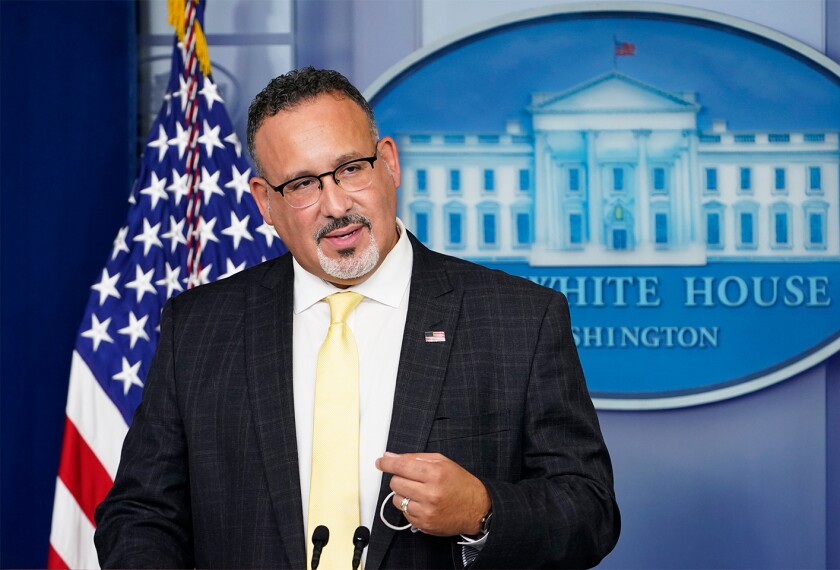
The Trump administration has repeatedly sought to root out programs with DEI through the president’s executive orders on the matter and Education Department guidance to states and schools. The department has cut a number of grants and contracts, citing DEI as a reason and a change in agency priorities.
The department’s announcement of its new grant priorities derided the Biden-era priorities as “infusing many grants programs with divisive race stereotypes and even racial quotas.”
Under the new priorities, the department would be more keen to send money to projects that increase access to charter schools or expand or replicate successful charters that focus on STEM, students with disabilities, career-technical education, and two education emphases popular among Republicans: patriotic education and classical education.
Funds would also more readily flow to initiatives that support local development of educational savings accounts, which allows students and families to use taxpayer dollars for private schools. So far, such accounts have gained traction in Republican-led states, and the federal government does not have any major private school choice programs of its own (though that could change as Republicans consider a $5 billion private school scholarship tax-credit program as part of their major budget bill).
Articulating school choice as a grant priority makes good on a directive from Trump’s January executive order on the topic, which asked McMahon to include school choice as a priority in competitive grant programs. The department has also been developing guidance on how states can use their federal funds for choice.
“I do think that this follows in that path, which is they’re using the existing levers they have available to them to talk about ways to promote school choice,” Martin said.

Closing the Education Department remains a focus
The department is also focusing on “returning education to the states,” asking states to “take the lead in formulating, developing, and implementing policies.” Trump has ordered McMahon to “facilitate” the closure of the Education Department, which is already underway with a massive reduction of staff, though it will require an act of Congress to see through.
With that in mind, “it is more critical than ever for states to rise to the occasion and lead with urgency and vision,” the notice reads.
“I think that this is kind of a different, difficult balancing act, because they’re saying, ‘Here are the things you have to focus on, but by the way, you should be making more decisions at the state level,’” Martin said. “There’s kind of an inherent contradiction in there.”
The agency will also focus on programs that highlight evidence-based literacy instruction, citing declining reading scores on the latest National Assessment of Education Progress.
The notice defines that instruction as “supported by strong or moderate evidence that relates to explicit, systematic, and intentional instruction in phonological awareness, phonic decoding, vocabulary, language structure, reading fluency, and reading comprehension.”
The department can factor the priorities into evaluating grant applications in a few ways. It can require that applicants address one or more priorities, it can give a competitive edge to applicants that address them, or it can simply encourage applicants to address the priorities.
Martin said it will be important to see how the department incorporates the priorities into individual grant competitions.
“They haven’t really talked about how those priorities will be implemented across different grants, but this is a document that they could refer back to,” she said.
Whether the Education Department follows the rules for awarding grants—for an administration that has repeatedly toed, if not overstepped, the line—will be important, too, said Derek Black, a professor of law at the University of South Carolina who specializes in constitutional law and public education.
“Regardless of what their priorities are or are not, transparency and fairness in awarding federal funds so that there are not illegitimately given funds, nor illegitimately denied funds, is a crucial part of constitutional democracy,” Black said. “Hopefully, they’ll run the process right.”


