
Federal

Most Voters Reject Trump’s Push to Cut U.S. Education Department, Poll Finds

The poll also found support from across the political spectrum for career-connected learning in schools
By Alyson Klein — January 22, 2025 3 min read
Young girl working on an electrical panel in a classroom setting.
  • Save to favorites
  • Print

A majority of voters don’t want the U.S. Department of Education abolished, a recent poll found, signaling tenuous support for President Donald Trump’s signature education campaign pledge.

What’s more, voters favor boosting funding for education, though they don’t want to see tax hikes to pay for education programs, according to the poll, a nationally representative sample of 1,000 voters. The poll also found deep support for career-and-technical education across a wide swath of the electorate.

The poll was conducted last fall, from Oct. 30 to Nov. 5, by Lake Research Partners, a Democratic polling organization, and the Tarrance Group, a Republican polling firm, on behalf of All4Ed, a policy and advocacy organization that promotes college and workforce readiness, particularly for students of color and students from low-income families.

More than half of voters surveyed—58 percent—don’t want to see the Education Department nixed, compared to 29 percent who support getting rid of the department, the poll found.

While Democrats are more likely to oppose deep-sixing the department than Republicans, a plurality of GOP voters don’t like the idea of scrapping the agency, either. Forty-four percent of Republicans surveyed said they aren’t on board with getting rid of the department, compared to 39 percent who would like to see it abolished.

More than three-quarters of Democrats—76 percent—oppose getting rid of the Education Department, compared to 18 percent who would like to see it abolished.

“Eliminating the Department of Education is unpopular,” said Celinda Lake, president and CEO of Lake Research Partners. Voters, she said, “want to prioritize education.”

That sentiment is bipartisan, added Brian Nienaber, a vice president at the Tarrance Group.

“There really is strong support among Republicans for public education,” he said.

Public sentiment aside, Trump faces an uphill battle in his bid to squelch the Education Department. There have been GOP proposals to get rid of the agency since its inception more than four decades ago, but the move would require 60 votes in the U.S. Senate, where Republicans hold only a 53-vote majority.

Trump and his team can diminish the agency, however, in part by getting rid of offices within the department that aren’t mandated by legislation, rolling back guidance and regulatory documents, or shrinking its ranks of career staffers.

See Also

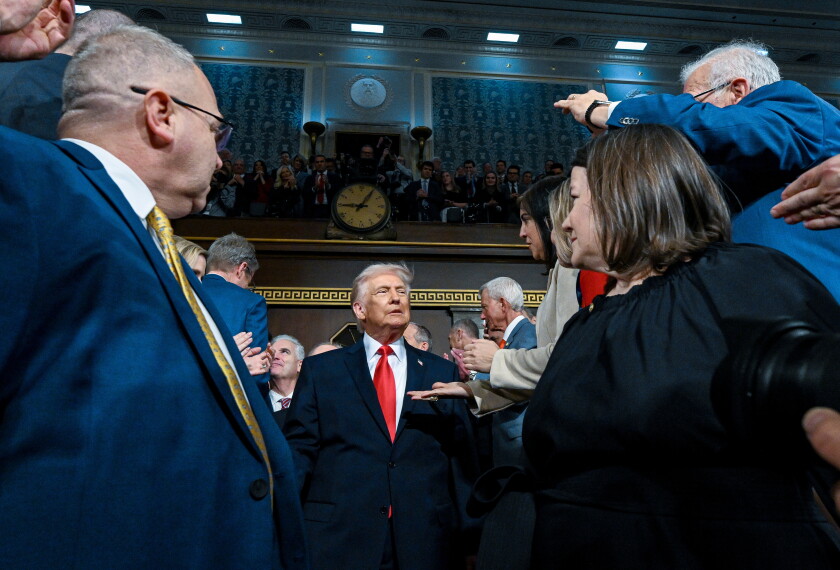
President Donald Trump speaks in Emancipation Hall after the 60th Presidential Inauguration, Monday, Jan. 20, 2025, at the U.S. Capitol in Washington.
President Donald Trump speaks in Emancipation Hall after his inauguration, Monday, Jan. 20, 2025, at the U.S. Capitol in Washington. Trump signed a number of executive orders on his first day in office, including some taking aim at career civil servants in the federal government.
Al Drago/AP

Voters want to hike education spending, but not their taxes

The poll also found that a majority of voters—56 percent—would rather see federal education spending increased than cut or remain the same.

But that number ticks down significantly when tax increases come into the picture. Only 39 percent of voters surveyed were willing to pay more in taxes to increase federal school funding.

During his first term, Trump sought massive cuts to the Education Department’s bottom line. For the most part, those proposals were rejected by a GOP-controlled Congress.

A ‘massive appetite’ among voters for career-connected learning

While some voters are skeptical of the value of a four-year college degree, voters across the board embrace career-and-technical training and work-based learning opportunities, such as internships, the poll found.

Three-quarters of voters agree it is either “extremely” or “very” important that schools provide students with career-connected learning, including internships and apprenticeships, and help them earn credentials sought by employers.

See Also

A George Westinghouse Career and Technical Education High School student participates in a butchery class at Essex Kitchen in New York, Tuesday, May 21, 2024.
A student at George Westinghouse Career and Technical Education High School tries her hand in a butchery class at Essex Kitchen in New York on May 21, 2024. Most high school students think they need more education after graduation, but they're less likely than previous generations to think it needs to be at a four-year college.
James Pollard/AP

And three-quarters said the same about the value of partnerships among school districts, colleges, and employers aimed at ensuring that students “are prepared to navigate life after high school and have opportunities to thrive.”

On the flip side, only 30 percent of voters believe a four-year college degree is worth pursuing given the cost, the poll found.

When it comes to work-based, career-connected learning, voters “like the whole big agenda,” Lake said. “They have a very massive appetite for it. They think this will help everybody. It’ll help the future of the country. It’ll help people do well in school. It’ll help people do well in jobs and careers, and it’ll help people thrive in their lives.”
Events

This content is provided by our sponsor. It is not written by and does not necessarily reflect the views of Education Week's editorial staff.
Sponsor
Special Education Webinar
Bridging the Math Gap: What’s New in Dyscalculia Identification, Instruction & State Action
Discover the latest dyscalculia research insights, state-level policy trends, and classroom strategies to make math more accessible for all.
Content provided by TouchMath
This content is provided by our sponsor. It is not written by and does not necessarily reflect the views of Education Week's editorial staff.
Sponsor
School Climate & Safety Webinar
Belonging as a Leadership Strategy for Today’s Schools
Belonging isn’t a slogan—it’s a leadership strategy. Learn what research shows actually works to improve attendance, culture, and learning.
Content provided by Harmony Academy
This content is provided by our sponsor. It is not written by and does not necessarily reflect the views of Education Week's editorial staff.
Sponsor
School & District Management Webinar
Too Many Initiatives, Not Enough Alignment: A Change Management Playbook for Leaders
Learn how leadership teams can increase alignment and evaluate every program, practice, and purchase against a clear strategic plan.
Content provided by Otus

EdWeek Top School Jobs

Teacher Jobs
Search over ten thousand teaching jobs nationwide — elementary, middle, high school and more.
View Jobs
Principal Jobs
Find hundreds of jobs for principals, assistant principals, and other school leadership roles.
View Jobs
Administrator Jobs
Over a thousand district-level jobs: superintendents, directors, more.
View Jobs
Support Staff Jobs
Search thousands of jobs, from paraprofessionals to counselors and more.
View Jobs

Read Next

Federal Trump Talks Up AI in State of the Union, But Not Much Else About Education
The president didn't mention two of his cornerstone education policies from the past year.
4 min read
President Donald Trump enters to deliver the State of the Union address to a joint session of Congress in the House chamber at the U.S. Capitol in Washington, Tuesday, Feb. 24, 2026.
President Donald Trump enters to deliver the State of the Union address to a joint session of Congress in the House chamber at the U.S. Capitol in Washington, Tuesday, Feb. 24, 2026. The president devoted little time in the speech to discussing his education policies.
Kenny Holston/The New York Times via AP, Pool
Federal Education Department Will Send More of Its Programs to Other Agencies
Education grants for school safety, community schools, and family engagement will shift to Health and Human Services.
4 min read
Various school representatives and parent liaisons attend a family and community engagement think tank discussion at Lowery Conference Center on March 13, 2024 in Denver. One of the goals of the meeting was to discuss how schools can better integrate new students and families into the district. Denver Public Schools has six community hubs across the district that have serviced 3,000 new students since October 2023. Each community hub has different resources for families and students catering to what the community needs.
A program that helps state education departments and schools improve family engagement policies is among those the Trump administration will transfer from the U.S. Department of Education to the U.S. Department of Health and Human Services. In this photo, school representatives and parent liaisons attend a family and community engagement discussion on March 13, 2024, in Denver to discuss how schools can better integrate new students and families into the district.
Rebecca Slezak For Education Week
Federal New Trump Admin. Guidance Says Teachers Can Pray With Students
The president said the guidance for public schools would ensure "total protection" for school prayer.
3 min read
MADISON, AL - MARCH 29: Bob Jones High School football players touch the people near them during a prayer after morning workouts and before the rest of the school day on March 29, 2024, in Madison, AL. Head football coach Kelvis White and his brother follow in the footsteps of their father, who was also a football coach. As sports in the United States deals with polarization, Coach White and Bob Jones High School form a classic tale of team, unity, and brotherhood. (Photo by Jahi Chikwendiu/The Washington Post via Getty Images)
Football players at Bob Jones High School in Madison, Ala., pray after morning workouts before the rest of the school day on March 29, 2024. New guidance from the U.S. Department of Education says students and educators can pray at school, as long as the prayer isn't school-sponsored and disruptive to school and classroom activities, and students aren't coerced to participate.
Jahi Chikwendiu/Washington Post via Getty Images
Federal Ed. Dept. Paid Civil Rights Staffers Up to $38 Million as It Tried to Lay Them Off
A report from Congress' watchdog looks into the Trump Admin.'s efforts to downsize the Education Department.
5 min read
Commuters walk past the headquarters of the U.S. Department of Eduction, which were ordered closed for the day for what officials described as security reasons amid large-scale layoffs, on March 12, 2025, in Washington.
The U.S. Department of Education spent up to $38 million last year to pay civil rights staffers who remained on administrative leave while the agency tried to lay them off.
Mark Schiefelbein/AP
