Federal

NCLB Seen as Ineffective, Poll Suggests

By Laura Greifner — August 22, 2006 3 min read
  • Save to favorites
  • Print

Almost 70 percent of American adults who say they are familiar with the federal No Child Left Behind Act believe it has had no effect or is actually hurting public schools, says a nationwide survey released today.

The 38th Annual Phi Delta Kappa/Gallup Poll of the Public’s Attitudes Toward the Public Schools surveyed 1,007 adults on issues such as how public schools are evalu-ated, how school improvement should occur, and the state of current reform efforts.

Links to the 38th Annual Phi Delta Kappa/Gallup Poll, as well as further resources on the survey, are available from Phi Delta Kappa.

“The views expressed in this year’s PDK/Gallup poll should serve as a wake-up call to our nation’s policymakers as they begin the process of reauthorizing NCLB in 2007,” William Bushaw, the executive director of Bloomington, Ind.-based PDK International, said in a statement.

More American adults reported being knowledgeable about No Child Left Behind than in previous surveys, but many have an unfavorable view of the law. Forty-five percent of those polled said they knew either “a great deal” or “a fair amount” about the federal law, up from 40 percent last year and 31 percent two years ago.

However, of this group, 31 percent said the law was hurting the performance of public schools in their communities, and 37 percent said it had made no difference. Twenty-nine percent said it was helping their local public schools.

State tests as mandated by NCLB currently require students to be assessed only in reading and mathematics. In this year’s survey, 69 percent of respondents said a single test will not provide a fair picture of whether a school needs improvement, and 81 percent said they believed testing requirements should include assessments of students’ knowledge in subjects beyond just reading and math. The No Child Left Behind law requires states to test students in science at least once annually in each 3-5, 6-8, and 9-12 grade span, beginning in the 2007-08 school year.

‘A Clear Message’

NCLB: Help or Hindrance

Americans who report knowing a great deal or a fair amount about the NCLB law are more inclined to think it is hurting public schools than the public at large.

*Click image to see the full chart

BRIC ARCHIVE

SOURCE: Phi Delta Kappa International

Despite the negative public perception of No Child Left Behind, the poll showed an overall positive view of the nation’s public schools. When asked how educators should attempt to improve education, 71 percent of respondents preferred improvements in the existing public school system, rather than establishing an alternative system.

“The fact that the public’s support of its local schools is unaffected by the criticism directed at public schools in general should send a clear message… that change proposals should be built on the assumption that people like the schools they have,” Lowell C. Rose, the executive director emeritus of PDK International and co-author of the study, said in a statement.

In addition, just 19 percent of the poll’s respondents blame the quality of schooling for the achievement gap between white students and their minority counterparts, while the overwhelming majority, 77 percent, attribute the inequality to “other factors.”

The poll also addressed the topic of charter schools and choice, finding that the public has several misconceptions about the nature of charter schools. For example, only 39 percent of those polled knew that charters are public schools. The majority of respondents believed charters are free to teach religion, charge tuition, and select students on the basis of ability, when, in fact, they are prohibited from doing any those things.

In addition, the poll asked people whether they favored or opposed allowing parents to choose to have their children attend private schools at public expense. Of those surveyed, 36 percent favored the idea while 60 percent opposed it.
Events

This content is provided by our sponsor. It is not written by and does not necessarily reflect the views of Education Week's editorial staff.
Sponsor
School & District Management Webinar
Too Many Initiatives, Not Enough Alignment: A Change Management Playbook for Leaders
Learn how leadership teams can increase alignment and evaluate every program, practice, and purchase against a clear strategic plan.
Content provided by Otus
This content is provided by our sponsor. It is not written by and does not necessarily reflect the views of Education Week's editorial staff.
Sponsor
Artificial Intelligence Webinar
Beyond Teacher Tools: Exploring AI for Student Success
Teacher AI tools only show assigned work. See how TrekAi's student-facing approach reveals authentic learning needs and drives real success.
Content provided by TrekAi
This content is provided by our sponsor. It is not written by and does not necessarily reflect the views of Education Week's editorial staff.
Sponsor
College & Workforce Readiness Webinar
Building for the Future: Igniting Middle Schoolers’ Interest in Skilled Trades & Future-Ready Skills
Ignite middle schoolers’ interest in skilled trades with hands-on learning and real-world projects that build future-ready skills.
Content provided by Project Lead The Way

EdWeek Top School Jobs

Teacher Jobs
Search over ten thousand teaching jobs nationwide — elementary, middle, high school and more.
View Jobs
Principal Jobs
Find hundreds of jobs for principals, assistant principals, and other school leadership roles.
View Jobs
Administrator Jobs
Over a thousand district-level jobs: superintendents, directors, more.
View Jobs
Support Staff Jobs
Search thousands of jobs, from paraprofessionals to counselors and more.
View Jobs

Read Next

Federal Trump Talks Up AI in State of the Union, But Not Much Else About Education
The president didn't mention two of his cornerstone education policies from the past year.
4 min read
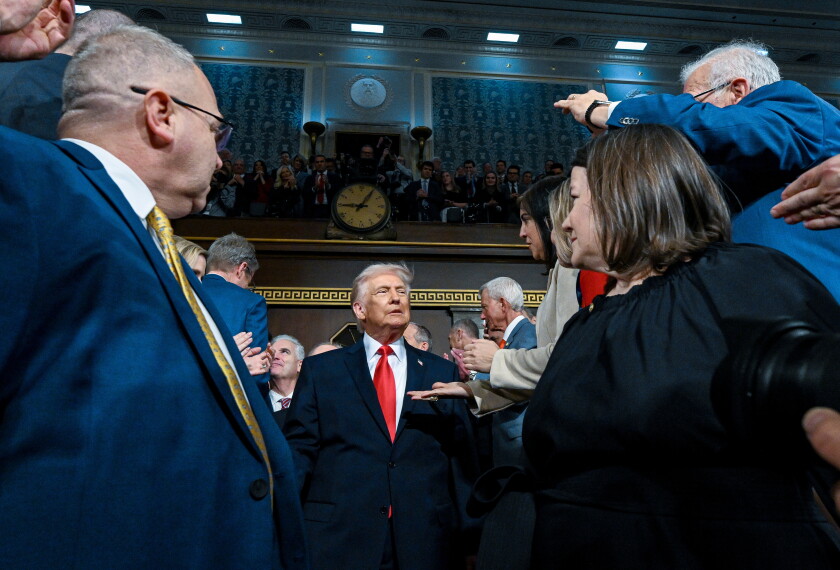
President Donald Trump enters to deliver the State of the Union address to a joint session of Congress in the House chamber at the U.S. Capitol in Washington, Tuesday, Feb. 24, 2026.
President Donald Trump enters to deliver the State of the Union address to a joint session of Congress in the House chamber at the U.S. Capitol in Washington, Tuesday, Feb. 24, 2026. The president devoted little time in the speech to discussing his education policies.
Kenny Holston/The New York Times via AP, Pool
Federal Education Department Will Send More of Its Programs to Other Agencies
Education grants for school safety, community schools, and family engagement will shift to Health and Human Services.
4 min read
Various school representatives and parent liaisons attend a family and community engagement think tank discussion at Lowery Conference Center on March 13, 2024 in Denver. One of the goals of the meeting was to discuss how schools can better integrate new students and families into the district. Denver Public Schools has six community hubs across the district that have serviced 3,000 new students since October 2023. Each community hub has different resources for families and students catering to what the community needs.
A program that helps state education departments and schools improve family engagement policies is among those the Trump administration will transfer from the U.S. Department of Education to the U.S. Department of Health and Human Services. In this photo, school representatives and parent liaisons attend a family and community engagement discussion on March 13, 2024, in Denver to discuss how schools can better integrate new students and families into the district.
Rebecca Slezak For Education Week
Federal New Trump Admin. Guidance Says Teachers Can Pray With Students
The president said the guidance for public schools would ensure "total protection" for school prayer.
3 min read
MADISON, AL - MARCH 29: Bob Jones High School football players touch the people near them during a prayer after morning workouts and before the rest of the school day on March 29, 2024, in Madison, AL. Head football coach Kelvis White and his brother follow in the footsteps of their father, who was also a football coach. As sports in the United States deals with polarization, Coach White and Bob Jones High School form a classic tale of team, unity, and brotherhood. (Photo by Jahi Chikwendiu/The Washington Post via Getty Images)
Football players at Bob Jones High School in Madison, Ala., pray after morning workouts before the rest of the school day on March 29, 2024. New guidance from the U.S. Department of Education says students and educators can pray at school, as long as the prayer isn't school-sponsored and disruptive to school and classroom activities, and students aren't coerced to participate.
Jahi Chikwendiu/Washington Post via Getty Images
Federal Ed. Dept. Paid Civil Rights Staffers Up to $38 Million as It Tried to Lay Them Off
A report from Congress' watchdog looks into the Trump Admin.'s efforts to downsize the Education Department.
5 min read
Commuters walk past the headquarters of the U.S. Department of Eduction, which were ordered closed for the day for what officials described as security reasons amid large-scale layoffs, on March 12, 2025, in Washington.
The U.S. Department of Education spent up to $38 million last year to pay civil rights staffers who remained on administrative leave while the agency tried to lay them off.
Mark Schiefelbein/AP
