Federal

Proposed Federal Transit Rules Upset Districts

By Christina A. Samuels — July 15, 2008 3 min read
  • Save to favorites
  • Print

The Federal Transit Administration wants public transit agencies to get out of the business of creating routes designed exclusively to take students to and from school.

But a proposed policy statement, which the agency says only clarifies rules that have been in effect for more than 30 years, has raised alarm among district officials. For some districts, those officials say, public transit is the most effective way to get students to school.

Paul Griffo, a spokesman for the federal agency, said that a final proposal would be released soon, but that any changes the FTA makes would not be expected to affect school transportation for the 2008-09 school year. The changes are meant to ensure that transit agencies that receive federal money are only using the funds for general transit service, Mr. Griffo said in an e-mail message last week.

Some organizations are predicting dire consequences, however, if the FTA proposal is adopted.

“One transit agency reports the change would affect some 40 percent of its routes, another reports over 80 percent of its supplemental-service trips would be impacted, many schools report this proposal would result in a complete disruption of service, and in at least one case, an entire state system would suffer,” said a letter in opposition to the proposal jointly submitted by the American Public Transportation Association, the National School Boards Association, the American Association of School Administrators, the Council of the Great City Schools, and the National Association of Secondary School Principals.

Rochester, N.Y., Case

Private bus companies, though, are supportive.

In a letter to the FTA, the Minnesota School Bus Operators Association said: “We have seen school districts in the state who advertise local transit authorities as a contact for transportation on their district Web site, circumventing the local school bus operator entirely from the process. We have seen districts that call the local transit authority to bid on specialized school bus transportation.

“We would hope that the FTA can better define the school bus operations because it seems that transit and school districts do not understand what violates the laws,” the letter continued. “Either that, or they are blatantly disregarding the law.”

The proposed policy, published in the May 19 issue of the Federal Register, arose from a 2008 district court ruling in New York state, and says that public transit agencies would be generally prohibited from creating service “that a reasonable person would conclude primarily was designed to accommodate students and school personnel, and only incidentally to serve the nonstudent general public.”

In January, U.S. District Judge David G. Larimer of Rochester determined that the FTA could not stop a transit agency from modifying its bus routes to serve the 34,000-student Rochester, N.Y., district. About 9,000 middle and high school students ride regular transit buses for free, a service that has been available for 12 years. Transportation for elementary school students is provided by a private contractor that operates familiar yellow school buses.

The FTA gets involved in such issues because in 1973, Congress said that public transit agencies could get federal funding only if they agreed “not to provide school bus transportation that exclusively transports students and school personnel in competition with a private school bus operator.” In the years since that bill passed, the FTA has allowed public agencies to make what it calls “minor modifications” to transit routes to accommodate students.

But what the Rochester-Genesee Regional Transportation Authority planned to do was a major modification, argued the union that represents private drivers of school buses.

The transit authority planned to change some routes so that instead of students’ having to go into downtown Rochester to transfer to another bus, they could get on one express bus, avoid the downtown transfer point, and loop around the city to their final destination.

The FTA agreed with the union’s arguments, and tried to stop the transportation authority from making the route changes. But Judge Larimer said the FTA was applying arbitrary standards in evaluating the regional transit authority’s plans. The bus routes are open to the public, and the transit authority should be allowed to design routes with student needs in mind, he wrote in his opinion.

“The regulations clearly allow you to design or modify existing routes to accommodate students,” said Mark R. Aesch, the chief operating officer of the Rochester-Genesee transportation authority. “I think there’s a significant flaw as to the way the FTA is thinking of this.”
A version of this article appeared in the July 16, 2008 edition of Education Week as Proposed Federal Transit Rules Upset Districts

Events

This content is provided by our sponsor. It is not written by and does not necessarily reflect the views of Education Week's editorial staff.
Sponsor
School Climate & Safety Webinar
Belonging as a Leadership Strategy for Today’s Schools
Belonging isn’t a slogan—it’s a leadership strategy. Learn what research shows actually works to improve attendance, culture, and learning.
Content provided by Harmony Academy
This content is provided by our sponsor. It is not written by and does not necessarily reflect the views of Education Week's editorial staff.
Sponsor
School & District Management Webinar
Too Many Initiatives, Not Enough Alignment: A Change Management Playbook for Leaders
Learn how leadership teams can increase alignment and evaluate every program, practice, and purchase against a clear strategic plan.
Content provided by Otus
This content is provided by our sponsor. It is not written by and does not necessarily reflect the views of Education Week's editorial staff.
Sponsor
Artificial Intelligence Webinar
Beyond Teacher Tools: Exploring AI for Student Success
Teacher AI tools only show assigned work. See how TrekAi's student-facing approach reveals authentic learning needs and drives real success.
Content provided by TrekAi

EdWeek Top School Jobs

Teacher Jobs
Search over ten thousand teaching jobs nationwide — elementary, middle, high school and more.
View Jobs
Principal Jobs
Find hundreds of jobs for principals, assistant principals, and other school leadership roles.
View Jobs
Administrator Jobs
Over a thousand district-level jobs: superintendents, directors, more.
View Jobs
Support Staff Jobs
Search thousands of jobs, from paraprofessionals to counselors and more.
View Jobs

Read Next

Federal Trump Talks Up AI in State of the Union, But Not Much Else About Education
The president didn't mention two of his cornerstone education policies from the past year.
4 min read
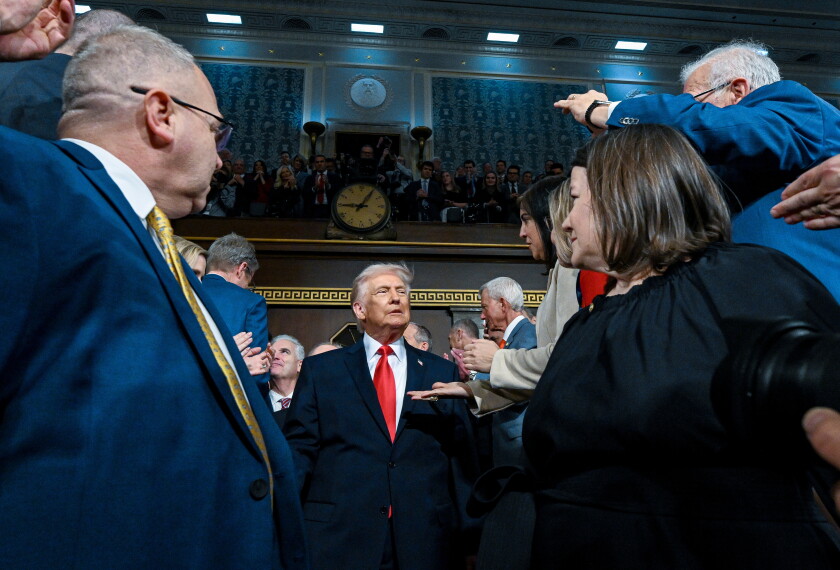
President Donald Trump enters to deliver the State of the Union address to a joint session of Congress in the House chamber at the U.S. Capitol in Washington, Tuesday, Feb. 24, 2026.
President Donald Trump enters to deliver the State of the Union address to a joint session of Congress in the House chamber at the U.S. Capitol in Washington, Tuesday, Feb. 24, 2026. The president devoted little time in the speech to discussing his education policies.
Kenny Holston/The New York Times via AP, Pool
Federal Education Department Will Send More of Its Programs to Other Agencies
Education grants for school safety, community schools, and family engagement will shift to Health and Human Services.
4 min read
Various school representatives and parent liaisons attend a family and community engagement think tank discussion at Lowery Conference Center on March 13, 2024 in Denver. One of the goals of the meeting was to discuss how schools can better integrate new students and families into the district. Denver Public Schools has six community hubs across the district that have serviced 3,000 new students since October 2023. Each community hub has different resources for families and students catering to what the community needs.
A program that helps state education departments and schools improve family engagement policies is among those the Trump administration will transfer from the U.S. Department of Education to the U.S. Department of Health and Human Services. In this photo, school representatives and parent liaisons attend a family and community engagement discussion on March 13, 2024, in Denver to discuss how schools can better integrate new students and families into the district.
Rebecca Slezak For Education Week
Federal New Trump Admin. Guidance Says Teachers Can Pray With Students
The president said the guidance for public schools would ensure "total protection" for school prayer.
3 min read
MADISON, AL - MARCH 29: Bob Jones High School football players touch the people near them during a prayer after morning workouts and before the rest of the school day on March 29, 2024, in Madison, AL. Head football coach Kelvis White and his brother follow in the footsteps of their father, who was also a football coach. As sports in the United States deals with polarization, Coach White and Bob Jones High School form a classic tale of team, unity, and brotherhood. (Photo by Jahi Chikwendiu/The Washington Post via Getty Images)
Football players at Bob Jones High School in Madison, Ala., pray after morning workouts before the rest of the school day on March 29, 2024. New guidance from the U.S. Department of Education says students and educators can pray at school, as long as the prayer isn't school-sponsored and disruptive to school and classroom activities, and students aren't coerced to participate.
Jahi Chikwendiu/Washington Post via Getty Images
Federal Ed. Dept. Paid Civil Rights Staffers Up to $38 Million as It Tried to Lay Them Off
A report from Congress' watchdog looks into the Trump Admin.'s efforts to downsize the Education Department.
5 min read
Commuters walk past the headquarters of the U.S. Department of Eduction, which were ordered closed for the day for what officials described as security reasons amid large-scale layoffs, on March 12, 2025, in Washington.
The U.S. Department of Education spent up to $38 million last year to pay civil rights staffers who remained on administrative leave while the agency tried to lay them off.
Mark Schiefelbein/AP
