Law & Courts

Retired Justice Souter, Advocate for Civics and Church-State Split, Dies at 85

By Mark Walsh — May 09, 2025 4 min read
Retired Supreme Court Justice David Souter smiles during a new lecture series titled, "Constitutionally Speaking" on Sept. 14, 2012 in Concord, N.H. Souter spoke to more than 1,300 who packed a small theater to hear him.
  • Save to favorites
  • Print

Retired U.S. Supreme Court Justice David H. Souter, a staunch defender of racial equity and the constitutional separation of church and state in education, died Thursday at home in New Hampshire, the court announced on Friday. He was 85.

Souter was appointed by President George H.W. Bush in 1990 to succeed liberal stalwart Justice William J. Brennan Jr. Over the next 19 years, he became a reliably liberal vote in several areas of school law before being succeeded by Justice Sonia Sotomayor in 2009.

He wrote a dissent to a 1995 decision that struck down a broad remedial desegregation plan for the Kansas City, Mo., schools, and in 2007 joined the dissent to a ruling that made it more difficult for school districts to consider race in assigning students to schools.

That same year, Souter was in dissent in a decision upholding the discipline of a student who displayed a “Bong Hits 4 Jesus” banner at an Alaska high school.

In 2009, just before he stepped down from the court, Souter wrote the majority opinion in Safford Unified School District v. Redding, which held that the strip search of a middle school student by school officials looking for drugs was unconstitutional.

“Here, the content of the suspicion failed to match the degree of intrusion,” Souter wrote, adding that requiring students to undress before school officials for the purposes of a search was “fairly understood as so degrading that a number of communities have decided that strip searches in schools are never reasonable.”

Warning about aid to religious schools

Souter was a strong proponent of a strict separation when it came to government embrace of religion in public education or state aid to religious schools.

In a 1992 decision, Lee v. Weisman, Souter joined the 5-4 majority that ruled clergy-led graduation prayers at a middle school violated the First Amendment’s prohibition against government establishment of religion.

“When public school officials, armed with the state’s authority, convey an endorsement of religion to their students, they strike near the core of the establishment clause,” Souter wrote in a concurrence.

In 2002, in Zelman v. Simmons-Harris, Souter wrote a bitter dissent from the court’s decision to uphold an Ohio program that created a pilot voucher program for Cleveland in which parents of that city’s schoolchildren could choose to send them to private religious schools at public expense. The majority said such vouchers were a neutral program resulting in aid to religious schools only through the “true private choice” of parents.

U.S. Supreme Court justices pose for a group portrait at the court in Washington on Nov. 9, 1990. Clockwise from top left are Justice Sandra Day O'Connor, Antonin Scalia, David Souter, John Paul Stevens, Thurgood Marshall, and Chief Justice William Rehnquist.

Souter said, “Religious teaching at taxpayer expense simply cannot be cordoned from taxpayer politics” and will lead to “expectable friction” in society.

“The ban on supporting religious establishment has protected free exercise” of religion, Souter added.

Just last month, in Oklahoma Statewide Charter School Board v. Drummond, the court considered similar arguments against the idea that states must fund religious charter schools.

In retirement, Souter regularly sat on panels of the U.S. Court of Appeals for the 1st Circuit, in Boston, including on several education cases. In one of those, he was a member of a unanimous three-judge panel that in 2020 upheld the state of Maine’s exclusion of “sectarian” schools from its program of paying private school tuition for its communities that lacked public high schools.

The Supreme Court reversed that decision in its 2022 ruling in Carson v. Makin, holding that the exclusion violates the free exercise clause. The Carson decision was cited by supporters of religious charters in the Oklahoma case that is pending a decision.

A commitment in retirement to civics education

Souter also became an advocate for civics education in his retirement, though he was not as much in the spotlight on the issue as the late Justice Sandra Day O’Connor, who started the iCivics program after she left the court, or Sotomayor, who sits on the board of directors for iCivics and has been outspoken on the issue.

“Civic education in the United States is not good enough, and we have to do something about it,” Souter said in an address to the American Bar Association in 2009, just months after he had retired, adding that there is a “risk to constitutional government when a substantial portion of the American populace” fails to learn basic civics.

Louise Dubé, the executive director of iCivics, recalled in an interview Friday traveling with O’Connor to New Hampshire in 2014 for a public appearance with Souter about civics.

Dubé was new to working with O’Connor, and the former justice was being a bit hard on her when Souter chimed in to say, “Give the kid a break,” she recalled. “He was incredibly kind and just a very humble person.”

Souter worked on civics efforts in New Hampshire, but he preferred to stay in the background, she said.

“He didn’t want it to be about him,” Dubé said. “It was always about the country.”

In his 2009 address to the ABA, Souter offered an observation that sounds familiar to points being made in recent speeches by current members of the Supreme Court, who appear to be responding to rhetorical attacks on judges by President Donald Trump or members of his administration.

“I’ll ask you to consider the danger to judicial independence when people have no conception of how the judiciary fits within the constitutional scheme,” Souter said.
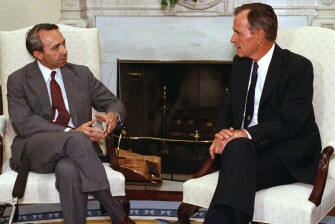
President George H.W. Bush talks with Supreme Court nominee Judge David Souter in the Oval Office of the White House, Sept. 13, 1990.

A version of this article appeared in the June 04, 2025 edition of Education Week as Retired Justice Souter, Advocate for Civics and Church-State Separation, Dies at 85

Events

This content is provided by our sponsor. It is not written by and does not necessarily reflect the views of Education Week's editorial staff.
Sponsor
Special Education Webinar
Bridging the Math Gap: What’s New in Dyscalculia Identification, Instruction & State Action
Discover the latest dyscalculia research insights, state-level policy trends, and classroom strategies to make math more accessible for all.
Content provided by TouchMath
This content is provided by our sponsor. It is not written by and does not necessarily reflect the views of Education Week's editorial staff.
Sponsor
School Climate & Safety Webinar
Belonging as a Leadership Strategy for Today’s Schools
Belonging isn’t a slogan—it’s a leadership strategy. Learn what research shows actually works to improve attendance, culture, and learning.
Content provided by Harmony Academy
This content is provided by our sponsor. It is not written by and does not necessarily reflect the views of Education Week's editorial staff.
Sponsor
School & District Management Webinar
Too Many Initiatives, Not Enough Alignment: A Change Management Playbook for Leaders
Learn how leadership teams can increase alignment and evaluate every program, practice, and purchase against a clear strategic plan.
Content provided by Otus

EdWeek Top School Jobs

Teacher Jobs
Search over ten thousand teaching jobs nationwide — elementary, middle, high school and more.
View Jobs
Principal Jobs
Find hundreds of jobs for principals, assistant principals, and other school leadership roles.
View Jobs
Administrator Jobs
Over a thousand district-level jobs: superintendents, directors, more.
View Jobs
Support Staff Jobs
Search thousands of jobs, from paraprofessionals to counselors and more.
View Jobs

Read Next

Law & Courts Supreme Court Strikes Trump Tariffs in Case Brought by Educational Toy Companies
Two educational toy companies were among the leading challengers to the president's tariff policies
3 min read
Members of the Supreme Court sit for a new group portrait following the addition of Associate Justice Ketanji Brown Jackson, at the Supreme Court building in Washington, Oct. 7, 2022. Bottom row, from left, Associate Justice Sonia Sotomayor, Associate Justice Clarence Thomas, Chief Justice of the United States John Roberts, Associate Justice Samuel Alito, and Associate Justice Elena Kagan. Top row, from left, Associate Justice Amy Coney Barrett, Associate Justice Neil Gorsuch, Associate Justice Brett Kavanaugh, and Associate Justice Ketanji Brown Jackson.
Members of the U.S. Supreme Court sit for a new group portrait following the addition of Justice Ketanji Brown Jackson, at the court building in Washington, Oct. 7, 2022. On Feb. 20, 2026, the court ruled 6-3 to strike down President Donald Trump's broad tariff policies, ruling that they were not authorized by the federal statute that he cited for them.
J. Scott Applewhite/AP
Law & Courts Mark Zuckerberg Quizzed on Kids' Instagram Use in Landmark Social Media Trial
The Meta chief testified in a court case examining whether the company's platforms are addictive and harmful.
5 min read
Meta CEO Mark Zuckerberg arrives for a landmark trial over whether social media platforms deliberately addict and harm children, Wednesday, Feb. 18, 2026, in Los Angeles.
Meta CEO Mark Zuckerberg arrives at a federal courthouse in Los Angeles on Feb. 18, 2026. Zuckerberg was questioned about the features of his company's platform, Instagram, and about his previous congressional testimony.
Ryan Sun/AP
Law & Courts California Sues Ed. Dept. in Clash Over Gender Disclosures to Parents
California challenges U.S. Department of Education findings on state policies over gender disclosure.
4 min read
California Attorney General Rob Bonta speaks to reporters as Arizona Attorney General Kris Mayes, left, and Oregon Attorney General Dan Rayfield, right, listen outside the Supreme Court on Wednesday, Nov. 5, 2025, in Washington. (AP Photo/Mark Schiefelbein)
California Attorney General Rob Bonta speaks to reporters outside the U.S. Supreme Court in Washington on Nov. 5, 2025, with Arizona Attorney General Kris Mayes and Oregon Attorney General Dan Rayfield behind him. Bonta this week sued the U.S. Department of Education, asking a court to block the agency's finding that the state is violating FERPA by <ins data-user-label="Matt Stone" data-time="02/13/2026 4:22:45 PM" data-user-id="00000185-c5a3-d6ff-a38d-d7a32f6d0001" data-target-id="">not requiring schools to disclose</ins> students’ gender transitions <ins data-user-label="Matt Stone" data-time="02/13/2026 4:22:45 PM" data-user-id="00000185-c5a3-d6ff-a38d-d7a32f6d0001" data-target-id="">to</ins> parents.
Mark Schiefelbein/AP
Law & Courts Oklahoma Board Rejects Jewish Charter as Supreme Court Fight Looms
Oklahoma's charter school board rejected the Jewish school as members said their hands were tied.
4 min read
Ben Gamla Charter Schools founder and former U.S. Rep. Peter Deutsch, right, speaks with Brett Farley, executive director of the Catholic Conference of Oklahoma, left, before a Jan. 12 meeting of the Statewide Charter School Board in Oklahoma City. Both are founding board members of an Oklahoma Jewish Charter School.
Ben Gamla Charter Schools founder and former U.S. Rep. Peter Deutsch, right, speaks with Brett Farley, executive director of the Catholic Conference of Oklahoma, before a Jan. 12, 2026, meeting of the Statewide Charter School Board in Oklahoma City. The board rejected the proposed Jewish charter school on Feb. 9, 2026.
Nuria Martinez-Keel/Oklahoma Voice
