
Law & Courts

States Sue Trump Over Education Department Firings

The lawsuit comes from 21 Democratic attorneys general. A department spokesperson said the cuts “will not directly impact students and families.”
By Brooke Schultz — March 13, 2025 4 min read
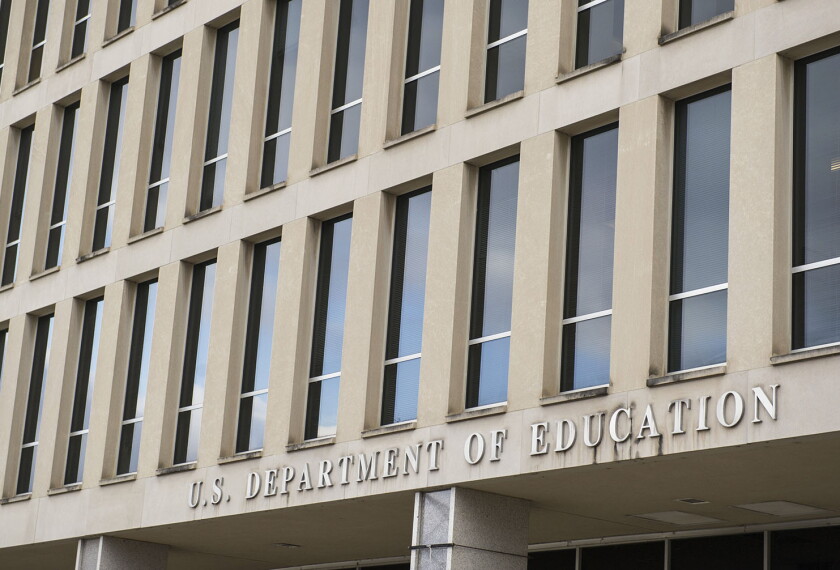
A commuter walks past the headquarters of the U.S. Department of Education, which were ordered closed for the day for what officials described as security reasons amid large-scale layoffs, Wednesday, March 12, 2025, in Washington.
  • Save to favorites
  • Print

The U.S. Department of Education’s massive firing of staff is an illegal overreach of the Trump administration’s authority because the move seeks to incapacitate the agency, argues a lawsuit filed Thursday by nearly two dozen Democratic attorneys general.

The lawsuit, filed in federal court in Massachusetts by 21 Democratic attorneys general from across the nation, asks a judge to halt the Education Department’s effort to halve its staff, a move that the attorneys argue is “causing immense damage” to state education systems.

The filing comes just days after the Education Department announced it would shrink its staff of more than 4,000 employees to fewer than 2,200. Education Secretary Linda McMahon confirmed in a Fox News interview Tuesday night that the reduction-in-force was a “first step” toward ultimately abolishing the department.
See Also

The exterior of the Department of Education Building in Washington, DC on Thursday, December 14, 2017.
The exterior of the Department of Education building in Washington on Thursday, December 14, 2017. The department's Washington office and regional offices will be closed on Wednesday for "security reasons," according to an email sent to staff members.
Swikar Patel/Education Week

The department’s elimination has been a long-standing campaign promise from President Donald Trump, who has been weighing an executive order to direct McMahon to prepare the department for closure. But shuttering the agency is an act that requires congressional approval.

The attorneys general argue that the massive reduction is “so severe and extreme” that it prevents the department from carrying out its congressionally mandated functions. As a result, it goes beyond the president’s authority, they argue.

“The RIF is part and parcel of President Trump’s and Secretary McMahon’s opposition to the Department of Education’s entire existence,” the lawsuit says.

Madi Biedermann, a department spokesperson, said in a statement that the reduction in force was “implemented carefully and in compliance with all applicable regulations and law.”

She added that no employees were terminated who work on programs for student loans, formula and grant programs, and student with disabilities, and the office for civil rights will continue fulfilling its role.

“They are strategic, internal-facing cuts that will not directly impact students and families,” Biedermann said.

The attorneys general suing represent Arizona, California, Colorado, Connecticut, Delaware, the District of Columbia, Hawaii, Illinois, Maine, Maryland, Massachusetts, Michigan, Minnesota, Nevada, New Jersey, New York, Oregon, Rhode Island, Vermont, Washington, and Wisconsin.

New York Attorney General Letitia James, right, and Connecticut Attorney General William Tong, left, speak during a news conference outside Manhattan federal court, Friday, Feb. 14, 2025, in New York.

Nothing allows the president to ‘gut an agency such that it can no longer meet its statutory obligations,’ lawyers argue

The Education Department, since it was created by Congress in 1979, touches nearly every level of the nation’s education system—from early education through higher education. It is the smallest Cabinet agency by employee headcount, overseeing a budget of approximately $80 billion. It distributes funding to schools, with its two largest funding streams supporting low-income students and students with disabilities, totaling roughly $34 billion. It manages more than $1.6 trillion in federal student loans from 45 million borrowers, as of 2024.

Beyond its financial charge, the department collects data, disseminates research, and investigates discrimination in schools and universities.

See Also

Chloe Kienzle of Arlington, Va., holds a sign as she stands outside the headquarters of the U.S. Department of Eduction, which were ordered closed for the day for what officials described as security reasons amid large-scale layoffs, Wednesday, March 12, 2025, in Washington.
Chloe Kienzle of Arlington, Va., holds a sign as she stands outside the headquarters of the U.S. Department of Education on Wednesday, March 12, 2025, in Washington. The department this week said it was cutting nearly half its staff.
Mark Schiefelbein/AP

Under the reduction in force, employees will be placed on leave beginning March 21, and will receive pay until early June. The firings disproportionately affected the department’s office for civil rights, its research arm, and its financial aid office—which is the largest by headcount.

The mass firings come as the department has already diminished its staff through a series of buyout offers and by firing probationary employees who didn’t yet have full civil servant protections. (A federal judge deemed the probationary firings unlawful, and ordered those employees be reinstated at six other federal agencies Thursday).

The attorneys general argue that the reduction in force violates the separation of powers, alleging that the president and McMahon are hurting the agency’s ability to fulfill its statutorily mandated responsibilities.

“Congress has granted the Secretary of Education limited discretion to reallocate functions within the Department, but that authority is modest, and in no way includes the power to eliminate statutorily-created functions,” the lawsuit argues.

Already, the cuts have caused system breakdowns and unresponsive administrators, the lawsuit argues. Losses of or delays in funding could harm funding to pay teacher salaries, curtail professional development for educators, and pause services for students with disabilities, the lawsuit argues.

Abolishing the department has been a perennial cause for Republicans.

Though Trump proposed its elimination in his first term, and his secretary of education at the time sought to consolidate offices within her limited authority, the effort did not pick up much steam. But the president’s administration has set an aggressive pace in his second term, and since he returned to the White House on Jan. 20, the Education Department has been a focus of the administration’s aggressive cost-cutting.

Dismantling the department is part of Project 2025, a 900-page conservative public policy agenda. Its authors have joined Trump’s administration, and Trump has already acted on several of its policy pieces.

During her confirmation hearing, McMahon echoed some of its outline for where to move key department functions if the agency were eliminated. She agreed shutting down the department would require Congress, and vowed to lawmakers that funding would not be touched if the agency were eliminated.

Events

This content is provided by our sponsor. It is not written by and does not necessarily reflect the views of Education Week's editorial staff.
Sponsor
Special Education Webinar
Bridging the Math Gap: What’s New in Dyscalculia Identification, Instruction & State Action
Discover the latest dyscalculia research insights, state-level policy trends, and classroom strategies to make math more accessible for all.
Content provided by TouchMath
This content is provided by our sponsor. It is not written by and does not necessarily reflect the views of Education Week's editorial staff.
Sponsor
School Climate & Safety Webinar
Belonging as a Leadership Strategy for Today’s Schools
Belonging isn’t a slogan—it’s a leadership strategy. Learn what research shows actually works to improve attendance, culture, and learning.
Content provided by Harmony Academy
This content is provided by our sponsor. It is not written by and does not necessarily reflect the views of Education Week's editorial staff.
Sponsor
School & District Management Webinar
Too Many Initiatives, Not Enough Alignment: A Change Management Playbook for Leaders
Learn how leadership teams can increase alignment and evaluate every program, practice, and purchase against a clear strategic plan.
Content provided by Otus

EdWeek Top School Jobs

Teacher Jobs
Search over ten thousand teaching jobs nationwide — elementary, middle, high school and more.
View Jobs
Principal Jobs
Find hundreds of jobs for principals, assistant principals, and other school leadership roles.
View Jobs
Administrator Jobs
Over a thousand district-level jobs: superintendents, directors, more.
View Jobs
Support Staff Jobs
Search thousands of jobs, from paraprofessionals to counselors and more.
View Jobs

Read Next

Law & Courts Appeals Court Allows Louisiana Ten Commandments Displays to Proceed
The court said it was premature to rule on the constitutionality of La. Ten Commandments displays.
3 min read
Students work under Ten Commandments and Bill of Rights posters on display in a classroom at Lehman High School in Kyle, Texas, Thursday, Oct. 16, 2025.
Students work under Ten Commandments and Bill of Rights posters on display in a classroom at Lehman High School in Kyle, Texas, Oct. 16, 2025. A federal appeals court has lifted a lower-court injunction blocking a Louisiana law that requires Ten Commandments displays, clearing the way for the law to take effect.
Eric Gay/AP
Law & Courts Social Media Companies Face Legal Reckoning Over Mental Health Harms to Children
Some of the biggest players from Meta to TikTok are getting a chance to make their case in courtrooms around the country.
6 min read
Social Media Kids Trial 26050035983057
Meta CEO Mark Zuckerberg leaves court after testifying in a landmark trial over whether social media platforms deliberately addict and harm children, on Feb. 18, 2026, in Los Angeles.
AP Photo/Damian Dovarganes
Law & Courts Supreme Court Strikes Trump Tariffs in Case Brought by Educational Toy Companies
Two educational toy companies were among the leading challengers to the president's tariff policies
3 min read
Members of the Supreme Court sit for a new group portrait following the addition of Associate Justice Ketanji Brown Jackson, at the Supreme Court building in Washington, Oct. 7, 2022. Bottom row, from left, Associate Justice Sonia Sotomayor, Associate Justice Clarence Thomas, Chief Justice of the United States John Roberts, Associate Justice Samuel Alito, and Associate Justice Elena Kagan. Top row, from left, Associate Justice Amy Coney Barrett, Associate Justice Neil Gorsuch, Associate Justice Brett Kavanaugh, and Associate Justice Ketanji Brown Jackson.
Members of the U.S. Supreme Court sit for a new group portrait following the addition of Justice Ketanji Brown Jackson, at the court building in Washington, Oct. 7, 2022. On Feb. 20, 2026, the court ruled 6-3 to strike down President Donald Trump's broad tariff policies, ruling that they were not authorized by the federal statute that he cited for them.
J. Scott Applewhite/AP
Law & Courts Mark Zuckerberg Quizzed on Kids' Instagram Use in Landmark Social Media Trial
The Meta chief testified in a court case examining whether the company's platforms are addictive and harmful.
5 min read
Meta CEO Mark Zuckerberg arrives for a landmark trial over whether social media platforms deliberately addict and harm children, Wednesday, Feb. 18, 2026, in Los Angeles.
Meta CEO Mark Zuckerberg arrives at a federal courthouse in Los Angeles on Feb. 18, 2026. Zuckerberg was questioned about the features of his company's platform, Instagram, and about his previous congressional testimony.
Ryan Sun/AP
