
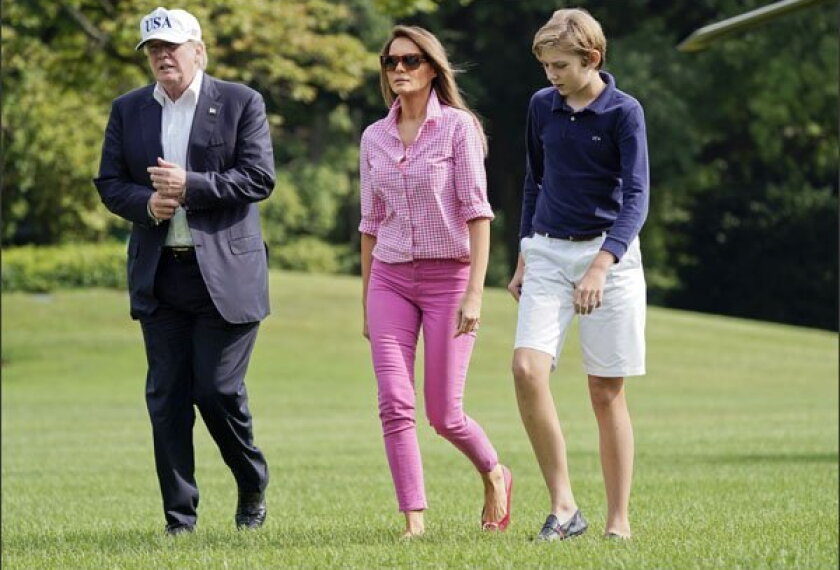
As millions of students start the 2017-18 school year, their ranks will include Barron Trump, the president’s youngest son, who heads off to a private school in the Washington suburbs.
Barron, 11, remained in New York City even after his father became president to finish out the school year at the Columbia Grammar and Preparatory School in Manhattan. But this fall, he’ll start classes at St. Andrew’s Episcopal School in Potomac, Md. In fact, Sept. 5 was the scheduled first full day of the school year, according to St. Andrew’s website.
Historically, schools that have taken on the task of educating presidential children have had to consider things like student privacy and security. So how well will Barron—and the school—adjust to the new arrangement?
Richard Jung, the executive director of the Association of Independent Schools of Greater Washington, expects the school will do everything to ensure that Barron’s experience is as normal as possible.
That seems to be what happened when the Clinton and Obama families sent their daughters to Sidwell Friends School, a Quaker school with campuses in the District of Columbia and suburban Maryland. (The Obamas are sticking around the nation’s capital so that Sasha Obama, their younger daughter, can finish her education there.)
There may have been an “extra charge” in the air at Sidwell when Chelsea Clinton and the Obama children enrolled, Jung said. But ultimately, “the kids did very well,” he said.
Personalized Experience
A spokesman for St. Andrews’ declined to comment. Sidwell Friends also declined to comment.
St. Andrew’s likely will be looking for a way to personalize Barron’s experience—because that’s what the school does for all its students, Jung said.
St. Andrew’s website highlights its connection with Research Schools International, which is led by faculty at the Harvard Graduate School of Education.
The school also partners with the brain-research team at Johns Hopkins University. St. Andrew’s is known for its Center for Transformative Teaching and Learning, which helps tailor instruction to students’ individual learning needs, whether they are high achievers or in need of more academic support. St. Andrew’s graduates often go on to Ivy League colleges, according to its website.
“St. Andrew’s is set up to make adjustments for individual kids. It wouldn’t be unique to Barron” and his status as the son of a president, Jung said. “It’s a hallmark of the school.”
St. Andrew’s is particularly interested in training its teachers on brain science and how it can be applied in the classroom, he said. “They really walk the walk on this.”
And he thinks the school is just far enough removed from Washington to allow Barron to get a break from the pressures of being the first kid. “I’m very, very happy for the boy,” he said.
St. Andrew’s has about 580 students, according to its website, making it a medium- to large-sized private school for the Washington area. The student-teacher ratio is 6-to-1, a lot lower than the national average of 16.1-to-1 in 2013, according to the National Center for Education Statistics. And tuition at St. Andrew’s runs from $23,490 for prekindergarten to $40,650 for high school.
Historical Perspective
So far, the Trump family seems to have put a premium on Barron’s privacy, which is not so different from how the two most recent presidents with minor children—Bill Clinton and Barack Obama—handled the challenge of raising a child in the White House.
“Presidential parents such as the Clintons and Obamas have worked to ensure that their children are given secure, private space within the [White House] as well as opportunities to interact openly but privately with peers inside and outside the building and (where possible) in school,” said Edward G. Lengel, the chief historian for the White House Historical Association, a nonprofit.
In recent years, presidential children have attended area private schools. But that wasn’t always the case, Lengel said. Quentin Roosevelt, Charlie Taft, and Amy Carter all attended District of Columbia public schools. And President John F. Kennedy’s family turned the White House solarium into a classroom. Their own children attended school there alongside the children of other government officials.
The Kennedys “were the only first family to use this as an actual schoolroom adhering to the regulations and academic requirements of D.C. public schools,” Lengel said.
The need for privacy was part of the reason the Kennedys choose to home-school their children in the White House, Lengel said. But that, too, wasn’t necessary until relatively recently.
“Until the 20th century, presidential children lived very much in the public eye and without much attention to security,” Lengel said. “By the mid-20th century and beyond, however, security for presidential families became a round-the-clock affair, and as media scrutiny increased, privacy became nearly impossible outside the actual confines of the White House.”
St. Andrew’s won’t be working alone in protecting Barron’s privacy and security, said Lengel’s colleague, Evan Phifer, a research historian.
“Balancing privacy, education, and security is an effort that incorporates cooperation between schools, first families, and Secret Service,” he said.


