Federal

Washington Test Data Rekindle Concerns Over Graduation Test

By Catherine Gewertz — June 20, 2006 3 min read
  • Save to favorites
  • Print

The first high school class that must pass an exit exam to graduate in Washington state has produced mixed results on its initial round of required tests, renewing debate about high-stakes testing there and raising interest in the support being offered to struggling students.

Eighty-six percent of the approximately 71,000 students tested this spring passed reading, and 84 percent passed the writing portion, on the Washington Assessment of Student Learning, or WASL. But only 54 percent passed the math portion. Students are permitted four more attempts to pass. (“Washington Readies for High School Exit Exam,” April 19, 2006.)

State Superintendent of Public Instruction Terry Bergeson welcomed the progress indicated by the language arts results—9 percentage points in reading and 13 percentage points in writing over the 2005 scores. But she acknowledged that much remains to be done in mathematics. Fifty-one percent of student passed that test in 2005.

“I don’t have any brilliant schemes today,” she said at a June 8 news conference announcing the results, according to The Seattle Times. “But I clearly know we have a challenge.”

What will remain unknown until at least August is what portion of the class of 2008 passed all three tests, which they must do to graduate. Last year, only 42.3 percent of those tested passed all three, raising worries about how much remediation might be required once passage was mandated for graduation.

The exam results sparked another round of discussion of the WASL.

Charles Hasse, the president of the 80,000-member Washington Education Association, said the union considers it “morally and politically untenable” to base graduation on a high-stakes test. The National Education Association affiliate would rather see the WASL considered alongside other factors, such as a student’s grades and teachers’ professional judgment, in considering whether students deserve diplomas.

Marc Frazer, the vice president of the Washington Roundtable, a business group in the state that supports the WASL, said the test was a sobering gauge of how far students still must go to be competitive in college and jobs.

“It does students no favor to graduate them without the skills they need for college and work,” he said.

Earlier Results

Cognizant that this year’s sophomores would have to pass all three tests, Washington legislators built in additional requirements and support.

The lawmakers in 2005 required education officials to find a way to return individual test results earlier in 2006 so students and their families would have enough time to plan for summer school, WASL retakes, and fall courses, said Kim Schmanke a spokeswoman for the state department of education.

The reading and writing tests, which take longer to score than the math exams, were moved back to March, three weeks earlier than usual, and the results were delivered in mid-June rather than the usual mid-August, Ms. Schmanke said.

This year, the legislature provided $28 million for summer and school-year remedial programs, which students who failed one or more of the tests can use in any of Washington’s 296 school districts, not only their home districts, Ms. Schmanke said.

Starting this fall, the state will offer alternative ways of showing proficiency to students having trouble passing the WASL. The students may attempt to show proficiency through a collection of their work, or by demonstrating that they earned grades comparable to those of students who passed the WASL in the pertinent subject areas.

In math only, they may prove mastery with strong scores on such tests as the SAT or ACT college-entrance exam.

In addition to passing the three WASL tests, students must complete a culminating project, design a plan for their high school and postsecondary years, and satisfy all course requirements to graduate.
A version of this article appeared in the June 21, 2006 edition of Education Week as Washington Test Data Rekindle Concerns Over Graduation Test

Events

This content is provided by our sponsor. It is not written by and does not necessarily reflect the views of Education Week's editorial staff.
Sponsor
School & District Management Webinar
Too Many Initiatives, Not Enough Alignment: A Change Management Playbook for Leaders
Learn how leadership teams can increase alignment and evaluate every program, practice, and purchase against a clear strategic plan.
Content provided by Otus
This content is provided by our sponsor. It is not written by and does not necessarily reflect the views of Education Week's editorial staff.
Sponsor
Artificial Intelligence Webinar
Beyond Teacher Tools: Exploring AI for Student Success
Teacher AI tools only show assigned work. See how TrekAi's student-facing approach reveals authentic learning needs and drives real success.
Content provided by TrekAi
This content is provided by our sponsor. It is not written by and does not necessarily reflect the views of Education Week's editorial staff.
Sponsor
College & Workforce Readiness Webinar
Building for the Future: Igniting Middle Schoolers’ Interest in Skilled Trades & Future-Ready Skills
Ignite middle schoolers’ interest in skilled trades with hands-on learning and real-world projects that build future-ready skills.
Content provided by Project Lead The Way

EdWeek Top School Jobs

Teacher Jobs
Search over ten thousand teaching jobs nationwide — elementary, middle, high school and more.
View Jobs
Principal Jobs
Find hundreds of jobs for principals, assistant principals, and other school leadership roles.
View Jobs
Administrator Jobs
Over a thousand district-level jobs: superintendents, directors, more.
View Jobs
Support Staff Jobs
Search thousands of jobs, from paraprofessionals to counselors and more.
View Jobs

Read Next

Federal Trump Talks Up AI in State of the Union, But Not Much Else About Education
The president didn't mention two of his cornerstone education policies from the past year.
4 min read
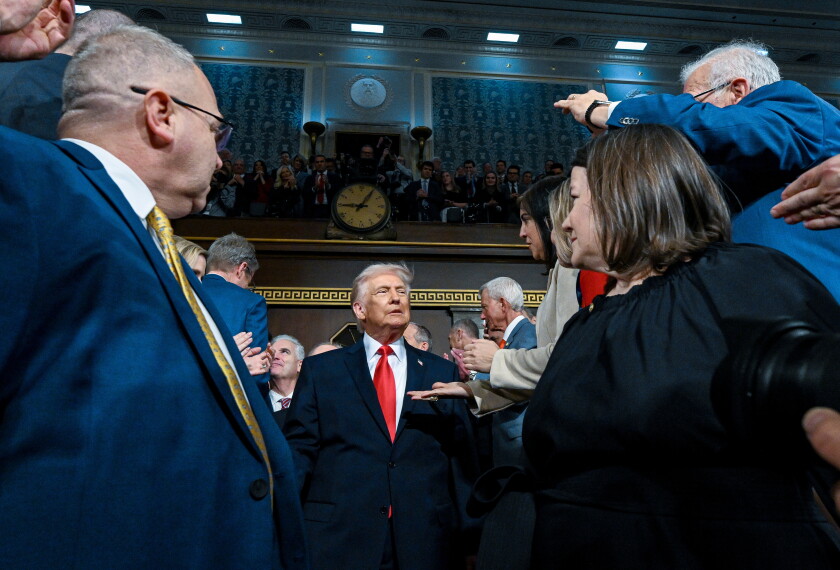
President Donald Trump enters to deliver the State of the Union address to a joint session of Congress in the House chamber at the U.S. Capitol in Washington, Tuesday, Feb. 24, 2026.
President Donald Trump enters to deliver the State of the Union address to a joint session of Congress in the House chamber at the U.S. Capitol in Washington, Tuesday, Feb. 24, 2026. The president devoted little time in the speech to discussing his education policies.
Kenny Holston/The New York Times via AP, Pool
Federal Education Department Will Send More of Its Programs to Other Agencies
Education grants for school safety, community schools, and family engagement will shift to Health and Human Services.
4 min read
Various school representatives and parent liaisons attend a family and community engagement think tank discussion at Lowery Conference Center on March 13, 2024 in Denver. One of the goals of the meeting was to discuss how schools can better integrate new students and families into the district. Denver Public Schools has six community hubs across the district that have serviced 3,000 new students since October 2023. Each community hub has different resources for families and students catering to what the community needs.
A program that helps state education departments and schools improve family engagement policies is among those the Trump administration will transfer from the U.S. Department of Education to the U.S. Department of Health and Human Services. In this photo, school representatives and parent liaisons attend a family and community engagement discussion on March 13, 2024, in Denver to discuss how schools can better integrate new students and families into the district.
Rebecca Slezak For Education Week
Federal New Trump Admin. Guidance Says Teachers Can Pray With Students
The president said the guidance for public schools would ensure "total protection" for school prayer.
3 min read
MADISON, AL - MARCH 29: Bob Jones High School football players touch the people near them during a prayer after morning workouts and before the rest of the school day on March 29, 2024, in Madison, AL. Head football coach Kelvis White and his brother follow in the footsteps of their father, who was also a football coach. As sports in the United States deals with polarization, Coach White and Bob Jones High School form a classic tale of team, unity, and brotherhood. (Photo by Jahi Chikwendiu/The Washington Post via Getty Images)
Football players at Bob Jones High School in Madison, Ala., pray after morning workouts before the rest of the school day on March 29, 2024. New guidance from the U.S. Department of Education says students and educators can pray at school, as long as the prayer isn't school-sponsored and disruptive to school and classroom activities, and students aren't coerced to participate.
Jahi Chikwendiu/Washington Post via Getty Images
Federal Ed. Dept. Paid Civil Rights Staffers Up to $38 Million as It Tried to Lay Them Off
A report from Congress' watchdog looks into the Trump Admin.'s efforts to downsize the Education Department.
5 min read
Commuters walk past the headquarters of the U.S. Department of Eduction, which were ordered closed for the day for what officials described as security reasons amid large-scale layoffs, on March 12, 2025, in Washington.
The U.S. Department of Education spent up to $38 million last year to pay civil rights staffers who remained on administrative leave while the agency tried to lay them off.
Mark Schiefelbein/AP
