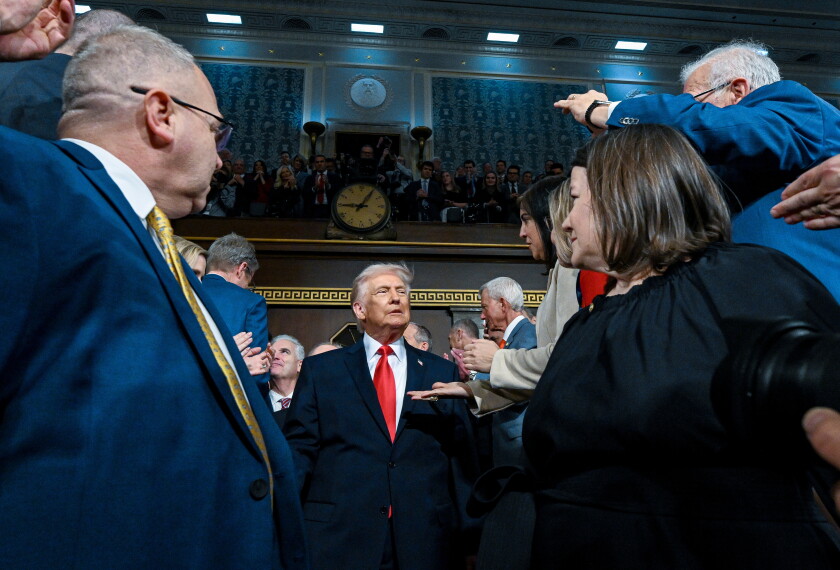
A prominent and sustained White House push for renewal of the Elementary and Secondary Education Act—which is widely expected to be part of President Barack Obama’s State of the Union address next week—is viewed as crucial to prospects for the 9-year-old law’s reauthorization by a now-divided Congress.
The law’s current version, the No Child Left Behind Act, was President George W. Bush’s signature domestic achievement when it was passed in late 2001 with big, bipartisan majorities. Now it is considered outdated by practitioners and policymakers from all parts of the political spectrum.
Last March, the Obama administration released a blueprint for overhauling the ESEA, and even proposed $1 billion extra for K-12 education if Congress approved the proposal. But while lawmakers in both the House of Representatives and the Senate met regularly last year to discuss a renewal, neither chamber introduced a reauthorization bill.
With Republicans now in control of the House, and Democrats divided on what changes should be made to the law, the importance of a full-court press by the White House may be even greater, observers say.
“My view has always been the only way this makes it to the finish line is if the president rolls up his sleeves and gets personally involved, and even then I think it’s going to be tough,” said Vic Klatt, a principal at Penn Hill Group, a government-relations and advocacy organization in Washington.
For the past year, U.S. Secretary of Education Arne Duncan has been championing ESEA overhaul on Capitol Hill. Mr. Klatt, a former top aide to Republicans on the House education committee, gives him high marks for his outreach.
But, he added, “having a president put his or her prestige on the line to try to pass a bill sends an entirely different message [to lawmakers] than a Cabinet official.”
President Obama briefly called for an ESEA renewal in his State of the Union Address last year, but did not make it a focal point of the speech. On the day the blueprint was released, he made a bid for overhauling the law in his weekly radio address. But the ESEA never became a regular part of his stump speech.
Although most education advocates think a high-profile pitch from the White House would provide momentum for the ESEA this year, any legislation to reauthorize the law faces a bumpy road, in no small part because of divisions within each party on the best direction to take on federal K-12 policy.
And it’s unclear to what extent Republican leaders—who share common ground with the administration on issues such as teacher quality—will want to work with Mr. Obama on education.
Rep. John A. Boehner, the Ohio Republican who is the new speaker of the House, chaired the House education committee when Congress approved the No Child Left Behind version of the ESEA, which sought to make schools more accountable for students’ academic performance. His role this time will be pivotal.
“The question will be, do they see it in their interest politically to let Obama have the win?” Charles Barone, the director of federal policy for Democrats for Education Reform, a New York City-based political action committee, said of congressional Republicans. He said he thinks that lawmakers can find common ground “if they are given the green light to execute” by their leaders.
On the other side of the Capitol, U.S. Sen. Tom Harkin, D-Iowa, the chairman of the Senate, Health, Education, Labor, and Pensions Committee, is aiming for his panel to consider a bill by Easter, and then bring the measure to the floor in late spring or early summer, according to Justine Sessions, a spokeswoman for the committee.
The GOP education leaders in that chamber, including Sen. Michael B. Enzi of Wyoming, the top Republican on the Senate education committee, and Sen. Lamar Alexander of Tennessee, the top Republican on its K-12 policy subcommittee, have a history of working across the political aisle on education issues. But neither has provided a wholesale endorsement of the administration’s reauthorization proposal.
Policy Blueprint
The ESEA blueprint the Obama administration rolled out last year sought to tie teacher evaluation in part to student test scores and to give states more control over how to help schools improve student progress, while adhering to a stringent set of strategies for schools that are struggling most.
It also called for states to get students ready for college or a career, as distinguished from just bringing them to proficiency on tests.
But at the time the proposal was introduced, Congress was in the middle of a pitched battle over health-care reform, which left lawmakers with little energy to tackle another tricky domestic-policy issue.
Even without a revision of the ESEA, the administration has been able to push much of its K-12 agenda through the American Recovery and Reinvestment Act, the federal economic-stimulus program, which provided some $100 billion for education.
In particular, the $4 billion Race to the Top competition spurred states to embrace more uniform, rigorous standards and revise their charter school laws, as well as revisit teacher tenure and evaluation.
Some members of Congress—including Rep. John Kline, R-Mich., the chairman of the House Education and the Workforce Committee, —have questioned whether states should have been given an edge in the Race to the Top competition for embracing common standards. But, in general, there hasn’t been major criticism by the GOP of the administration’s agenda as outlined in the Race to the Top.
“I think we have a great foundation of bipartisan enthusiasm for what we have done and for what we want to do,” said Peter Cunningham, the U.S. Department of Education’s assistant secretary for communications and outreach. “We’ve got good, strong relationships on the state level. … This is an issue where there is a strong center, and that’s meaningful.”
Intraparty Splits
But there are deep intraparty differences on education redesign—particularly within the Democratic Party—which many say could doom any effort to renew the ESEA.
For instance, the 3.2 million-member National Education Association, typically a strong ally of the party, has been sharply critical of the Obama administration’s push to tie decisions on teacher evaluation and tenure partly to student test scores.
The NEA’s opposition to that policy helped sink an ESEA reauthorization discussion draft that was introduced in 2007 by Rep. George Miller, D-Calif., who at the time was the chairman of the House education committee. He’s now the committee’s top Democrat.
“What’s going to prevent this from happening are Democrats versus Democrats,” said Patrick Riccards, an education consultant based in Falls Church, Va.
But a high-profile pitch from President Obama has a chance of changing that dynamic, he added. After losing the House of Representatives in the 2010 midterm elections, Democrats are unlikely to agree to proposals that teachers’ unions don’t like without political cover from the president, said Mr. Riccards, who served as an aide to Democrats in Congress.
“Unless they know the White House has their backs, they’re not willing to go to the mattresses at this point,” he said.
On the GOP side of the aisle, a number of Republicans, particularly those backed by the tea party movement, campaigned on the idea of completely scrapping the Education Department and are unlikely to embrace anything that smacks of an increased federal role.
But Mr. Barone thinks it’s time to have the ESEA debate.
“We’re nine years into a law that most people want to have fixed,” he said.
But despite that sentiment—and the possibility of a presidential push—the legislation still faces long odds, Mr. Klatt said.
“It’s hard to pass a bill when both parties are split internally—it just is,” he said.