Special Report
Assessment

Gauging Student Learning

By Lynn Olson — December 29, 2006 2 min read
  • Save to favorites
  • Print

Even the best early-childhood programs cannot guarantee educational success.

“To expect effects to be sustained throughout childhood and adolescence, at their initial high levels, in the absence of continued high-quality schooling,” says Jeanne Brooks-Gunn, a professor of education at Teachers College, Columbia University, “is to believe in magic.”

See Also

Last year, Quality Counts looked at the progress states have made in raising student achievement in elementary and secondary schools over more than a decade as measured by the National Assessment of Educational Progress, or NAEP, often known as “the nation’s report card.”

When looked at over that longer time period, student achievement has gotten better, particularly in mathematics and for low-income and African-American and Hispanic students. But reading achievement has barely budged since 1992. And high school achievement remains flat.

Moreover, achievement gaps by race and class remain daunting: Near the end of high school, African-American and Latino students have reading and math skills that are virtually the same as those of white 8th graders.

Large proportions of students—particularly poor and minority teenagers—also fail to graduate from high school within four years. And even those who do may not be ready for college. Despite calls for more young people who are trained in math and science, for example, just over half of high school students took upper-level math courses in 2004, and just one in three took upper-level science courses.

Data Download

K-12 AchievementPDFExcel

To help provide a picture of K-12 performance across states, Quality Counts 2007 includes an achievement index that assigns points to each state based on whether its students are significantly above or below the national average on 15 indicators: the percent of students scoring at the “proficient” level or higher on NAEP reading and math tests in grades 4 and 8; the average change in NAEP scores in both grades and subjects from 2003 to 2005; the gap in NAEP math performance between 8th graders who are and are not eligible to receive subsidized school meals, and the change in that gap between 2003 and 2005; the high school graduation rate and the change in that rate between 2000 and 2003; the number of Advanced Placement scores of 3 or higher (out of a possible 5) for every 100 public high school students, and the change in that figure from 2000 to 2005; and the percent of 8th graders scoring at the “advanced” level on the NAEP math exam.

Accompanying Charts

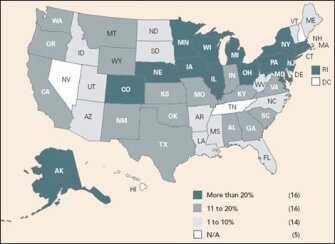
  • Graduation-Rate Advantage The socioeconomic makeup of districts is strongly related to graduation rates. Low-poverty districts, where the percentage of students eligible for free or reduced-price lunches is below the national average, tend to have much better graduation rates than high-poverty districts (those in which the poverty level exceeds the national average of 38.7 percent). But that graduation-rate advantage is much more pronounced in some states than in others.
BRIC ARCHIVE

  • Math-Performance Disparities Early disparities in math performance by race and ethnicity persist throughout elementary and high school. Toward the end of high school, black and Hispanic teenagers score at levels slightly below non-Hispanic white 8th graders, based on data from the National Assessment of Educational Progress.
BRIC ARCHIVE

Massachusetts, New Jersey, and Vermont are the top performers on the achievement index, while Mississippi, West Virginia, New Mexico, Hawaii, and Alabama perform at the bottom.

The index underscores the conclusions of a recent paper by economists James J. Heckman and Flavio Cunha of the University of Chicago: “Early investment in cognitive and noncognitive skills lowers the cost of later investment by making learning at later ages more efficient,” they write. But they add: “Early investments must be followed up by later investments in order to be effective.”

Related Tags:

In March 2024, Education Week announced the end of the Quality Counts report after 25 years of serving as a comprehensive K-12 education scorecard. In response to new challenges and a shifting landscape, we are refocusing our efforts on research and analysis to better serve the K-12 community. For more information, please go here for the full context or learn more about the EdWeek Research Center.

Events

This content is provided by our sponsor. It is not written by and does not necessarily reflect the views of Education Week's editorial staff.
Sponsor
Webinar
Smarter Tools, Stronger Outcomes: Empowering CTE Educators With Future-Ready Solutions
Open doors to meaningful, hands-on careers with research-backed insights, ideas, and examples of successful CTE programs.
Content provided by Pearson
Webinar Supporting Older Struggling Readers: Tips From Research and Practice
Reading problems are widespread among adolescent learners. Find out how to help students with gaps in foundational reading skills.
This content is provided by our sponsor. It is not written by and does not necessarily reflect the views of Education Week's editorial staff.
Sponsor
Reading & Literacy Webinar
Improve Reading Comprehension: Three Tools for Working Memory Challenges
Discover three working memory workarounds to help your students improve reading comprehension and empower them on their reading journey.
Content provided by Solution Tree

EdWeek Top School Jobs

Teacher Jobs
Search over ten thousand teaching jobs nationwide — elementary, middle, high school and more.
View Jobs
Principal Jobs
Find hundreds of jobs for principals, assistant principals, and other school leadership roles.
View Jobs
Administrator Jobs
Over a thousand district-level jobs: superintendents, directors, more.
View Jobs
Support Staff Jobs
Search thousands of jobs, from paraprofessionals to counselors and more.
View Jobs

Read Next

Assessment Opinion I Don’t Offer My Students Extra Credit. Here’s What I Do Instead
There isn’t anything "extra," but there is plenty my students can do to improve their grade.
Joshua Palsky
4 min read
A student standing on a letter A mountain peak with other letter grades are scattered in the vast landscape.
Vanessa Solis/Education Week + DigitalVision Vectors
Assessment Download How Digital Portfolios Help Students Showcase Skills and Growth
Electronic folders showcase student learning and growth over time, and can form a platform for post-high school endeavors.
1 min read
Vector illustration image with icons of digital portfolio concepts: e-portfolios; goals; ideas; feedback; projects, etc.
iStock/Getty
Assessment Here's What Teachers Really Think About Equitable Grading Policies
A new study examines the prevalence of policies like no zeroes or unlimited retakes in classrooms.
4 min read
A classroom is seen at Woodmore Elementary @ Meadowbrook on August 15, 2025 in Bowie, Maryland. In a so-called ‘swing move,’ Woodmore Elementary has relocated to Meadowbrook Elementary school until Summer 2027.
A classroom is seen at Woodmore Elementary @ Meadowbrook on August 15, 2025 in Bowie, Md. A new survey shows most teachers have begun to use some elements of what's known as equitable grading.
Pete Kiehart for Education Week
Assessment What Teachers Really Think About State Testing
State testing remains a complicated debate amongst educators as the end-of-year assessments take place.
1 min read
A teacher points to a board as students listen in a fourth grade classroom at William Jefferson Clinton Elementary in Compton, Calif., on Feb. 6, 2025.
A teacher points to a board as students listen in a fourth grade classroom at William Jefferson Clinton Elementary in Compton, Calif., on Feb. 6, 2025. State testing happens every spring and educators share their thoughts on whether these assessments accurately reflect student learning.
Eric Thayer/AP
