
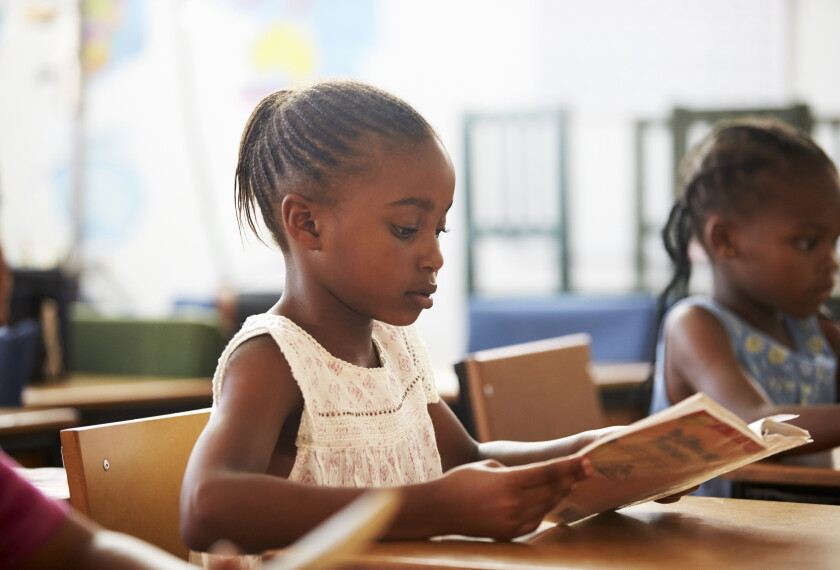
For Black and Brown children in the United States, a major part of their schooling experience is associated with White female teachers who have no understanding of their culture. That was certainly my experience. My K-12 schooling was filled with White teachers who, at their core, were good people but unknowingly were murdering my spirit with their lack of knowledge, care, and love of my culture.
Fast forward 25 years. Now my job is teaching future educators about what it takes to teach beautiful Black children. No matter where I go, when I ask future teachers why they want to teach–especially White women, who make up the vast majority of all teachers—their first or second answer is always: “I love children,” followed by, without taking a breath, “I love all children.” The word “all” is meant to signal, “I am not racist; I am fit to be in the classroom with children of color.” The statement is used to show that White teachers can be kind to every Black and Brown child that walks through their classroom doors. But how can you love or care for someone you know so little about?
I do not think White teachers enter the profession wanting to harm children of color, but they will hurt a child whose culture is viewed as an afterthought.
A few years ago, a White student of mine wrote in a paper that traveling to South Africa for a missionary trip was the first time she had been around African-American students. I simply wrote on her paper, “See me after class.” I informed her that she had not been interacting with African-American people but with South Africans. I told her African-Americans are right here in Georgia. I am one of them. Her face turned red. She was embarrassed and assured me that she knew the difference.
After our brief chat, one thing was clear: Yes, she knew the difference, but her interactions with African-Americans were clearly limited, and so much about our very existence was unknown to her.
As an interesting exercise, I ask my students to guess the percentage of Black people in the U.S. population. I am always blown away that their estimations are so high: guesses range from 20 to 40 percent. In reality, Black folks make up just less than 14 percent of the U.S. population. So, if you have limited interactions with Black folks, how can you think there are so many of us?
Black folks are highly visible and invisible at the same time in America—just look at Sunday and Monday night football. Former NFL quarterback Colin Kaepernick took a knee during the national anthem to bring attention to police brutality and the killings of Black and Brown people by law enforcement. Him taking a knee became highly visible; the Black deaths he took a knee to bring attention to were invisible in his fight to many White Americans. The sad truth is that White people can spend their entire lives dismissing dark people’s existence and still be successful in life. Unfortunately, the same cannot be said for us.
Let me be clear: I do not think White teachers enter the profession wanting to harm children of color, but they will hurt a child whose culture is viewed as an afterthought.
Teachers who disregard the impact of racism on Black children’s schooling experiences, resources, communities, and parent interactions will do harm to children of color. This ignorance is not just a painful sign of a blatant lack of information—a function of racism is to erase the history and contributions of people of color—it is a dangerous situation as these teachers go on to take jobs in schools filled with Black and Brown children. This turns schools into places that mirror society instead of improving it. The hard truth is that racism functions as a “superpredator” of Black and Brown children within our schools.
There is no easy fix to this problem, but there are solutions. Future teachers should be required to take classes such as African studies, African-American studies, Latinx studies, Caribbean studies, Chicana/o studies, Asian and Southeast Asian studies, and Native American studies.
There also needs to be a push to recruit future teachers of color as early as high school, pay for their college education, and mentor them when they enter the classroom. Research consistently shows that teachers of color have higher expectations of students of color, which leads to more students of color referred to gifted programs. Moreover, having a teacher of color helps students confront issues of racism.
Before they ever step into a classroom, teachers need to work in urban school communities to understand the beauty and the difficulty of teaching in that environment and to examine how racism functions to allow schools to be underresourced and students labeled at-risk.
But, at the end of the day, White teachers need to want to address how they contribute to structural racism. They need to join the fight for education justice, racial justice, housing justice, immigration justice, food justice, queer and trans justice, labor justice, and, above all, the fight for humanity.
So, the question is not: Do you love all children? The question is: Will you fight for justice for Black and Brown children? And how will you fight? I argue that you must fight with the creativity, imagination, urgency, boldness, ingenuity, and rebellious spirit of abolitionists to advocate for an education system where all Black and Brown children are thriving. I call this abolitionist teaching. To love all children, we must struggle together to create the schools we are taught to believe are impossible: Schools built on justice, love, joy, and anti-racism.


