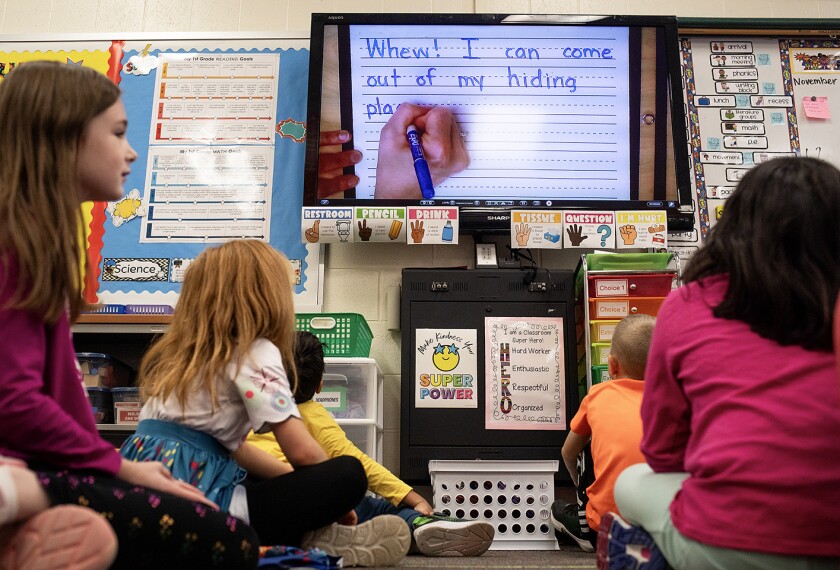
As a reward for its recent good behavior, my daughter’s 4th grade class was preparing to vote on an animated movie to watch in class. And as a mathematician and college professor with a particular interest in how math plays a role in political decisionmaking, I asked her to share the results of the class vote with me. We had recently been discussing different voting methods and their merits at the dinner table, and as my kids sometimes do when I wear my professor hat at home, my daughter teased, “You just want to see if we’ll pick the movie that’s not most people’s first choice, right?”
She was correct. And when she dutifully reported the outcome from the class’ vote (“Bolt” received eight votes; “Incredibles 2" six; and “Coco” three) and informed me that the class watched “Bolt” because it got the most votes, I realized that the mathematical deficits of plurality voting—a method we use to elect so many of the people who represent us, including our president—have an impact on even the simplest decisions we make. The good news is that opportunities for teaching the critical role that math plays in the American political system in a way that resonates even with a 9-year-old abound. And we need to create classroom experiences that are conducive to this now more than ever.
We are in the middle of an election cycle already imbued with a post-truth disregard for facts.
Misleading statistics, sham metrics, cooked numbers, and erroneous alternative science herald a precipitous decline of rigorous thinking, starting with the erosion and weaponization of that rigor’s foundation—mathematics. One does not need to understand math to use it for political gain, for good or for evil. Politicians regularly toss out numbers, such as how many immigrants are crossing the border; the millions spent on abortions at Planned Parenthood; the trillions spent on the war in Afghanistan; the percentage of wealth held by a fraction of our population; and most recently, the scope of the coronavirus outbreak.
Whether these numbers are manipulated, fabricated, or real, both sides of the aisle deploy them to elicit an emotional response from us. This succeeds all too frequently because relying on emotion and defaulting to unquantifiable criteria—moral, religious, and communal—to make decisions (or take a position) is often easier than analyzing the data, statistics, and numbers to do so. The inability to scrutinize and distinguish between bad and good math in political contexts is detrimental to effective citizenship. Greater numeracy leads to greater agency in political decisionmaking and can make us better consumers of democracy. As long as we are fooled by unsubstantiated math or perplexed by its rigor, our democracy is in peril.
The only substantive solution to this problem is more education aimed at cultivating political numeracy. My college students are frequently incredulous that they have not learned more about the math behind some key democratic processes like voting, the Electoral College, apportionment of legislative seats, and gerrymandering.
This means that we are not doing a good enough job in teaching our students about subjects that have unparalleled importance for democracy and occupy a unique place in the intersection of mathematics, statistics, computer science, political science, history, and economics. For example, there is no reason why mathematically superior ways to vote, such as ranked-choice methods that incorporate more information about voters’ preferences, should not be taught in our schools. Ultimately, having this knowledge would empower students to demand a better voting system.
We also need mathematics education that emphasizes political quantitative literacy—the ability to examine and assess data and statistical information in a political context. We could achieve this by incorporating more real-life examples from voting, taxation, crime, climate change, or immigration in scenarios that foster numerical and data skills like statistical analysis or the assessment and weighing of evidence in the context of politics in our instruction.
This integrated mathematics and politics education—one that teaches more about the mathematics behind democratic processes, and uses real-life political data—would cultivate students’ critical thinking because of its interdisciplinary nature and the depth of the issues it scrutinizes.
It would provide the tools to identify political matters that should be tackled mathematically, recognize when mathematics is being misused for political gain, demand mathematical rigor in politics, and enact changes in the political system based on sensible mathematical evidence.
We are in the middle of an election cycle already imbued with a post-truth disregard for facts. We can lament the deterioration of informed participation in our democracy. Or we can work to empower our kids (and ourselves) by giving them the tools of mathematical political literacy with which they can transform politics and ensure that it remains based in truth—the only place where democracy thrives. It is never too early to start. Just ask my 9-year-old daughter.