
A majority of the students who took the nation’s second-most-popular college-admissions test before they graduated this year were far from ready for the academic rigors awaiting them on higher education campuses, a study shows.
“Crisis at the Core: Preparing All Students for College and Work” is available from ACT. (Requires Adobe’s Acrobat Reader.)
Seventy-eight percent of students who took the ACT were not prepared for college-level biology, algebra, or English-composition classes, according to the report released last week by the Iowa City, Iowa, testing service.
That study, “Crisis at the Core: Preparing All Students for College and Work,” emerges as a growing number of state and national elected officials are bemoaning the dearth of academic skills among teenagers and are pushing to make improvements to high schools that rival those that have touched on other aspects of K-12 education.
The new report, however, suggests any such changes may not bring quick results. It finds that 8th, 9th, and 10th graders fared at least as poorly on ACT-sponsored tests of their college readiness as this year’s graduates.
High school students face two well-documented pitfalls in preparing for college, the report says: Not enough of them are taking challenging classes, and the quality of those courses, which may look rigorous on paper, varies greatly by school. The study concludes that a wide range of students, not just high achievers, can benefit from taking more demanding classes.
“The fact is, American high school students are not ready for college, and they’re not ready for work,” said Cynthia B. Schmeiser, the ACT’s vice president for development, at an event earlier this month detailing the study’s results. “This message is not getting out. It is not well understood, and it is not being done in practice.”
Soft at the Core
Moreover, ACT officials said their findings led them to reconsider their view—espoused by the testing service for almost 20 years—that a core high school curriculum of four years of English and three years of mathematics and science was sufficient for students to be prepared for college. Students who took more than that minimum were far more likely to succeed in college, the study found.
The Education Commission of the States recently identified more than 25 public and private organizations that have recently studied or sought ways to improve academic rigor in high schools, including the National Governors Association and the Council of the Great City Schools, a Washington-based coalition of many of the nation’s largest school systems. President Bush has made high school reform a piece of his re-election platform; his Democratic challenger, Sen. John Kerry of Massachusetts, has a plan of his own.
“Almost everything you see out there today is high school, high school, high school,” said Kathy Christie, the vice president for the research arm at the ECS, a Denver-based policy organization that studies state education trends. “There’s a growing recognition that the gap needs to be addressed.”
Science at Bottom
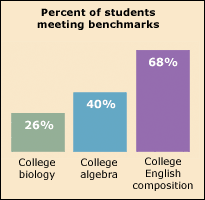
The ACT study—which echoes the results of reports released by several academic and policy organizations in recent years—found that only 26 percent of 2004 high school graduates who took the college-entrance test were academically prepared to take college biology, that just 40 percent were ready for college algebra, and that 68 percent were ready for English composition at the postsecondary level.
Unlikely to Succeed
SOURCE: ACT Inc.
Among blacks, Hispanics, and Native Americans, those numbers were consistently lower. Only 11 percent of African-Americans, 24 percent of Hispanics, and 23 percent of Native Americans were academically prepared for college algebra, compared with 46 percent of whites and 57 percent of students of Asian descent. Just 5 percent of African-Americans, 12 percent of Hispanics, and 15 percent of Native Americans were college-ready in biology, compared with 33 percent of Asians and 31 percent of whites, the study found.
To judge whether students were ready for college, the ACT first performed an analysis of 90,000 students who took the test in recent years and then looked at how they performed academically at 98 different two- and four-year institutions.
ACT officials then established minimum scores on their test (which is conducted on a scale of 1 to 36, in English, mathematics, social studies, and science) that corresponded with students’ having a strong chance of getting a C or better in certain college courses.
Those benchmark ACT scores are 18 in English, 22 in algebra, and 24 in biology. The testing company then looked at what percentage of 2004 high school graduates who took the ACT met those standards.
Officials of the ACT acknowledged that college readiness among the overall high school population might be even lower than it is among the students they examined, who presumably want to pursue college degrees. But the officials also noted that the postsecondary preparation among students they studied in Colorado and Illinois—two states where the ACT is required of all students—was only slightly below the nationwide totals.
Lower Grades No Better
Among 8th, 9th, and 10th graders, only 12 percent were prepared for postsecondary lessons in biology, 34 percent for algebra, and 63 percent for English composition.
Those estimates were taken from student test scores on Explore, an ACT-sponsored assessment of 8th and 9th grade students. The study found similar shortcomings on Plan, an ACT assessment of high school sophomores.
In an attempt to improve college and workforce preparation, the ACT is launching “Ready to Succeed,” a partnership with selected school districts around the country that will assess courses in those systems and ways to improve them.
Roughly 1.2 million of this year’s high school graduates took the ACT. About 1.4 million members of that same class took the ACT’s competitor, the SAT. The New York City-based College Board, which sponsors the SAT, also has studied strategies for improving college preparation. One such enterprise, called “Springboard,” lays out a model curriculum for students starting in 6th grade and methods for districts to improve academic rigor.
‘Expectations Too Low’
Photo Anagnostopoulos, the College Board’s senior vice president for research, was not surprised by the ACT findings. She said her organization encourages middle and high schools to make honors and other demanding courses available to a broad range of students, not just top-tier ones.
“It’s not that kids can’t do the work,” Ms. Anagnostopoulos said. “It’s that expectations are too low, and they start too late.”
Cathy L. Seeley, the president of the National Council of Teachers of Mathematics, was most troubled by the ACT’s estimates of preparedness among younger students—though she suggests that stronger state academic standards and improved teacher training would have an impact in middle and high schools eventually.
“I would expect we’ll start seeing results [from those changes] in a few years,” said Ms. Seeley, whose Reston, Va.-based professional organization has 100,000 members. The number of students taking trigonometry and other upper-level mathematics courses, she believes, “is more than it used to be, but it’s still not enough.”


