Special Education Report Roundup

Study on Restraints and Seclusion Stirs Alarm

By Christina A. Samuels — June 09, 2009 1 min read
  • Save to favorites
  • Print

A recent federal report outlined cases of abusive restraints and seclusion being used on students with disabilities, prompting U.S. Secretary of Education Arne Duncan to say that he wanted to hear from state schools chiefs on how they planned to ensure student safety.

The May 19 report from the Government Accountability Office was requested by U.S. Rep. George Miller, D-Calif., the chairman of the House Education and Labor Committee. The report noted there were hundreds of cases of alleged abuse over the past 20 years, yet there are no federal policies on the use of such techniques and no agency that collects information on all the cases.

A handful of states keep their own statistics on how often restraints and seclusion are used on students. According to the report, from September 2007 to June 2008, Texas officials said they restrained 4,202 students 18,741 times. During the same period, California officials said they used restraints, seclusion, or emergency interventions 14,354 times on an unspecified number of students. The GAO also reported on 10 cases of seclusion and restraint, four of which resulted in death.

The day after the report’s release, members of the House education committee met with Mr. Duncan, who expressed “grave concern” about the findings.

“Children’s safety has to be our number one concern, before we think about educating them or doing other things,” Mr. Duncan told the committee.

Representatives from 40 advocacy organizations also brought up the issue of seclusion and restraints in a May 26 meeting at the White House. They urged the White House to consider federal action to prohibit such techniques from being used in schools as discipline.

Related Tags:

A version of this article appeared in the June 10, 2009 edition of Education Week

Events

This content is provided by our sponsor. It is not written by and does not necessarily reflect the views of Education Week's editorial staff.
Sponsor
College & Workforce Readiness Webinar
Smarter Tools, Stronger Outcomes: Empowering CTE Educators With Future-Ready Solutions
Open doors to meaningful, hands-on careers with research-backed insights, ideas, and examples of successful CTE programs.
Content provided by Pearson
Reading & Literacy Webinar Supporting Older Struggling Readers: Tips From Research and Practice
Reading problems are widespread among adolescent learners. Find out how to help students with gaps in foundational reading skills.
This content is provided by our sponsor. It is not written by and does not necessarily reflect the views of Education Week's editorial staff.
Sponsor
Reading & Literacy Webinar
Improve Reading Comprehension: Three Tools for Working Memory Challenges
Discover three working memory workarounds to help your students improve reading comprehension and empower them on their reading journey.
Content provided by Solution Tree

EdWeek Top School Jobs

Teacher Jobs
Search over ten thousand teaching jobs nationwide — elementary, middle, high school and more.
View Jobs
Principal Jobs
Find hundreds of jobs for principals, assistant principals, and other school leadership roles.
View Jobs
Administrator Jobs
Over a thousand district-level jobs: superintendents, directors, more.
View Jobs
Support Staff Jobs
Search thousands of jobs, from paraprofessionals to counselors and more.
View Jobs

Read Next

Special Education Quiz Quiz Yourself: How Much Do You Know About the Keys to Successful Dyslexia Education?
Answer 7 questions about the keys to successful dyslexia education
Special Education Educators Worry About How Trump's Autism Rhetoric Will Affect Students, Parents
Misinformation about autism can fuel stigma that harms students, educators say.
7 min read
Ear Defenders or Headphones And Fidget Toy To Help Child With ASD Or Autism On Table In School Classroom
iStock/Getty
Special Education Trump Canceled Millions for Special Education Teacher Training. What's Next?
More than $30 million for teacher training and parent resources will no longer flow as scheduled.
9 min read
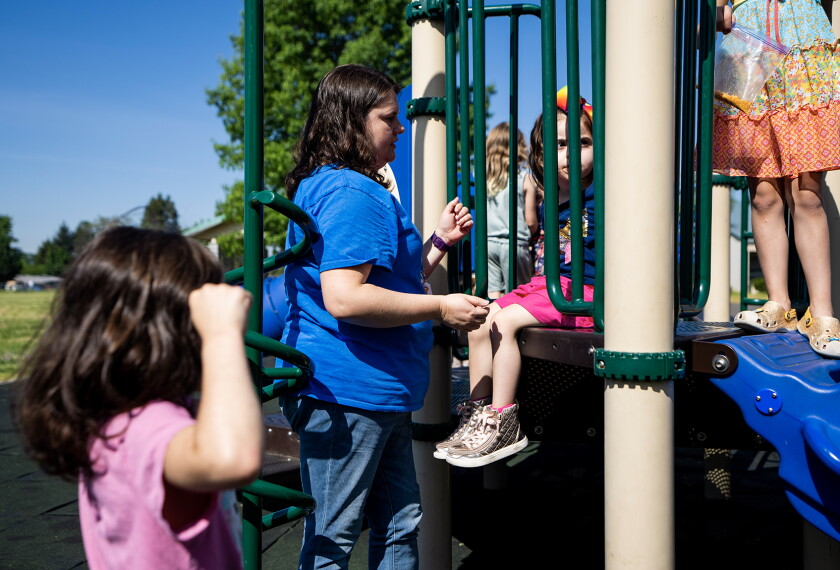
Vivien Henshall, a long-term substitute special education teacher, talks with Scarlett Rasmussen, 8, during recess at Parkside Elementary School on May 17, 2023, in Grants Pass, Ore. Scarlett is nonverbal and uses an electronic device and online videos to communicate, but reads at her grade level. She was born with a genetic condition that causes her to have seizures and makes it hard for her to eat and digest food, requiring her to need a resident nurse at school.
A long-term substitute special education teacher at Parkside Elementary School in Grants Pass, Ore., speaks with a student during recess on May 17, 2023. The Trump administration has canceled more than $30 million in special education grants, including some aimed at training special education teachers.
Lindsey Wasson/AP
Special Education Most—But Not All—Imperiled Federal Grants for Special Education Will Continue
The U.S. Department of Education says it wants projects aligned with Trump administration priorities.
5 min read
Scarlett Rasmussen, 8, tosses a ball with other classmates underneath a play structure during recess at Parkside Elementary School on May 17, 2023, in Grants Pass, Ore. Chelsea Rasmussen has fought for more than a year for her daughter, Scarlett, to attend full days at Parkside.
A student who receives special education services tosses a ball during recess at Parkside Elementary School on May 17, 2023, in Grants Pass, Ore. Several recipients of grants awarded under the Individuals with Disabilities Education Act learned Friday that the U.S. Department of Education would continue their grants for another year, provided they certify their projects align with Trump administration priorities.
Lindsey Wasson/AP
