

The first step to boosting reading scores statewide is believing that students can and will make great strides if educators are committed to seeing it happen.
That was a key message from Carey Wright, who oversaw Mississippi’s education department during what many have called the “Mississippi Miracle"—a period of historic reading gains for the state that traditionally ranked among the lowest in the nation—in an on-stage interview at Education Week’s Leadership Symposium in Arlington, Va., on May 3.
Wright is now the state superintendent in Maryland, where she’s been serving as interim chief since October before her full term begins July 1. She led the education department in Mississippi from 2013 through 2022, a span during which the state went from 2nd worst in 4th grade reading on the National Assessment of Educational Progress to 21st.

In addition to a belief in high expectations for students, Wright made the case for strong state leadership—a state department that’s focused on more than getting districts to comply with data reporting and funding deadlines—to guide such a transformation.
“You cannot do this work without a strong state department that believes in leaning in, believes in student achievement, and believes in doing everything possible for the state,” Wright said during the interview with Education Week’s Stephen Sawchuck.
In 2022, 64 percent of Mississippi 4th graders performed at or above basic on the NAEP reading exam, slightly exceeding the national percentage of 61 percent. The Magnolia State achieved that score despite having the lowest median household income in the nation and some of the lowest per-pupil spending in K-12—and despite its history about a decade before of scoring among the lowest.
According to Wright, a key component of Mississippi’s turnaround was a commitment to the “science of reading,” which refers to evidence-based reading instruction that centers on five core, research-backed components: phonemic awareness (identifying sounds and blending them into words), phonics, fluency, vocabulary, and comprehension.
The state’s strategy was enshrined in law with the 2013 Literacy-Based Promotion Act, which requires all students to learn to read through a “science of reading” approach. The law required schools to hold back 3rd grade students if they scored in the lowest achievement level in reading and assigned—and paid for—coaches to lead intervention programs at low-performing schools. In 2016, an amendment introduced a requirement that students with reading deficiencies have individual reading plans outlining goals for growth, the additional instruction and interventions they’ll receive, strategies their parents will be encouraged to use, and more.
Mississippi’s reading law inspired a wave of laws and policies in other states to move their classrooms to an evidence-based approach to reading instruction. Thirty-eight states have passed laws or implemented new policies related to evidence-based reading instruction since 2013, according to Education Week’s “science of reading” tracker. Many replicate Mississippi’s law or elements of it.
Now in Maryland, Wright and her team are looking to make the science of reading the standard throughout the state.
In January, the state’s board of education passed a resolution calling for all schools to implement evidence-based reading instruction starting next school year. The state will include a specific evaluation of reading instruction in its renewal for educator licensure programs.
While students’ reading scores have been rising on state standardized tests, Maryland has struggled to keep up on a national scale. In 2022, 56 percent of Maryland’s 4th graders scored at or above basic reading levels on the NAEP exam, below the national percentage and a drop from 2019, when 64 percent of 4th graders scored at or above basic in reading.

There’s more to raising student reading scores than passing a resolution, Wright said. It also requires a commitment from the state department down to the teachers to do everything in their power to help students succeed.
The Mississippi turnaround “was proof positive that, yes, children in poverty can learn and can succeed,” Wright said. “As educators, our job is to do whatever it takes.”
Starting with foundational skills
Wright began the statewide reading transition in Mississippi by focusing on foundational skills. That meant providing professional development to train teachers on the core components of the “science of reading” before ever asking them to teach it.
The goal, she said, was to avoid a “hodgepodge approach” and ensure that teachers felt supported and well-equipped to adopt evidence-based strategies from day one. Once those foundational skills were in place, the state superintendent said, the next step was to determine how the strategy should work in classrooms.
That’s what she’s doing in Maryland right now. Wright and her team are meeting with superintendents, curriculum directors, principals, and teachers to see what they need to effectively line up their instruction with the “science of reading” tenets.

“It’s really drilling down further into the classroom,” Wright said. “How do we help classroom teachers implement those lessons? How do we better help them diagnose concerns they have initially? And what are the practical applications of this in a literacy classroom? How much time do they spend on literacy?”
All of those questions are part of ensuring that teachers are using the key components of the science of reading across the state, Wright said.
In Mississippi, the state also invited college and university professors who teach literacy instruction in teacher preparation programs to attend professional development on the “science of reading.”
That will also be a part of Maryland’s transition, Wright said.
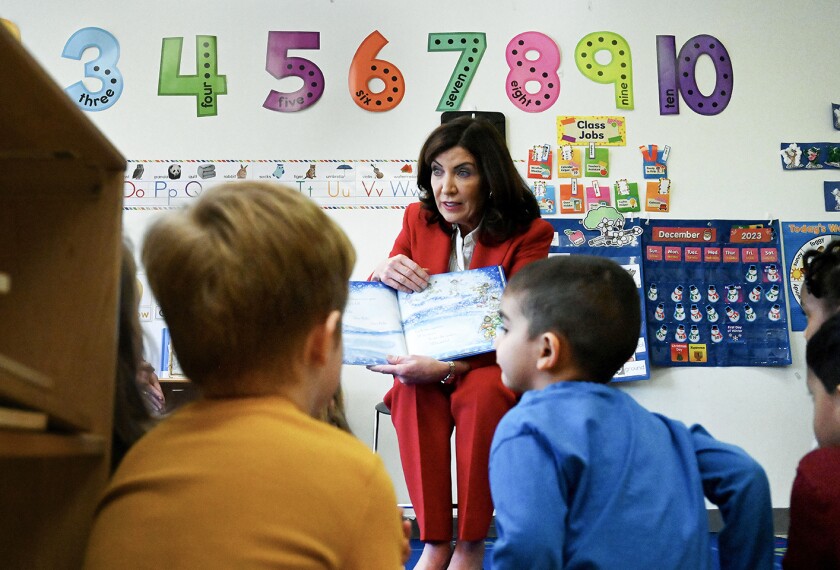
The higher education professors “can actually see and feel what it was like, what we were expecting our teachers to know and be able to do on day one,” Wright said.
Teacher preparation programs nationally have been slow to shift to a science-of-reading approach. In Mississippi, teaching candidates have been required to pass a test in reading science, and a governor’s task force at one point suggested that education preparation program faculty also pass a test in the science of reading.
Combatting low expectations
The main challenge Wright identified in the work to transform reading was low expectations.
She found that educators in Mississippi were doubtful they could actually turn around student achievement.
“There really was just a cultural environment of low expectations for children,” Wright said. “My message was, no, all students are capable of learning and achieving, and we’re going to do everything we can to prepare our teachers and our leaders and our parents with what they need in order to make that happen.”
Part of making sure that message was clear in Mississippi was setting high expectations through state standards and ensuring that the state’s assessments aligned with those standards, Wright said.
The education agencies in Mississippi and Maryland allow schools to choose their curricula, but Wright has been adamant that whatever curriculum a school chooses and the accompanying instructional materials should be aligned to state standards.
Wright and her team in Mississippi also hired coaches that helped schools with literacy, math, early childhood improvement, data analysis, and digital learning across the state. Those coaches were trained to have high expectations, she said.

“Our standards were very rigorous, our assessment was very rigorous, and our accountability system … was also very rigorous in keeping folks accountable for student progress,” Wright said.
While the state agency in Mississippi was setting high standards and expectations, Wright said she was setting high expectations for the agency. She worked to change the mindset among her staff from a focus on compliance with state policies and initiatives to providing districts with support to achieve state goals.
She has those same expectations for the department in Maryland.
“We are here to serve our teachers, our leaders, our families, and our communities,” Wright said. “We are not a compliance-driven organization. There’s room for compliance—I get it, but that’s not what we’re here for. We’re here to serve the people.”


