Artificial Intelligence

More Teachers Are Embracing ChatGPT. Students? Not So Much

By Arianna Prothero — July 18, 2023 2 min read
Photo of girl using desktop computer.
  • Save to favorites
  • Print

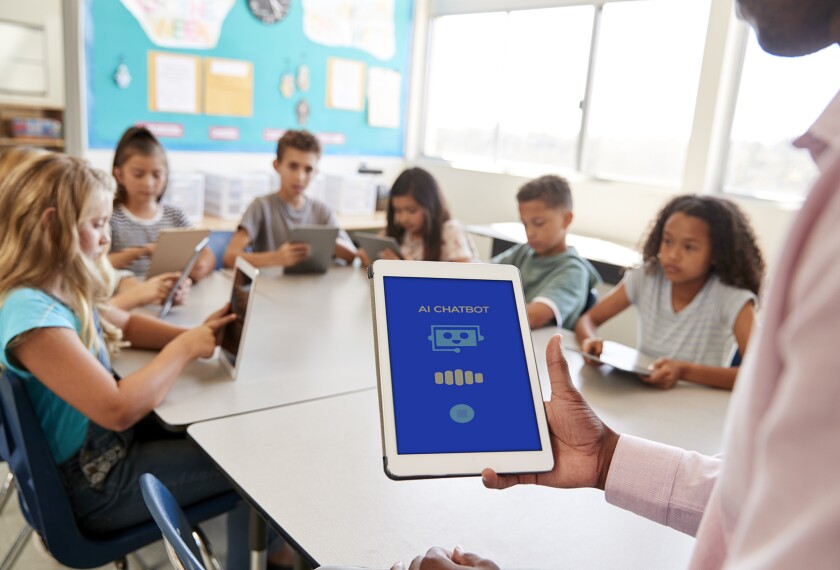
Turns out that students, not teachers, are the bigger skeptics when it comes to using ChatGPT.
Results of a new survey flip the early narrative on ChatGPT—that students would rush to use it to cheat on assignments and that teachers would scramble to keep up—on its head.

Half of students, ages 12-18, said they have never used ChatGPT, according to the poll conducted in late June and early July by Impact Research on behalf of the Walton Family Foundation. A quarter of students reported using ChatGPT at least once per week. That’s compared to 40 percent of teachers who said they used it at least once a week.

Bigger picture, 6 in 10 teachers now say they have used ChatGPT in their jobs, marking a 13-point increase from February when a similar survey was done. And three-quarters of teachers say they are at least familiar with the technology, which can generate lesson plans and write essays in seconds with a simple prompt, and 58 percent say they have a favorable view of the chatbot.

Those are among the latest findings in a second survey of teachers, students, and parents conducted by Impact Research for Walton. (The Walton Family Foundation provides support to Education Week for coverage of race and opportunity and other topics).

Parents, too, are eager to have their children use the generative AI technology in the classroom. Sixty-four percent said they think teachers and schools should allow students to use ChatGPT to do schoolwork, with 28 percent saying that schools should encourage the technology’s use.

Student reluctance emerged in February when Impact Research conducted its first survey of ChatGPT use among teachers and students.

Only 35 percent of students said in this most recent survey that ChatGPT has had a positive impact on their schooling experience, compared to 54 percent of teachers who said the new technology has been positive. And when asked whether they believe ChatGPT has legitimate educational uses that can’t be ignored, 39 percent of students agreed compared with 49 percent of parents and 61 percent of teachers.

See also

Image of AI sources and tools.
CoreDesignKEY/iStock/Getty

The survey found that a third of teachers are using ChatGPT to help them plan lessons and create instructional materials, 30 percent say they are using it to generate creative ideas for their classes, and 30 percent say they are using the chatbot to help build their background knowledge.

Teachers are also using ChatGPT to create tests and assessments, grade students’ work, and communicate with students, parents, and colleagues.

Many teachers and education technology experts say that it’s vital for educators to teach students how to use AI tools such as ChatGPT and to model the proper use of those tools for their students. But there are still many potential pitfalls to using it.

For example, ChatGPT’s track record on accuracy is spotty at best—the chatbot sometimes makes up information—so using it for acquiring background knowledge on a subject can be risky if teachers aren’t diligent about fact-checking the information.

For this latest survey, Impact Research polled 1,000 teachers, 903 parents, and 1,002 students ages 12-18.

When it comes to preparing students for the jobs of the future—including those in artificial intelligence—students, parents, and teachers question whether schools and teachers are currently up to the task.

Related Tags:

Events

Student Well-Being & Movement K-12 Essentials Forum How Schools Are Teaching Students Life Skills
Join this free virtual event to explore creative ways schools have found to seamlessly integrate teaching life skills into the school day.
This content is provided by our sponsor. It is not written by and does not necessarily reflect the views of Education Week's editorial staff.
Sponsor
Special Education Webinar
Bridging the Math Gap: What’s New in Dyscalculia Identification, Instruction & State Action
Discover the latest dyscalculia research insights, state-level policy trends, and classroom strategies to make math more accessible for all.
Content provided by TouchMath
This content is provided by our sponsor. It is not written by and does not necessarily reflect the views of Education Week's editorial staff.
Sponsor
School & District Management Webinar
Too Many Initiatives, Not Enough Alignment: A Change Management Playbook for Leaders
Learn how leadership teams can increase alignment and evaluate every program, practice, and purchase against a clear strategic plan.
Content provided by Otus

EdWeek Top School Jobs

Teacher Jobs
Search over ten thousand teaching jobs nationwide — elementary, middle, high school and more.
View Jobs
Principal Jobs
Find hundreds of jobs for principals, assistant principals, and other school leadership roles.
View Jobs
Administrator Jobs
Over a thousand district-level jobs: superintendents, directors, more.
View Jobs
Support Staff Jobs
Search thousands of jobs, from paraprofessionals to counselors and more.
View Jobs

Read Next

Artificial Intelligence Opinion This Professor Won the ‘Nobel for Education.’ Here's What His Work Means for Educators
What skills do students need to make sense of complex systems in the age of AI?
7 min read
The United States Capitol building as a bookcase filled with red, white, and blue policy books in a Washington DC landscape.
Luca D'Urbino for Education Week
Artificial Intelligence From Our Research Center More Teachers Are Using AI in Their Classrooms. Here's Why
But there's still a big number of teachers who don't plan to use the technology.
3 min read
Teacher and kids using tablets and artificial intelligence in school classroom; a.i. assisted lessons.
iStock/Getty and Education Week
Artificial Intelligence Video Is the ‘AI Glow’ Starting to Wear Off? What to Expect in 2026
Artificial intelligence is now integrated into a wide variety of products and services that K-12 schools use, making it almost inescapable.
1 min read
English teacher Casey Cuny reads in his classroom as a screen displays guidelines for using artificial intelligence at Valencia High School in Santa Clarita, Calif., on Aug. 27, 2025.
Jae C. Hong/AP
Artificial Intelligence Quiz Quiz Yourself: How Is AI Reshaping K-12 Career and Technical Education?
Test your knowledge on AI trends in students' careers.
1 min read
Students in Bentonville public schools’ Ignite program work on projects during class on Nov. 5, 2025, in Bentonville, Ark. The program offer career-pathway training for juniors and seniors in the district.
Students in the Bentonville public schools' Ignite program work on projects during class on Nov. 5, 2025, in Bentonville, Ark. The program offer career-pathway training for juniors and seniors in the district.
Wesley Hitt for Education Week
