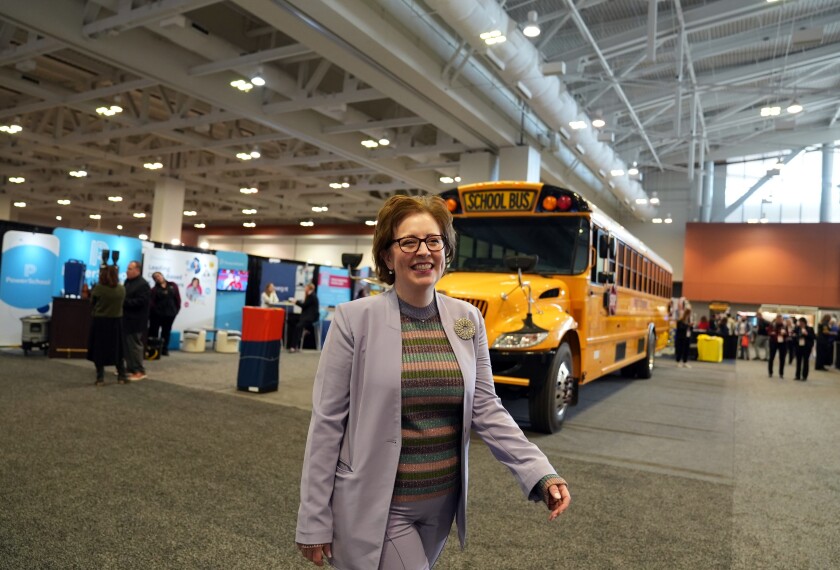
Superintendent Charles M. Irish makes involving the public in the Medina, Ohio, schools’ business his—and his district’s—mission.
| Poll: Public Lacks Time for School |
| Washington State Group Builds Support for Standards, Tests |
| Charlotte Foundation Gives Voters A Primer on School Board Races |
| » Involving Public a Way of Life For Ohio District |
For years, officials in the 6,700-student district have made a concerted effort to inform Medina parents and community members about big projects and decisions on the horizon. The idea, according to Mr. Irish, is to build on the public’s deep-rooted vision for its schools.
“Our job as a school system is to work to re-create the connection” between schools and others, he said. “If we don’t, we’re going to lose our public.”
By many accounts, the Medina schools are succeeding where others are struggling.
“The school system is truly part of the fabric of the community,” said Medina resident Steven H. Anderson. A father of three, Mr. Anderson co-chaired a major Medina school bond campaign in the late 1990s with his wife, Jane.
Mr. Irish has “capitalized” on the close-knit atmosphere in Medina, Mr. Anderson said, and succeeded in reaching people by “soliciting feedback in a sincere way.”
The superintendent “understands he needs to take the time to bring the community along with him,” added Denny A. Sampson, who covers the Medina schools for the local Gazette newspaper. He called the local schools chief a “genius at public engagement.”
From Conflict to Trust
Medina is a growing community of 25,000 in northeastern Ohio. For years, the city and the schools have enjoyed a good working relationship. Since 1990, in fact, the district has published a monthly supplement called Bee Informed, which is inserted into the Gazette and goes out to all the paper’s readers.
To Mr. Irish, public engagement is the result of a conscious, long-range strategy by educators, rather than a spurt of activity when a bond vote or news event makes reaching out a necessity. The goal, he added, is to get beyond the community’s knee-jerk opinions to its deeper values and beliefs.
“Get people to talk about the issue in the context of their values,” he said. “Too often, communities don’t even get to the point that they recognize their problems.”
The superintendent’s theories were put to the test in 1995, when news reports drew attention to a picture of Jesus that was hanging in the local Garfield Elementary School. The picture had been placed in the school decades before as a memorial to a Medina superintendent who died in office. But six years ago, when people outside Medina heard about it, it became a focal point for the media and for the American Civil Liberties Union and other advocacy groups.
Undaunted by public scrutiny and criticism, Mr. Irish opted against removing the portrait in haste. Instead, he convened meetings and sat down with people to get their thoughts.
“We said, ‘We’re here to listen,’ and we heard all kinds of things,” he recalled.
What came through, he said, was the community’s concern about declining morals and how the controversy over the picture reflected that drop.
To address both the legal issues and the big- picture fears, Mr. Irish said, the district did take down the picture, but officials used a respectful ceremony to transfer it to a nearby church. The district also created a values curriculum.
From a constitutional standpoint, removing the picture was viewed as a necessity for a public school system. “We had no leg to stand on,” Mr. Irish said. But to do so without talking the matter over with the public seemed wrong, he said.
What the Medina schools succeeded in doing was to “turn conflict into trust,” said William G. “Corky” O’Callaghan Jr., the founder of the Mohican Institute in Ohio, a think tank for school leaders that has devoted considerable attention to public engagement.
When the district was finished with its outreach efforts, “the level of trust was a notch higher,” Mr.O’Callaghan said.
Community Center
Mr. Irish and others also point with pride to the process that led to the current expansion of Medina High School. In 1995, when the district began weighing whether to expand its existing high school or build a new one, school leaders turned to the public.
First, a core group of about 15 school officials and community members visited high schools around Ohio and outside the state to pick up ideas. Next, meetings were held throughout the community to take the public pulse.
The first result: a confusing mixed signal. People wanted to stick with just one high school, Mr. Irish said, but they didn’t want that high school’s enrollment to climb beyond 1,500 students. (Medina High School now has an enrollment of about 2,000 students.)
Ultimately, the district found a way to meet the community’s wishes. The solution was to expand the school, but then divide it into four “houses,” each with its own principal and sense of community.
In addition, the district formed partnerships with the city government, the local hospital, an arts foundation, and a university. The expansion of Medina High School—which will be completed by the 2003-04 school year—will include community recreation facilities, a state-of-the-art, 1,200-seat auditorium, a hospital-supported physical-therapy branch, and room for the University of Akron to offer classes to Medina residents.
Finally, in spring 1999, Medina voters approved a $78 million bond issue to cover the high school project, as well as the cost of building a new elementary school and the purchase of land for future growth. The bond had failed in its first appearance on the ballot, in 1998.
Jane E. Anderson, who chaired the successful bond campaign with her husband, said she believes that the work leading up to the vote made all the difference.
“We drew in lots of people ...people at least felt as though their opinions were being heard,” Ms. Anderson said. “It’s a very slow process, ... but in the end most individuals feel they’ve had an opportunity to be heard.”