
This week, as I’ve done for the better part of a decade, I’m releasing the annual RHSU Edu-Scholar Public Influence Rankings. The 2017 results are an attempt to recognize the myriad ways in which academics can contribute to public discussion of educational practice and policy.
This year, however, on the cusp of Donald Trump’s inauguration and after two months of provosts and education school deans proclaiming that Trump’s victory marked the triumph of bigotry, xenophobia, and misogyny, it’s hard for me to dwell on the role of public scholarship without reflecting on scholarly biases. As I see things, the ability of education researchers to inform discussions of practice and policy is hampered by their community being so philosophically unrepresentative of the nation as a whole.

It’s no great secret that the American professoriate leans left. Liberal college faculty outnumber their conservative counterparts nearly 5-to-1, a tilt that has grown steadily more pronounced over the past quarter-century. In their 2016 Oxford University Press book Passing on the Right, Jon Shields and Joshua Dunn note that the self-identified conservatives make up 5 percent to 17 percent of faculty in social science and just 4 percent to 8 percent in the humanities in American colleges and universities.
At this point, some readers will surely protest, “Rick, what are you talking about? Education research does not lean left.” They will note that there are education researchers who endorse and those who oppose testing and test-based teacher evaluation. That some look favorably upon charter schools and Teach For America, and that others are more skeptical. Doesn’t this suggest a broad ideological spectrum?
In a word: No.
Explore the geographic distribution of 2017 RHSU Edu-Scholars concentrations and the political composition of their universities’ faculty.
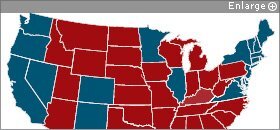
Source: Mitchell Langbert, Anthony J. Quain, and Daniel B. Klein (Econ Journal Watch, 2016); Associated Press
These differences over policy instruments don’t actually reflect much heterodoxy regarding some of the fundamental value differences that shape the nation’s public debates. Whatever their take on teacher tenure, college access, or online learning, for instance, university-based education scholars tend to frame their findings in race-conscious terms, justify recommendations with reflexive claims of “equity,” and casually nod assent when education school deans send out missives attributing the president-elect’s victory to xenophobia and misogyny.
I know, I know. To university-based education researchers, all this can seem innocuous, unobjectionable, and even inevitable. But this manner of thinking and talking reflects one shared worldview, to the exclusion of others. While education school scholars may almost uniformly regard a race-conscious focus on practice and policy as essential for addressing structural racism, a huge swath of the country sees instead a recipe for fostering grievance, animus, and division. What those in ed. schools see as laudable efforts to promote “equitable” school discipline or locker-room access strike millions of others as an ideological crusade to remake communities, excuse irresponsible behavior, and subject children to goofy social engineering. Many on the right experience university initiatives intended to promote “tolerance” and “diversity” as attempts to silence or delegitimize their views on immigration, criminal justice, morality, and social policy. For readers who find it hard to believe that a substantial chunk of the country sees things thusly, well, that’s kind of the issue.
For more in this package, please visit:
The Leftward Tilt of Education Scholarship
Now, let’s be clear: I am not suggesting that those who see things from the right are “correct.” I am suggesting that our views are principled and legitimate, and that we’re dumbstruck by the suggestion that they constitute little more than an attempt to rationalize bigotry or injustice. And, while those who see these things from the right make up a substantial part of the country, we are nearly invisible among university-based education researchers.
This table lists the top 10 junior scholars who have not yet received tenure, according to the 2017 RHSU Edu-Scholar Public Influence Rankings.

Many champions of diversity are entirely unbothered by this absence. Neil Gross, a sociologist at Colby College who studies diversity in academe, told Inside Higher Education last spring that he doesn’t consider ideological homogeneity a problem because he hasn’t “seen any evidence that conservatives make for better theorists or methodologists.” There are many possible responses to this, one of which is to ask what this logic means for those championing racial or gender diversity. I’ll simply note that the rationale for intellectual diversity is not that conservatives are “better” at X, but that they ask different questions, bring different assumptions, and see things differently.
Practically speaking, the result of the academy’s tilt is that, as the Trump Department of Education gears up for the next four years and the two-thirds of governors who are Republicans plan their agendas, university-based education researchers have been on the periphery. I’m not giving away any great secret when I note that Trump’s education team, conservative leaders, or the two-thirds of state legislatures controlled by Republicans are far more likely to look to think tanks or advocacy groups than to implacably hostile universities for input and guidance.
This is unfortunate. When the range of scholarly views on fraught questions can be reduced to settled dogma, education scholars turn into little more than a readily discounted interest group. Indeed, I’m always struck when the American Educational Research Association—charged with speaking for thousands of theoretically diverse scholars—takes pointed, predictably progressive stances on politically sensitive questions, as if there were not sincere disagreements about the core issues and how the relevant research ought to be read.
Linda Darling-Hammond, Diane Ravitch, and Gloria Ladson-Billings took the top three spots in the 2017 RHSU Edu-Scholar Public Influence Rankings. Click on the chart below to learn who took the other two spots. (The affiliations cited are drawn from the scholars’ CVs.)

One response is to assert that this just shows that the “real scholars” are in general agreement, and that only shallow ideologues see things otherwise. But those who have bothered to read their Burke and Kirk, Tocqueville and Hayek, Nock and Nash will, I think, recognize how bizarre a conceit that is. I think it’s truer to say that right-leaning education researchers feel unwelcome in the academy and have thus migrated almost wholesale to think tanks and advocacy groups. I don’t think this is good for research, policy debate, or scholars on the right or on the left.
What might we do about any of this?
Scholars should make it a point to engage with those outside of their philosophical comfort zone, and to explore the work of serious thinkers who see the world from the right. They should seek out and welcome lines of inquiry that start from premises inimical to their own. They should encourage their schools and departments to seek scholars and students who aren’t just racially or methodologically diverse, but also those who come at big questions with different assumptions and values.
Admittedly, this means the academy would feel less a cozy refuge for those who grimace at the mention of Fox News or Jeff Sessions and who seek a community where their beliefs are widely shared and regularly affirmed. I’m not saying it would be fun. But I am saying that it’s the price of relevance and the hallmark of responsible public scholarship.


