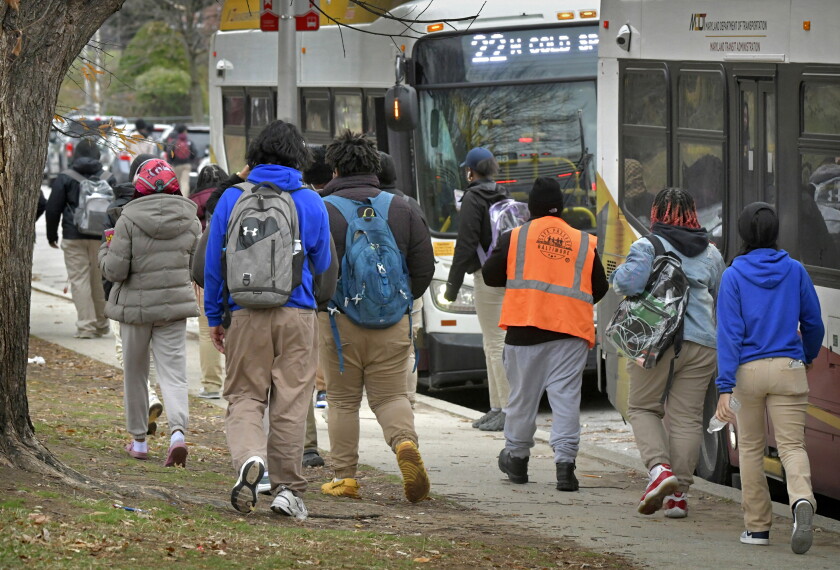
As Mike Moses listens intently to a group of about 100 students introduce themselves at a meeting of the “teen school board,” he folds his arms across his broad chest and nods approvingly. “I like that you say the name of your school with pride,” he tells the group of primarily African-American and Hispanic students. “I’m proud of your schools, too.”
Moses, a 50-year-old, baby-faced Texas native in his second year as the superintendent of the Dallas schools, promises to answer their questions. But first, anticipating their prime concern, he addresses the students’ dress code. As of last fall, it requires them to tuck in their shirts and prohibits midriff-baring tops, short skirts or shorts, and steel-toed boots. The dress code says something about the district: It shows “the pride we have in what we do at our schools,” he says.
That feeling of pride still feels new for the 166,000-student Dallas Independent School District. For years, the district was considered a laughingstock by many people here. The school board was once one of the nation’s most fractious, plagued by racial politics, infighting, and complaints of micromanagement.
Superintendents came and went, including one jailed for buying furniture for her home with public money.
Moses became the district’s sixth superintendent in eight years in January 2001. And he made changing the public’s perception of the schools his first order of business, using his trademark down-home charm.
“Mike had the advantage of coming at a time when the community was happily tired of the turmoil,” says Sandy Kress, a former member of the Dallas school board and one-time education adviser to President Bush.
People in Dallas, says Kress, are more than willing to let the schools chief lead the way. They listen to Moses, who was appointed by then-Gov. Bush to head the Texas Education Agency and has political and business connections throughout the state.
“What I tried to tell the staff was that parents don’t have to choose us,” Moses says. “If we want them to choose us, then we have to become service- oriented, and our culture has to change.”
Moses’ chief of staff set up a central customer-service department so that phone calls, particularly from parents, were answered promptly and concerns addressed accurately. The superintendent required employees to dress professionally, including ties for men and pantyhose for women when they wear skirts in winter.
Six principles of public service—trustworthiness, responsibility, respect, fairness, caring, and citizenship—now govern how business is conducted. Callers to the district’s central office now hear a chipper, friendly voice instead of a mumbled, brusque one.
For his efforts, Moses is handsomely rewarded: He earns $310,000 a year in salary alone and stands to receive a $500,000 lump-sum payment if he stays until 2006.
On a variety of measures, people here say, Moses’ collaborative, easygoing leadership style is paying off. Moses sets goals for his staff, provides support and encouragement, and then trusts them to get the job done well.
To boost student performance, Moses says, he told district administrators to focus on improving students’ reading, writing, and mathematics skills. All of the other subjects will fall in line, he believes.
Echoing the words of President Bush, Moses told the principals: “How children get educated I’m going to leave up to you, with this one caveat: With freedom goes accountability.”
Across the board, students’ scores on the Texas Assessment of Academic Skills, the nationally normed Stanford Achievement Test-9th Edition, and the Advanced Placement exams have increased. The district’s student population is 56 percent Hispanic, 35 percent African-American, 7 percent white, and 2 percent Native American. In 2000, when Moses was hired, Dallas had 28 schools that were considered low-performing by the state. Now just 14 bear that label.
Across the board, students' scores on standardized exams have increased. The community has taken notice.
The community has taken notice. This past January, Dallas passed a $1.36 billion bond package for school construction—the largest ever in the state of Texas—with 78 percent of the vote. The last bond the Dallas school board proposed was in 1992. It passed, but just 30,000 voters turned out. This year, 110,000 voters showed up at the polls.
“He rallies other leaders around the school because they trust him,” says John Stevens, the executive director of the Texas Business and Education Coalition in Austin. “They believe the resources will be well used and purposefully used.”
Peace has descended on the school board. The district’s last permanent superintendent, Waldemar “Bill” Rojas, was fired after 11 months on the grounds that he was unable to establish a good working relationship with its nine trustees. (He later sued them for defamation; the board settled with him for $135,000 in August.)
But with Moses at the helm, the venomous criticism is gone. Now, the board and the superintendent sing one another’s praises and attend training sessions designed to help them put their best faces forward.
Remarkably, the trustees have unanimously approved every issue brought to them by the superintendent but one, which was defeated. “If the community looks at the system and sees great divisiveness, which is what Dallas had seen, that doesn’t inspire confidence,” Moses says in explaining his preference for unanimous board votes.
His style is to keep in mind that he is the trustees’ employee, he adds. As such, he praises in public and criticizes in private, which has helped burnish the district’s image.
“Moses never misses an opportunity to compliment the board,” says Ken Zornes, the board president. “And it’s not phony, it’s sincere.”
The district’s current $1 billion budget, its largest ever, includes items dear to the hearts of its employees, including $1,400 raises for the district’s support staff and stipends that will provide teachers and librarians an extra $250 in their September paychecks to pay for school supplies. Starting salaries for teachers rose this year by $2,500, to $37,500, and in the next 18 months, each teacher in the district will have a laptop computer, Moses says.
John Wiley Price, a Dallas County commissioner and prominent African-American community leader, is skeptical of the district’s newfound harmony. “We have a basic mistrust of him,” he says of the superintendent, whose improvements he calls cosmetic. “We see him as being extremely political, as opposed to providing what is necessary for the education of children.”
Other changes here are less tangible, but are crucial to the district’s progress under its new leader. Employees say they feel valued, listened to, and confident enough to carry out their tasks without fear of being fired or having their efforts undermined.
“You feel that he is behind you, and that is an important quality in a leader,” says Rosemarie Allen, the associate superintendent who oversees special education.
In a recent meeting with Moses, Allen mentioned as a side note that she had a job open in her department. Moses knew exactly which position, she says, and that person’s responsibilities. “I thought to myself, ‘With all of the positions in the district, how does he know this?’ ” she says. Two years ago, the special education department was in such disarray that the Texas Education Agency assigned a monitor to oversee the program. Student files were being kept in a storage area and were not easily accessible, and staff members were scattered in 27 different facilities in the district. Now, the staff has been centralized, and the files are stored properly in each of the district’s 217 schools.
With Moses at the helm, the venomous criticism is gone.
To be sure, Moses hasn’t been content to overhaul the bureaucracy in modest silence. Shortly after he was hired, he took Associate Superintendent Allen and Gloria Gutierrez, the director of the office that oversees bilingual education and English-as-a-second-language classes, to meet with the editorial board of the Dallas Morning News. He came clean about problems in their departments—and he pledged to clean them up.
Coming from a family of educators—his wife, mother, father, brother, sister-in-law, mother-in-law, and father-in-law have all been teachers—Moses says he appreciates the importance of public education. He himself is a former teacher, principal, superintendent, state commissioner of education, and vice chancellor of Texas Tech University in Lubbock.
“He understands the importance of treating people with dignity and respect,” says Aimee Bolander, the president of the Alliance/AFT teachers’ organization, adding that he treats the union the same way.
While the passage of the bond issue was a turning point for the Dallas schools, Moses says it wouldn’t have happened if the district had not first raised student performance, improved fiscal responsibility, increased teacher compensation, and shown stable leadership.
He stresses that those improvements were the result of a team effort, and that he cannot be credited with single-handed success.
But just tell that to the worker at the junkyard in southeast Dallas where Donald Claxton, the district’s spokesman, went to find a taillight last year for his 1992 Chevy Lumina.
A man asked Claxton why he was moving to Dallas. When Claxton responded that he was going to work for Mike Moses, the man said, “ ‘Oh Mike Moses—he’s the guy who is going to turn around our school system,’ ” Claxton recalls.
In fact, Moses has come to personify the Dallas public schools in some people’s eyes, a development that doesn’t sit well with him.
One of the “teen school board” members, for example, tells Moses that his principal said students had to follow the new dress code because that’s what the superintendent ordered. When Moses meets later that day with principals, he recounts the student’s remark with exasperation. Taking a deep breath and rocking back to look at the ceiling, he reminds them, quietly, that the dress code is district policy—not a mandate from him.
Moses emphasizes that there is still work to be done. He intends to show that the district has met the requirements of its 30-year-old desegregation order, which focuses heavily on black students’ achievement. Recent community meetings to that end haven’t impressed County Commissioner Price, who charges that Moses is “more about trying to control what is public than what is reality.”
Still, the superintendent is intent on making positive cultural changes in the district. “We need to get this place to the point where, when somebody asks you where you go to school or where you work, you say, ‘I’m in the Dallas Independent School District, and boy, we are doing some great things over there.’ ”
Coverage of leadership issues in education—including governance, management, and labor relations—is supported by the Broad Foundation.