School & District Management

Schools Can More Easily Get Food, Laptops as Supply Chain Problems Fade

By Mark Lieberman — January 22, 2024 2 min read
Bell Beverage owner Frank Bell, rear left, watches as employee Anthony Casalena loads chromebooks onto one of their trucks to deliver to district schools, at School District Headquarters in Philadelphia on April 6, 2020.
  • Save to favorites
  • Print

Far fewer schools are struggling this school year to secure crucial goods like cafeteria menu items and laptops because of supply chain disruptions than at the same time last school year, new survey data show.

In October 2022, only 17 percent of schools reported they weren’t having any procurement issues caused by supply chain disruptions. A year later, in November 2023, that number had leapt to 48 percent.

Schools both years most often cited food services as the area most affected by supply chain disruptions. But this year, only 27 percent of schools reported food-related issues, compared with 54 percent the previous year.

These data come from the National Center for Education Statistics’ School Pulse Panel, a monthly survey examining ongoing challenges schools face. The new data, which the federal center published earlier this month, come from a nationally representative group of more than 1,500 schools from every state and the District of Columbia, which were surveyed in November.

The fragility of the international supply chain became visible in an unprecedented way during the early years of the pandemic, when widespread manufacturing shutdowns and volatile demand for products snarled the complex web of shipping on a global scale.

In response, many schools adjusted their operations to account for delays and shortages of items they need to keep in-person instruction running.

But survey results across the country, from high-poverty and low-poverty schools alike, as well as from large and small schools, show measurable improvement in procurement over the past year.

Still, slightly more than half of schools reported that supply chain challenges continue to affect their access to some supplies.

Detroit, for instance, recently altered its daily menus after a strike among workers at its largest food supplier delayed shipments of key items. Schools in several states also temporarily altered their milk offerings after a significant disruption in the production of milk cartons last fall.

Aside from food, laptops and other electronic devices have also proved harder to get because of supply chain problems in many districts—just shy of a quarter of respondents said in November that they’ve encountered difficulty securing the equipment, but that was down from 48 percent of schools in October 2022.

See Also

Shipping containers are stacked at the Port of Philadelphia, Thursday, Oct. 28, 2021.
Supplies for many school needs are stuck in shipping containers in places like the Port of Philadelphia.
Matt Rourke/AP

To be sure, concerns about supply shortages continue to play out in noticeable ways.

A new high school building in Dinuba, Calif., will open months behind schedule thanks to massive delays in securing crucial electrical equipment. Several districts in Georgia are facing delays of up to a year for the arrival of new school buses to replace aging vehicles.

Still, nearly four years into the COVID-19 pandemic, the ripple effects from those disruptions appear to be easing.

The percentage of schools that reported having to reduce options for students and staff as a result of supply chain issues has dropped, from 47 percent in October 2022 to 23 percent in November 2023.

Seventeen percent of schools in November 2023 said they temporarily operated without adequate equipment as a result of supply chain issues, compared with 38 percent the year before.

In the area of food service, a more pressing issue for many schools is a shortage of qualified staff. The percentage of schools reporting nutrition staff shortages increased from 32 percent in October 2022 to 41 percent in November 2023, the School Pulse Panel survey shows.

Recently released data from the survey also include findings on school improvement plans and absenteeism.

See Also

Vector illustration of diverse children, students climbing up on a top of a stack of staggered books.
iStock/Getty

Events

This content is provided by our sponsor. It is not written by and does not necessarily reflect the views of Education Week's editorial staff.
Sponsor
Special Education Webinar
Bridging the Math Gap: What’s New in Dyscalculia Identification, Instruction & State Action
Discover the latest dyscalculia research insights, state-level policy trends, and classroom strategies to make math more accessible for all.
Content provided by TouchMath
This content is provided by our sponsor. It is not written by and does not necessarily reflect the views of Education Week's editorial staff.
Sponsor
School & District Management Webinar
Too Many Initiatives, Not Enough Alignment: A Change Management Playbook for Leaders
Learn how leadership teams can increase alignment and evaluate every program, practice, and purchase against a clear strategic plan.
Content provided by Otus
This content is provided by our sponsor. It is not written by and does not necessarily reflect the views of Education Week's editorial staff.
Sponsor
College & Workforce Readiness Webinar
Building for the Future: Igniting Middle Schoolers’ Interest in Skilled Trades & Future-Ready Skills
Ignite middle schoolers’ interest in skilled trades with hands-on learning and real-world projects that build future-ready skills.
Content provided by Project Lead The Way

EdWeek Top School Jobs

Teacher Jobs
Search over ten thousand teaching jobs nationwide — elementary, middle, high school and more.
View Jobs
Principal Jobs
Find hundreds of jobs for principals, assistant principals, and other school leadership roles.
View Jobs
Administrator Jobs
Over a thousand district-level jobs: superintendents, directors, more.
View Jobs
Support Staff Jobs
Search thousands of jobs, from paraprofessionals to counselors and more.
View Jobs

Read Next

School & District Management Opinion Why Bad Bunny’s Half-Time Performance Was a Case Study for School Leadership
The megastar’s show was an invitation in a challenging moment. Did you catch it?
3 min read
Bad Bunny performs during halftime of the NFL Super Bowl 60 football game between the New England Patriots and the Seattle Seahawks, Sunday, Feb. 8, 2026, in Santa Clara, Calif.
Charlie Riedel/AP
School & District Management Texas Leader Named Superintendent of the Year
The 2026 superintendent of the year has led his district through rapid growth amid a local housing boom.
2 min read
Superintendent Roosevelt Nivens speaks after being announced as AASA National Superintendent of the Year in Nashville, Tenn. on Feb. 12, 2026.
Superintendent Roosevelt Nivens of the Lamar Consolidated schools in Texas speaks after being named National Superintendent of the Year in Nashville, Tenn. on Feb. 12, 2026, at the National Conference on Education sponsored by AASA, The School Superintendents Association.
Kaylee Domzalski/Education Week
School & District Management On Capitol Hill, Relieved Principals Press for Even More Federal Support
With the fiscal 2026 budget maintaining level K-12 funding, principals look to the future.
7 min read
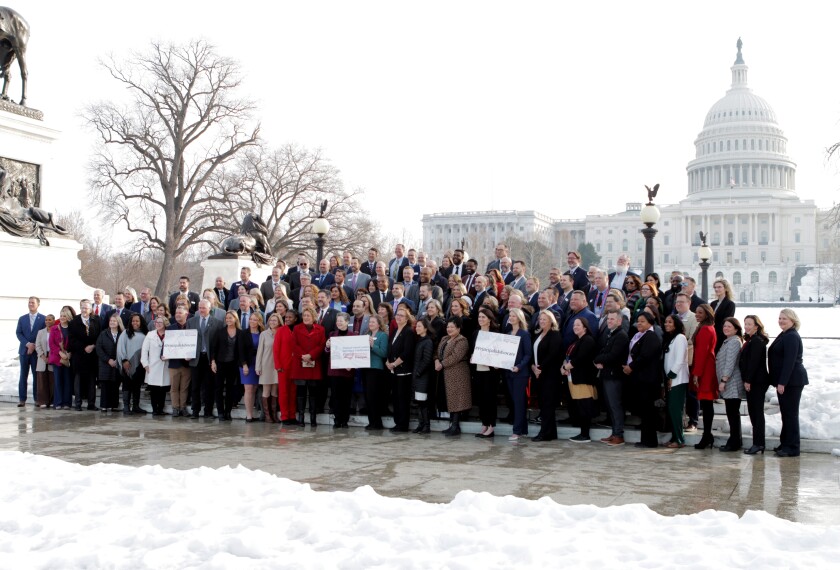
In this image provided by NAESP, elementary school principals gathered on Capitol Hill recently to meet with their state's congressional delegations in Washington
Elementary school principals gathered on Capitol Hill on Feb. 11, 2026,<ins data-user-label="Madeline Will" data-time="02/12/2026 11:53:27 AM" data-user-id="00000175-2522-d295-a175-a7366b840000" data-target-id=""> </ins>to meet with their state's congressional delegations in Washington. They advocated for lawmakers to protect federal K-12 investments.
John Simms/NAESP
School & District Management Q&A Solving Chronic Absenteeism Isn't 'One-Size-Fits-All,' This Leader Says
Proactive, sensitive communication with families can make a big difference.
7 min read
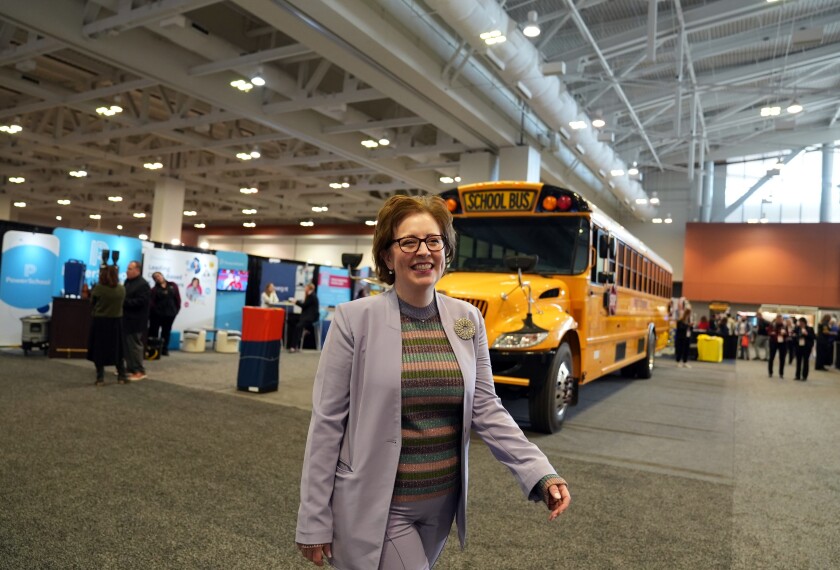
Superintendent Mary Catherine Reljac walks around the exhibition hall of the National Conference on Education in Nashville, on Feb. 12, 2026. Reljac is the superintendent for Fox Chapel Area School District in Pennsylvania.
Mary Catherine Reljac walks around the exhibition hall of the National Conference on Education in Nashville on Feb. 12, 2026. Reljac, the superintendent for Fox Chapel Area school district in Pennsylvania, is working to combat chronic absenteeism through data analysis and tailored student support.
Kaylee Domzalski/Education Week