Blog

Your Education Road Map

Politics K-12

Politics K-12 kept watch on education policy and politics in the nation’s capital and in the states. This blog is no longer being updated, but you can continue to explore these issues on edweek.org by visiting our related topic pages: Federal, States.

Federal

Biden Team: Schools Can Go Beyond Trump Rules in Response to Alleged Sexual Misconduct

By Andrew Ujifusa — July 20, 2021 3 min read
Symbols of gender.
  • Save to favorites
  • Print

Schools can respond to allegations of sexual misconduct in ways that “go beyond” the Title IX regulations adopted by the Trump administration last year, as long as those additional steps don’t conflict with the Trump-era rules or Title IX itself, the U.S. Department of Education stated in new guidance to schools.

The Education Department’s interpretation of the Trump-era rules, released July 20, makes it clear that those 2020 regulations represent “minimum steps” for educators. It also says that while schools must presume that a person alleged to have committed the misconduct isn’t responsible, schools “should never assume a complainant of sexual harassment is lying or that the alleged harassment did not occur.”

In addition, the guidance spells out that while elementary and secondary schools are not required to conduct live hearings with cross examinations of different parties, elementary and secondary schools must respond any time that any school employee “has notice that sexual harassment might have occurred.” And schools may respond to allegations of sexual misconduct that doesn’t meet the definition of sexual harassment spelled out in the 2020 regulations.

The department’s “Questions and Answers on the Title IX Regulations on Sexual Harassment” comes as the administration reviews rules for Title IX of the Education Amendments of 1972, following an executive order from President Joe Biden.

The review could lead to significant shifts in policies addressing how both K-12 schools and institutions of higher education must respond to allegations of sexual assault and harassment, as well as how they must protect LGBTQ students from discrimination and ensure students are treated equally irrespective of their gender.

The Biden administration held a hearing on Title IX enforcement last month. The education department shared transcripts of those hearings on July 20.

Political division around Title IX and sexual assault allegations has grown

The issue of how schools must respond to sexual-misconduct allegations under Title IX has become a prominent national political issue in recent years, as experts and others debated how to weigh the rights of the accusers and the accused, and what threshold of evidence officials should use when determining guilt.

In 2017, former education secretary Betsy DeVos revoked Obama administration guidance for Title IX enforcement, and said the Obama-era guidance threatened the due-process rights of those accused of misconduct. However, victims’ rights groups and others said DeVos’ decision put people at risk and could lead to less-aggressive Title IX enforcement.

After public input, DeVos issued new Title IX regulations last year. Among other things, DeVos’ rules said education officials could use a higher bar for determining if there is sufficient evidence of misconduct to require a response. Again, the new rules provoked different responses. Some said DeVos had taken appropriate steps to ensure fair safeguards for the accused, while others said the rules could make it more difficult for accusers to prove their claims and make it easier for schools to cover up incidents of misconduct.

Although much of the controversy around Title IX in the last several years has revolved around colleges and universities, the situation has affected K-12 educators as well. The tug of war over Title IX has fatigued school officials as well as students who feel caught in the middle. There were also concerns about the practicality of implementing the new rules in the midst of the coronavirus pandemic.

The Title IX rules adopted by DeVos say K-12 schools must respond when they have “actual knowledge” of a complaint of sexual harassment; the Obama-era guidance said schools must respond to incidents they “reasonably should” have been aware of.

The new guidance from the Biden administration says schools may respond to alleged sexual misconduct, even if the misconduct does not meet the definition of sexual harassment in the 2020 rules. It also highlights how last year’s Title IX rules addressed off-campus settings where the school exercises “substantial control” over the respondent and the context, such as a school field trip.

The Trump administration unveiled the Title IX regulations in May 2020 and they went into effect on Aug. 14, 2020, but the department’s new guidance stresses that the rules are not retroactive.

A version of this news article first appeared in the Politics K-12 blog.

Events

This content is provided by our sponsor. It is not written by and does not necessarily reflect the views of Education Week's editorial staff.
Sponsor
School Climate & Safety Webinar
Belonging as a Leadership Strategy for Today’s Schools
Belonging isn’t a slogan—it’s a leadership strategy. Learn what research shows actually works to improve attendance, culture, and learning.
Content provided by Harmony Academy
This content is provided by our sponsor. It is not written by and does not necessarily reflect the views of Education Week's editorial staff.
Sponsor
School & District Management Webinar
Too Many Initiatives, Not Enough Alignment: A Change Management Playbook for Leaders
Learn how leadership teams can increase alignment and evaluate every program, practice, and purchase against a clear strategic plan.
Content provided by Otus
This content is provided by our sponsor. It is not written by and does not necessarily reflect the views of Education Week's editorial staff.
Sponsor
Artificial Intelligence Webinar
Beyond Teacher Tools: Exploring AI for Student Success
Teacher AI tools only show assigned work. See how TrekAi's student-facing approach reveals authentic learning needs and drives real success.
Content provided by TrekAi

EdWeek Top School Jobs

Teacher Jobs
Search over ten thousand teaching jobs nationwide — elementary, middle, high school and more.
View Jobs
Principal Jobs
Find hundreds of jobs for principals, assistant principals, and other school leadership roles.
View Jobs
Administrator Jobs
Over a thousand district-level jobs: superintendents, directors, more.
View Jobs
Support Staff Jobs
Search thousands of jobs, from paraprofessionals to counselors and more.
View Jobs

Read Next

Federal Will the Ed. Dept. Act on Recommendations to Overhaul Its Research Arm?
An adviser's report called for more coherence and sped-up research awards at the Institute of Education Sciences.
6 min read
The U.S. Department of Education building is pictured on Oct. 24, 2025, in Washington, D.C.
The U.S. Department of Education building in Washington is pictured on Oct. 24, 2025. A new report from a department adviser calls for major overhauls to the agency's research arm to facilitate timely research and easier-to-use guides for educators and state leaders.
Maansi Srivastava for Education Week
Federal Trump Talks Up AI in State of the Union, But Not Much Else About Education
The president didn't mention two of his cornerstone education policies from the past year.
4 min read
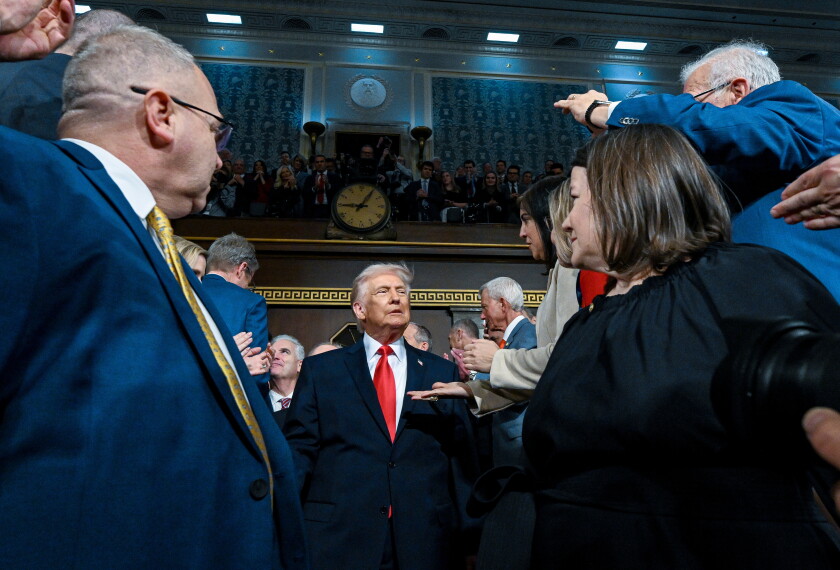
President Donald Trump enters to deliver the State of the Union address to a joint session of Congress in the House chamber at the U.S. Capitol in Washington, Tuesday, Feb. 24, 2026.
President Donald Trump enters to deliver the State of the Union address to a joint session of Congress in the House chamber at the U.S. Capitol in Washington, Tuesday, Feb. 24, 2026. The president devoted little time in the speech to discussing his education policies.
Kenny Holston/The New York Times via AP, Pool
Federal Education Department Will Send More of Its Programs to Other Agencies
Education grants for school safety, community schools, and family engagement will shift to Health and Human Services.
4 min read
Various school representatives and parent liaisons attend a family and community engagement think tank discussion at Lowery Conference Center on March 13, 2024 in Denver. One of the goals of the meeting was to discuss how schools can better integrate new students and families into the district. Denver Public Schools has six community hubs across the district that have serviced 3,000 new students since October 2023. Each community hub has different resources for families and students catering to what the community needs.
A program that helps state education departments and schools improve family engagement policies is among those the Trump administration will transfer from the U.S. Department of Education to the U.S. Department of Health and Human Services. In this photo, school representatives and parent liaisons attend a family and community engagement discussion on March 13, 2024, in Denver to discuss how schools can better integrate new students and families into the district.
Rebecca Slezak For Education Week
Federal New Trump Admin. Guidance Says Teachers Can Pray With Students
The president said the guidance for public schools would ensure "total protection" for school prayer.
3 min read
MADISON, AL - MARCH 29: Bob Jones High School football players touch the people near them during a prayer after morning workouts and before the rest of the school day on March 29, 2024, in Madison, AL. Head football coach Kelvis White and his brother follow in the footsteps of their father, who was also a football coach. As sports in the United States deals with polarization, Coach White and Bob Jones High School form a classic tale of team, unity, and brotherhood. (Photo by Jahi Chikwendiu/The Washington Post via Getty Images)
Football players at Bob Jones High School in Madison, Ala., pray after morning workouts before the rest of the school day on March 29, 2024. New guidance from the U.S. Department of Education says students and educators can pray at school, as long as the prayer isn't school-sponsored and disruptive to school and classroom activities, and students aren't coerced to participate.
Jahi Chikwendiu/Washington Post via Getty Images
